
Sacred Mark and Legend of the National Hero
Ha Nam Island is originally a low tide area at the mouth of the Bach Dang River, formed from the dike encroachment and sea encroachment of the Tien Cong people from the 15th century. If other communal houses on the island often worship Tien Cong for pioneering and establishing hamlets, Trung Ban communal house worships Hung Dao Dai Vuong Tran Quoc Tuan as the village tutelary god. This difference originates from a fascinating historical legend.
According to legend, in 1288, Quoc Cong Tiet Che Tran Hung Dao went to inspect the terrain of the Bach Dang river mouth area to find a place to plant stakes and deploy troops. When the boat passed through this alluvial ground, Vuong stepped onto a high mound to observe the water situation and wind direction. While engrossed in calculations, a sea breeze blew out a strand of hair ties. Tran Hung Dao used his hand to split the hair, stroking the hair evenly to both sides.
To commemorate this event, the people who later encroached on the sea established a village in that very mound, named Trung Ban (the word Trung means in the middle, Ban means root, containing the meaning of "dividing" the hair). The village communal house erected on the sacred mound in the past became a solid spiritual milestone in gratitude to the national hero.
Echoes" from wood carving art
Trung Ban communal house was built on a large scale during the Le Trung Hung period and largely restored during the Nguyen Dynasty. The communal house has a majestic Dinh-shaped layout, including 5 compartments, 2 front halls and 3 rear palace compartments. The roof is tiled with mossy nose, the roof slope is embossed with two dragons worshiping the moon and 4 corners of the sword are elegantly curved.
Entering the front hall space is a massive load-bearing system made of ironwood. The most valuable highlight is the sophisticated wood carving art on tops, armrests, lines, and bays with embossed, raised, and peeled carving techniques. The main themes are "Four Sacred Animals" and "Four Precious Animals". Dragon images appear densely (dragon winding water, carp transforming into dragon, mother dragon embracing baby dragon... ) symbolizing the desire for favorable weather and implicitly affirming the power of the Tran Dynasty's naval warfare. The carvings are both liberal (Le Trung Hung) and meticulous (Nguyen) creating a harmonious and magnificent overall.
Golden historical record with marks
The core value of Trung Ban communal house lies in the intact system of Han-Nom script heritage. At the front hall, the horizontal lacquered system, lacquered and gold-plated parallel sentences praising Hung Dao Dai Vuong's merits and Bach Dang battle formation. Prominent in the middle compartment is the majestic horizontal lacquered board: Van co anh linh - Muon thuo linh thieng; and the horizontal lacquered board: Tran trieu hien thanh - Bac thanh hien linh of the Tran dynasty.
Notably, the parallel sentences depicting the spirit of the naval battle in 1288: Phien am - "Bach Dang nhat tran dang Ho tran, thien dia chi than giai chan nep; Xich de thien thu luu thanh tich, son xuyen thao moc diec an quang"/
(A battle of Bach Dang swept away Ho's dust, heaven and earth, devils and gods were all terrified; Southern emperors left sacred marks for a thousand years, mountains, rivers, trees and grass were also washed with grace and light).
The first verse uses the word "đãng Hồ trần" (sweeping away Ho dust - referring to the Mongol Yuan invaders) to affirm the invincible power that makes "devils" fear. The second verse uses "Xích đế" (Southern king) to honor the position of Đại Việt on par with the Northern Dynasty, praising his merit in protecting the land of Hà Nam.
Another pair of parallel sentences emphasizes the merit of protecting the people: Phiên âm - "Thệ thủy đàn tâm, báo quốc trung thần thiên cổ ngưỡng; Phi trân khải vũ, tí dân minh đức vạn gia tôn".
(Only rivers swear wholeheartedly, subjects loyally report to the nation for thousands of generations to respect; Breaking thorns to expand borders, virtue protects millions of people and tens of thousands of houses to worship).
The word "The Thuy" evokes the story of Hung Dao Vuong crossing the Hoa River to swear that if he does not destroy the enemy, he will not return. The "Phi tran khai vu" part reflects the historical context of the people of Ha Nam island crossing the dike to encroach on the sea, believing in the "virtue" of the Saint who blessed them to settle down and build a career.
In addition, the communal house also preserves many royal decrees of the Nguyen Dynasty (Tu Duc, Dong Khanh, Khai Dinh), which are legal and cultural proofs affirming his Thanh Hoang status, with noble titles such as: "Thai Su Thuong Phu Thuong Quoc Cong Nhan Vu Hung Dao Dai Vuong...".
August Father's Death Anniversary, March Mother's Death Anniversary". Trung Ban communal house festival is solemnly held from August 18 - 20 of the lunar calendar every year to commemorate the death anniversary of the "Father" of the nation.
The highlight of the festival is the solemn procession of the gold-plated bát cống palanquin around the village, along with the sacrificial team performing traditional rituals from the Nguyen Dynasty. In particular, the festival is associated with the custom of "going to the clan feast" - a cultural feature of coastal residents. Clans compete to arrange feasts to offer to Saints, then receive blessings to strengthen village and neighborhood relations. Through these occasions, the heroic spirit of Bach Dang is recounted by the elders and passed down to later generations.
The communal house today is an "open museum", where the exquisite wood carvings and brilliant Han Nom script constantly remind today's generation of a heroic past and the resilient vitality of the nation on the land of Bach Dang Giang.
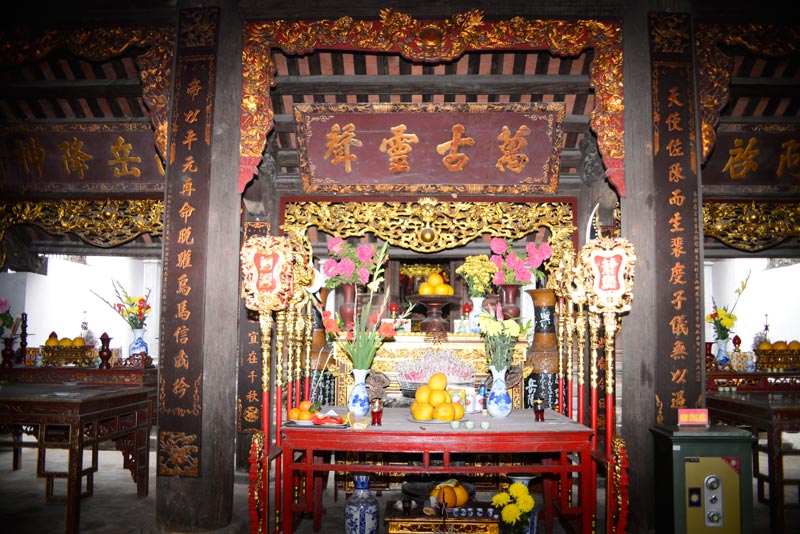
Having gone through more than 7 centuries since the Bach Dang victory, Trung Ban communal house still stands tall before the challenge of time. With outstanding values, the communal house has been ranked as a National Historical - Architectural and Art Relic, belonging to the National Special Relic Complex of the Bach Dang victory in 1288.


