
On the majestic Truong Son range, the traditional fireplace (Pa Co people call it Puk-boh) has long become the center of life of the Pa Co people. Having gone through many changes, the people here still preserve the fireplace as if keeping the bond connecting family and the cultural identity of their nation.
In a stilt house located in the middle of green forests in Apul - Ka Nhan village (Ta Rut commune, Quang Tri province), Meritorious Artist Mai Hoa Sen welcomes guests with a gentle smile and an invitation to sit by the red fire.
Next to him, his wife, Mrs. Ho Thi Danh, nearly 75 years old, quickly prepares traditional Pa Co people's porridge. While adjusting the firewoods to make the fire even, Mr. Sen shared about the process of building a fireplace of the Pa Co people. According to him, in each stilt house, the fireplace is always placed in the center and attached to the kitchen rack. When building a new house, the hanging of the kitchen rack is carried out first, then the stove is built. All materials such as lining leaves, tree bark for frames, and plaster are prepared, just waiting for the day of the ceremony to move to a new house.
The Pa Co people believe that every house has gods residing. Hanging the kitchen rack in front is to pray for harmony, convenience, and dispel bad luck. The soil for building the kitchen is usually taken from termite nests because it is both firm and clean, symbolizing solidarity. Âr-lang, Âr-đông or Achêr leaves are used for a durable kitchen. The kitchen frame is made of Pa-chá bark - a plant believed to have the ability to dispel evil energy.
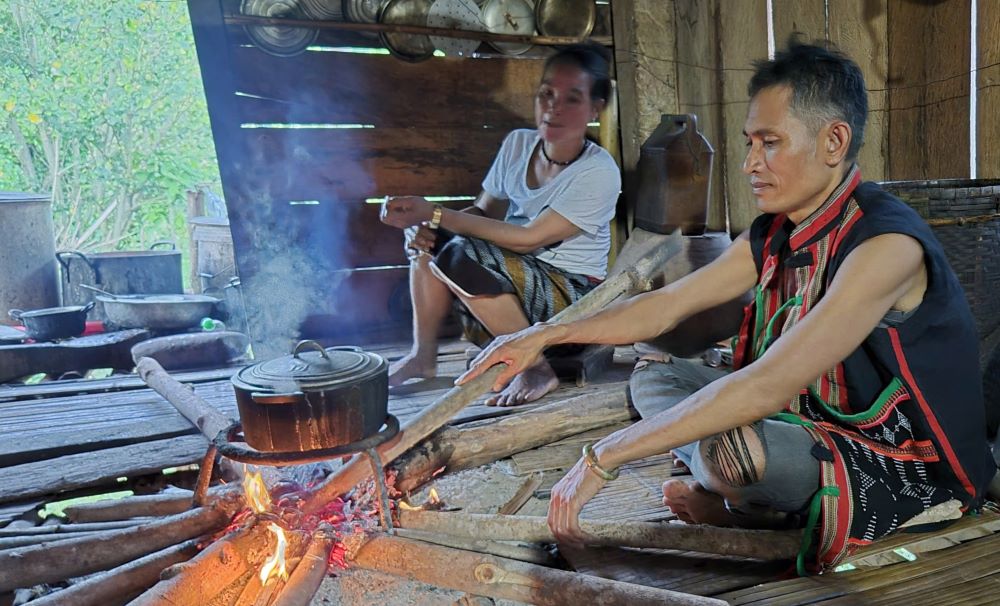
The kitchen structure is square but is divided into three sides: "Búh" above is for the homeowner to rest; "Târ-viêng" below is the walkway; on both sides of "Pluông" is where mothers, children, grandchildren or guests lie. Three stones at the base of the kitchen taken from rivers and streams are arranged symmetrically, creating a solid position.
Not only for cooking, the Pa Co people's stoves also keep warm, ward off mosquitoes, termites and wild animals. In winter, red charcoal helps the whole family gather to warm up. According to Mr. Sen, the Pa Co people also have their own way of explaining when the stove burns in each position - those are signals related to hunting, guests or health in the house. Therefore, keeping the fire is always carried out carefully.
The life of the Pa Co people is associated with fields, long and dangerous working distances. They often wake up early to light a fire to cook rice with them. Every day, the stove is usually red at least twice, morning and evening.
When night falls, the fire becomes a gathering place. Older people tell ancient stories, teach folk songs, guide musical instrument makers; young people listen, share learning and production stories.
Mr. Ho Van Viet's family in A Dang village (Ta Rut commune) also keeps the old stilt house and fireplace even though they have built a new house. According to him, the fireplace is a place to preserve national love and the memories of our forefathers.
Today, gas stoves and induction cookers are appearing more and more, but the majority of Pa Co people in mountainous Quang Tri province still maintain firewood stoves, replacing stone with three-legged iron stoves. For them, fire stoves are not only a household item but also a cultural symbol, reminding generations of their roots.
Amidst the modern pace of life, that fireplace still persistently burns brightly in every Pa Co stilt house, as proof of the vitality of a traditional value in the great forest.


