
According to the Ho Chi Minh City Public Transport Management Center, bus ticket exemption is implemented according to the principle of "free but controlled", both facilitating people's access to public transport and ensuring the requirements of management and effective use of the state budget.
The first 3 months on the bus, you get to go for free.
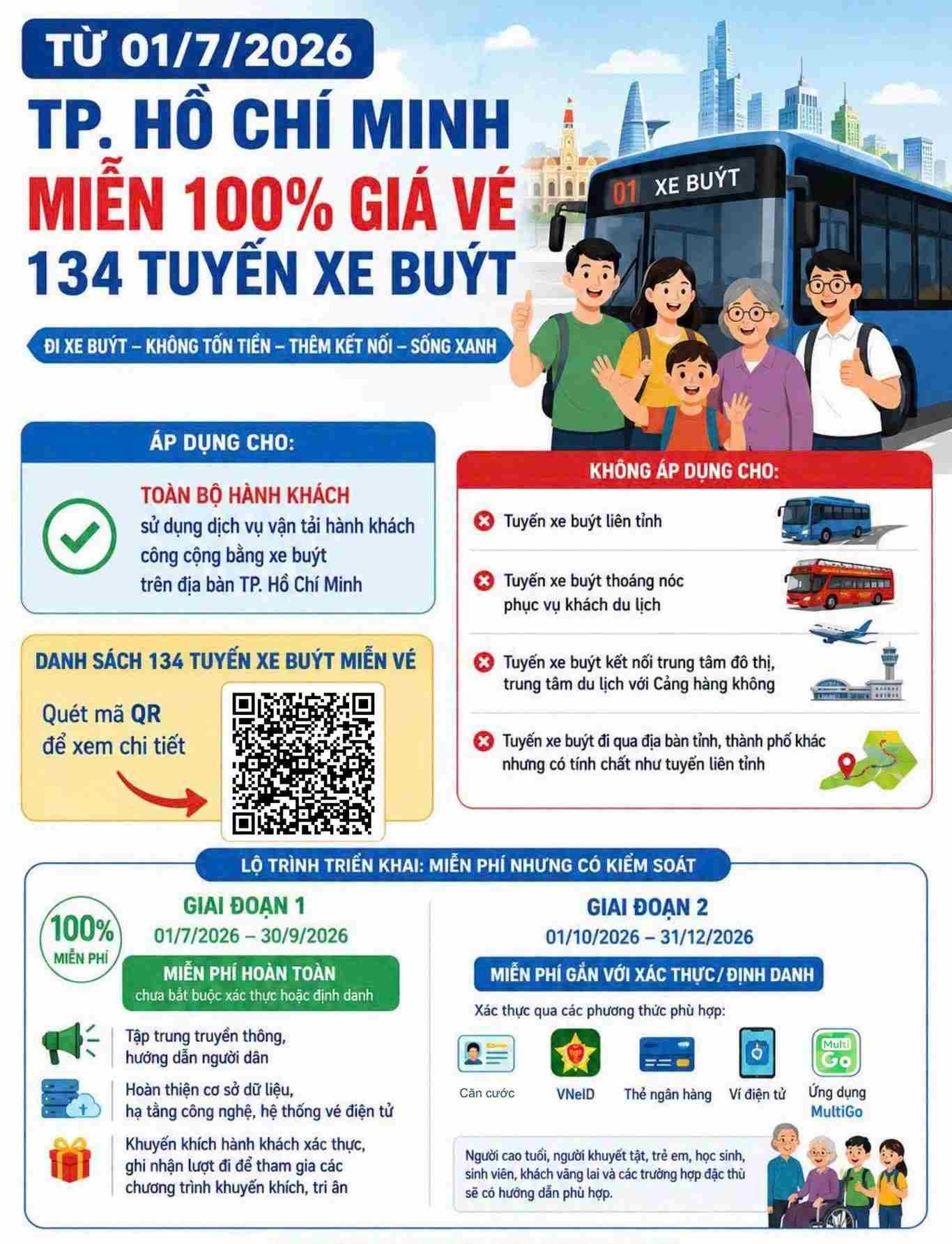
From July 1 to the end of September 30, 2026, all passengers using buses on 134 routes will be completely free, not required to authenticate or identify.
During this period, people only need to get on the bus and follow the instructions of the service staff or driver without having to pay for the ticket.
In parallel, the city will promote propaganda and guide people to get acquainted with the electronic ticket system, and at the same time complete the database and technology infrastructure to serve management work.
Although not mandatory, passengers are still encouraged to verify, identify and record bus trips to participate in gratitude and encouragement programs sponsored by companion units.
From October 1st, electronic authentication or identification must be required
Moving to phase 2, from October 1st to the end of December 31st, 2026, 100% ticket price support will be associated with passenger recognition and authentication.
People can carry out authentication or identification through many forms such as citizen identification cards, VNeID accounts, bank cards, e-wallets, MultiGo applications or other legal electronic methods according to the guidance of functional agencies.
For the elderly, people with disabilities, children, students, passersby and other special cases, the city will issue separate instructions to ensure convenience in the process of using the service.
According to management agencies, recording each individual bus trip is the basis for the State to pay fares to transport units instead of passengers.
Controlled by GPS, cameras and electronic tickets
To manage the free ticket policy, Ho Chi Minh City will apply synchronous technology solutions.
Functional agencies will base on online data from the journey monitoring system (GPS) to determine the number of trips performed; use images from cameras on the car to control service quality; and at the same time, exploit data from the electronic ticket system to accurately statistically count passenger volume.
Guiding passengers to operate on the T10 electronic ticket device and perform identification will help correctly identify beneficiaries, limit acts of taking advantage of policies, and at the same time ensure security and order on buses.
The Ho Chi Minh City Public Transport Management Center said that the support funds will be paid according to the principle of "actual payment, actual spending".
The number of passengers using the service must be recorded through an authenticated or identified electronic ticket system, and at the same time checked with GPS and camera data to ensure accuracy.
The total support cost is calculated based on the total number of passengers per group multiplied by the corresponding ticket price, including economy tickets and student tickets.
Transport units must also coordinate with management agencies to maintain technology infrastructure, ensuring the e-ticket system operates stably and smoothly. This is also seen as a motivation for businesses to improve service quality and attract more passengers to use buses instead of personal vehicles.


