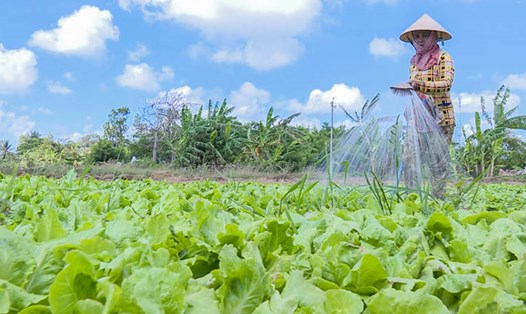
In Soc Trang, in the dry season of 2024-2025, thousands of hectares of fruit trees in Ke Sach and Chau Thanh districts have been protected from saline intrusion thanks to the Rach mop boat lock under the Hau River South Bank Water Control Project. The project has an investment capital of more than 500 billion VND, a water clearance width of 85m, and an automatic monitoring and supervision system. When the salinity in front of the sewers exceeds 2g/l, the valve doors will automatically close to protect the fresh water inside.
Mr. Nguyen Van Ut, a gardener in An My commune (Ke Sach) shared: "This year, I am no longer too worried about measuring the salinity of the river as before. Rach mop culvert helps prevent salinity, keep fresh water sources, and ensure irrigation water for plants even in the dry season".
Chairman of Soc Trang Provincial People's Committee Tran Van Lau said that the situation of saline intrusion in the dry season of 2024-2025 in the province has appeared since mid-January 2025. On the Hau River, the salinity level of 4g/l was recorded during high tides moving deep into the inland waters from 35-40km. Therefore, the operation of the Rach mop boat lock valve is of great significance in responding to saline intrusion, creating stable production and living conditions for people in the area.
Mr. Lau informed that the completion of Rach mop culvert will help control salinity and keep the natural area of 19,220 hectares in Ke Sach, Chau Thanh, Long Phu districts, Soc Trang city, and help reduce the impact of drought and salinity and support the supply of fresh water to 36,710 hectares of natural areas in Ke Sach, Chau Thanh (Soc Trang) and Chau Thanh districts, Nga Bay city (Hau Giang).
In Tien Giang province, the sewer system along the Tien River has also promoted the effectiveness of preventing salinity and storing fresh water before the 2024-2025 dry season.
Mr. Le Van Bay, a resident of Song Thuan commune (Chau Thanh), said: "Previously, saltwater often penetrated deep into the Tien River. Since Nguyen Tan Thanh sluice and 6 sluices along Tien River have been put into operation, we are very assured because there will be enough fresh water for production and daily life".
Mr. Nguyen Duc Thinh - Deputy Director of the Department of Agriculture and Environment of Tien Giang province - said that Nguyen Tan Thanh sluice is the second largest saltwater prevention and storage sluice in the Mekong Delta, after Cai Lon - Cai Be sluice in Kien Giang. This project is capable of storing fresh water, controlling high tides and salinity intrusion, regulating water sources for 12,580 hectares of the province, providing raw water for water plants to serve 800,000 people in Tien Giang province.
In Ben Tre province, the Bac Ben Tre irrigation system has basically been closed. The sluices in Ba Tri, Mo Cay Nam and Cho Lach districts have controlled salinity to protect production safety for 8,400 hectares of agricultural land, provide domestic water to serve 92,000 people and 40,000 livestock; improve land, improve the environment, stabilize the lives of residents in key economic areas of the province.
Mr. Le Minh Truyen - Deputy Director in charge of the Management Board of Investment and Construction of Agriculture and Rural Development Works of Ben Tre province informed that in 2024-2025, over 20 sluices have been put into use, some of which are being completed, which will contribute to preventing salinity storage for about 100,000 hectares in the area.
Similarly in Tra Vinh province, the sewer system such as Bong Bot, Tan Dinh and 3/2 Pumping Station has also contributed to ensuring water resources. Up to now, the production of Winter-Spring rice in the province is basically guaranteed. The Department of Agriculture and Environment of Tra Vinh province also directed the Irrigation Works Management and Exploitation Company Limited to organize 24/7 duty to monitor the development of salinity intrusion and operate the sewer system promptly. When the salinity increases, the sluices will close; when the salinity drops below 1g/l, fresh water will be brought into the fields, ensuring the water source for service.
Kien Giang province will also operate the entire sewer system, combined with Cai Lon and Cai Be sewers to avoid salinity intrusion and store fresh water in the 2024-2025 dry season.