The Ministry of Home Affairs officially sends the Ministry of Justice dossiers for appraisal of the draft Decree adjusting pensions, social insurance allowances and monthly allowances.
The drafting agency has a summary of the implementation of laws on adjusting pensions, social insurance allowances and monthly allowances (Decree No. 75/2024/ND-CP dated June 30, 2024).
The Ministry of Home Affairs said about the advantages, the implementation of adjusting pensions, social insurance allowances and monthly allowances at a fairly high level (15%).
This has contributed to stabilizing and improving the lives of people receiving pensions, social insurance allowances and monthly allowances.
The implementation of additional adjustments for retirees before 1995 has helped narrow the pension gap with retirees after 1995.
However, the Ministry of Home Affairs frankly pointed out some inadequacies of Decree No. 75/2024/ND-CP as follows:
Current pension adjustment regulations do not ensure the principle: "contribution - enjoyment".
Because the pension adjustment level is significantly higher than the increase in the consumer price index, exceeding the investment interest rate of the social insurance fund.
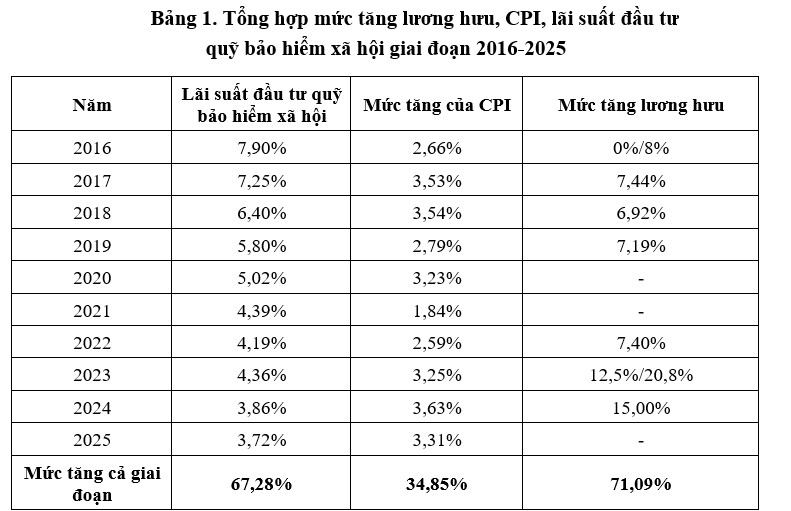
Calculated in the period 2016-2025: pension increase is 71.09%; CPI increase is 34.85%; investment interest rate of the social insurance fund is 67.28%.
This has caused the pension level of retirees to be adjusted up too high, not suitable for the previous contribution level and contribution time to the social insurance fund, specifically see table 1 below:
On the other hand, pension adjustments in the past period have not been consistent with principles and international practices.
According to international practice, the pension of retirees has been fully calculated based on the contribution level and contribution period to the social insurance fund.
Therefore, basically, people's pensions are adjusted based on the increase in the consumer price index, this has also been pointed out by our Party and issued an adjustment viewpoint in Resolution No. 28-NQ/TW at the 7th Conference of the 12th Central Executive Committee on social insurance policy reform: "Basic pensions are mainly adjusted based on the increase in the consumer price index, the capacity of the social insurance fund and the state budget".
The increase in pensions also affects the ability to ensure the long-term balance of the social insurance fund.
The adjustment of pensions, social insurance allowances and monthly allowances at a high level, combined with the impact of population aging (the number of retirees is tending to increase annually), has caused the rate of increase in the number of regime expenditures (retirement and death funds) to exceed the rate of increase in pension and death fund revenue.
the number of expenditures on pension and death benefits in 2024 has been 2.63 times higher than the expenditure of 2016; the revenue of the pension and death fund[3] in 2024 has been 2.19 times higher than the revenue of 2016. Accordingly, the ratio of fund expenditure to fund revenue has increased from 65.14% in 2016 to 78.37% in 2024.
The adjustment of pensions to increase generally at a percentage (%) with a high level in the past time has increased the gap in pension levels between retirees.
The higher the pension level, the more people benefit from the pension adjustment, the post-ajustment pension level is used as a basis for implementing the next adjustment (double impact) and not entirely due to the principle: "contribution - benefit".
This is increasingly increasing the pension gap between retirees with low pensions and retirees with high pensions.
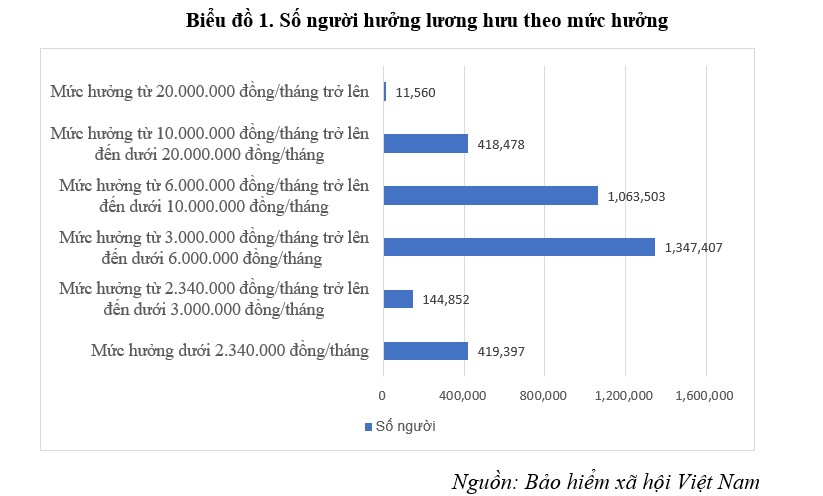
Meanwhile, most retirees today belong to the group with benefits below the average level, specifically, classifying the number of people receiving pensions, social insurance allowances and monthly allowances according to the benefit level as follows: