
The journey to find a solution to prolonged nighttime urination
For nearly 2 years, Ms. K.A (49 years old, Hanoi)'s life has been almost disrupted by prolonged nighttime urination. Every 30 minutes, she has to wake up to go to the toilet once, causing sleep to be interrupted for many months. Her body is increasingly depleted, in the past three months she has lost up to 11kg due to insomnia and poor eating.
She has been examined at many medical facilities. Ultrasound results all recorded uterine fibroids with a size of about 4 cm. Because the tumor is not large and no other abnormal signs have been recorded, the patient was advised to continue monitoring and searching for more causes, including the possibility of being related to psychological factors.
Ms. K.A decided to go for an examination at Hong Ngoc General Hospital (BVĐK). Here, the doctors spent a lot of time talking, carefully exploring Ms. K.A's medical history and discovered an important detail to help the doctor explain the relationship between the tumor location and the patient's prolonged nighttime urination: The patient had a history of 2 cesarean sections.
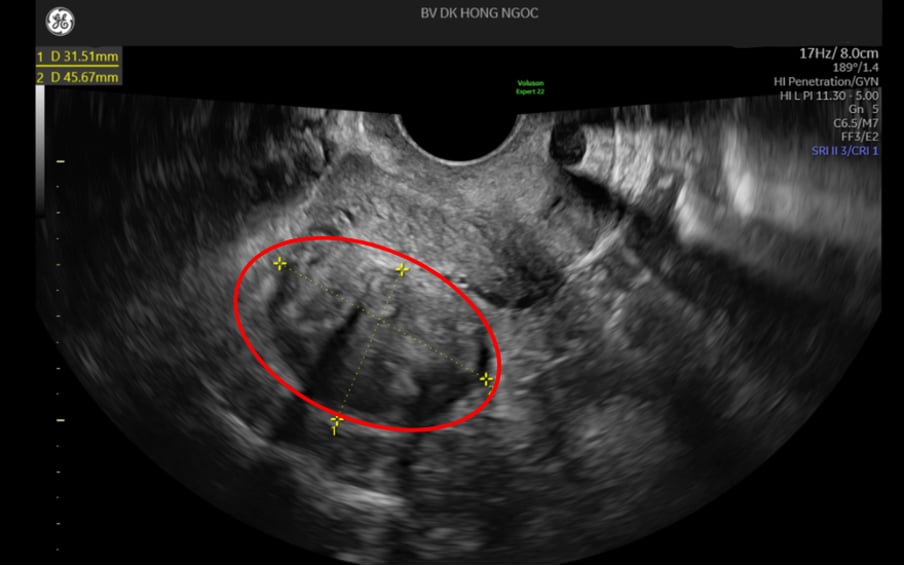
BSCKII Do Van Tu (Head of Obstetrics and Gynecology Department, Hong Ngoc General Hospital) analyzed: "After two cesarean sections, the anatomical structure of the pelvic area may change, causing the uterus to be pulled out of its natural position. At this time, although the fibroid tumor is only 4cm in size, it acts like a scale continuously weighing on the bladder, creating a false urge to urinate for the patient, especially at night.
After comprehensively assessing the disease status, the level of impact on the quality of life as well as the patient's reproductive needs, doctors agreed to choose the option of laparoscopic tumor removal surgery combined with hysterectomy.
Before surgery, the team carefully reviewed ultrasound images, assessed the risk of post-operative adhesions as well as the relationship between the tumor and the bladder and ureter to develop appropriate intervention plans.
During the surgery, each step of dissection is carried out carefully to identify and preserve important anatomical structures, and at the same time, the surgical team, anesthesia and resuscitation team and nurses closely coordinate to control the safety of patients throughout the surgery. Thanks to minimally invasive laparoscopic surgery, patients experience less pain, less blood loss and can exercise lightly after only about 12 hours.
Right from the early days after surgery, the patient felt a clear change. "For the first time in nearly 2 years, I slept a full night. The feeling was light as if I had just unloaded a rock that had been weighing on me for so long," Ms. K.A emotionally shared.
Uterine fibroids: When position is more important than size
According to many studies, uterine fibroids occur in about 30–50% of women of reproductive age. Most cases progress silently and are only detected during regular gynecological examinations.
Depending on the location of development, uterine fibroids can cause different symptoms. Tumors located close to the bladder are prone to frequent urination, frequent urination, or nighttime urination; rectal compression can cause constipation; while tumors in the uterine cavity are often related to menstruation, hypermenstruation, or affecting fertility. Conversely, there are large tumors that develop outside the uterus, so they hardly cause symptoms of compression.
“The assessment cannot only be based on the size of the tumor but needs to combine many factors such as location, number, clinical symptoms, obstetrics and gynecology history and reproductive needs of each patient. This is also the basis for us to develop appropriate treatment regimens, from periodic monitoring, medical treatment to surgical intervention when necessary” - Dr. Tu emphasized.

Doctors recommend that when abnormal symptoms appear such as prolonged nighttime urination, menorrhagia, pelvic pain or feeling heavy abdominal pain, women should proactively seek medical examination at medical facilities specializing in obstetrics and gynecology. Being examined by an obstetrician and gynecologist, combined with medical history and appropriate diagnostic imaging methods, will help identify the cause correctly, avoiding missing cases where tumors are small but located in a special position and seriously affect the quality of life.


