
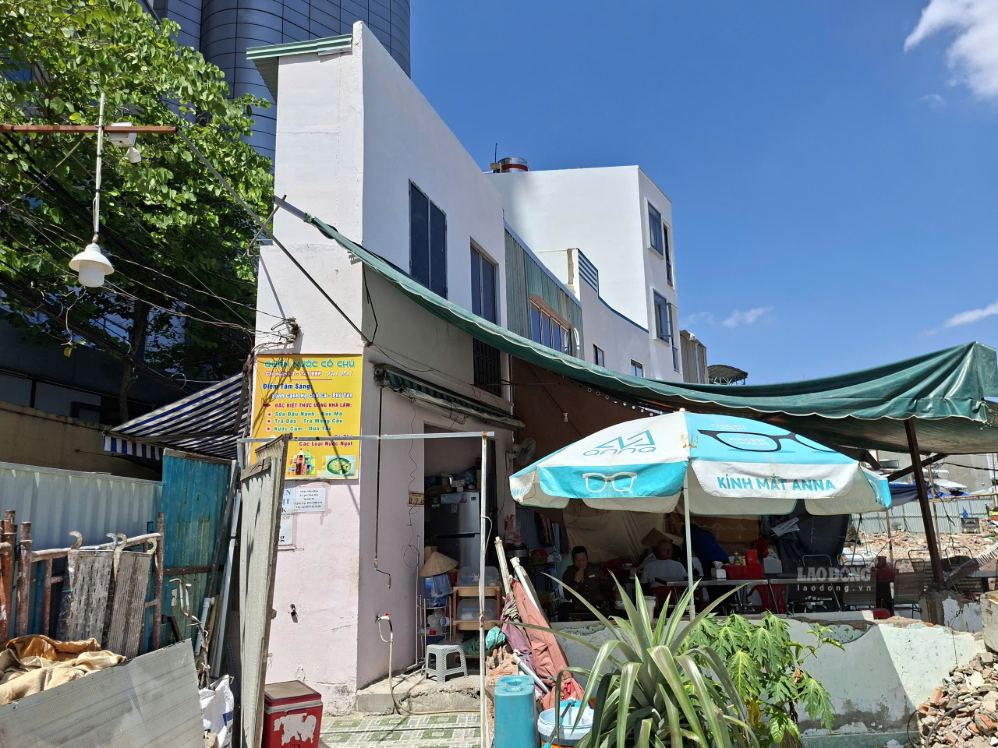
After site clearance for the Xuyen Tam canal renovation project through Gia Dinh ward, 41 super-thin houses under 9m2 appeared that were repaired by people on the remaining land to continue living.
According to Gia Dinh Ward People's Committee, the locality has repeatedly mobilized households to hand over the entire remaining land to be considered for resettlement arrangement.
However, most people do not agree to recover the entire area but want to keep the part of the project outside the site clearance boundary.
Gia Dinh Ward People's Committee said that the remaining land after recovery but outside the site clearance boundary still belongs to the legal use rights of the people. Meanwhile, current law does not have regulations allowing the State to compulsorily recover land plots that are too small.
Answering Lao Dong Newspaper, the Ho Chi Minh City Department of Construction said that construction on small land plots is carried out according to the Ho Chi Minh City Architectural Management Regulations issued with Decision No. 56/2021.
According to regulations, land plots expected to build townhouses must have a minimum area of 36m2, frontage width and depth compared to the construction boundary not less than 3m.
For land plots that do not meet this condition, the regulations still allow construction but apply many limits on the scale of works.
If the land plot has a frontage width or depth of less than 3m, the user is only allowed to renovate and repair according to the current status or build a new one with a maximum height at the construction boundary of 7m, and a height to the top of the roof not exceeding 9m.
For land plots with an area of less than 15m2 but a frontage width and depth of 3m or more, the project can only be renovated and repaired according to the current status or newly built with a height to the top of the roof not exceeding 7m.
According to the Department of Construction, the remaining land plots after site clearance have an area of 2 - 7m2, depending on the frontage width and depth, can still be considered for construction according to current regulations. However, the usable area is too small, causing the project to be limited in function and difficult to fully meet living needs.
Ho Chi Minh City sets a target to relocate 40,000 houses along canals and ditches by 2030. However, the legal loophole in handling micro-land plots still poses the risk of additional micro-thin houses.
To limit the formation of super-thin houses after urban embellishment and canal renovation projects, the Ho Chi Minh City Department of Construction believes that local authorities need to proactively exchange and agree with people to compensate for the remaining land area or encourage households to combine plots to ensure sufficient construction area according to regulations.
According to Dr. Tran Quang Thang - Director of the Institute of Economics and Management of Ho Chi Minh City, to end the situation of super-thin houses arising after urban embellishment projects, it is necessary to soon complete the legal framework instead of just handling individual cases.
He proposed to supplement regulations on the minimum area of the remaining land after clearance; not to issue construction permits for land plots that do not meet standards; and at the same time build a mechanism to recover land plots that are too small or force land consolidation, consolidation, and exchange to ensure effective land use.
In addition, it is necessary to integrate urban design right from the preparation stage of road opening and canal renovation projects; strengthen control of construction permits, tighten construction supervision, and at the same time improve compensation, support, and resettlement policies to ensure harmony of interests between the State and people.
Without synchronous solutions, after each road opening or canal renovation project, super-thin houses will reappear, making the urban appearance continue to be patchy and difficult to achieve the goal of sustainable renovation" - Dr. Tran Quang Thang assessed.


