
Talking to Lao Dong Newspaper, Ms. Do Thu Hang - Senior Director, Research and Consulting Department of Savills Hanoi said that as of the first quarter of 2026, the apartment market for sale in Hanoi recorded a new supply of more than 6,000 units, down compared to the previous quarter and the same period last year.
Among these, about 70% are Grade B apartments, 30% are Grade A apartments and there are no Grade C apartments. This shows that the market continues to lack the Grade C apartment segment.

Also in Q1/2026, the number of apartments sold reached more than 4,700 units, a decrease compared to the previous quarter. According to Ms. Do Thu Hang, there are some reasons for this situation. Accordingly, new supply has decreased and mainly concentrated in areas far from the center, mostly outside Ring Road 3. Besides, selling prices are still maintained at a high level, although there have been some slight adjustments. In addition, the interest rate factor from the end of Q4/2025 has also clearly affected the market, especially the volume of transactions in Q1/2026.
Regarding price developments, Ms. Hang said that prices on the secondary market tend to increase faster than the primary market. In the first quarter of 2026, secondary prices still increased compared to the same period last year, but if considered in a 5-year period, the primary market still had better growth. The reason for this trend is that secondary prices are still lower than primary prices, and at the same time reflect the need to find completed products that can be moved in immediately. This is a trend suitable for the actual needs of buyers.
Meanwhile, the average price on the primary market in the first quarter of 2026 is about 100 million VND/m2, a slight decrease compared to the fourth quarter of 2025. This adjustment is mainly due to new supply, with about 90% located outside Ring Road 3, with prices lower than the general market level.
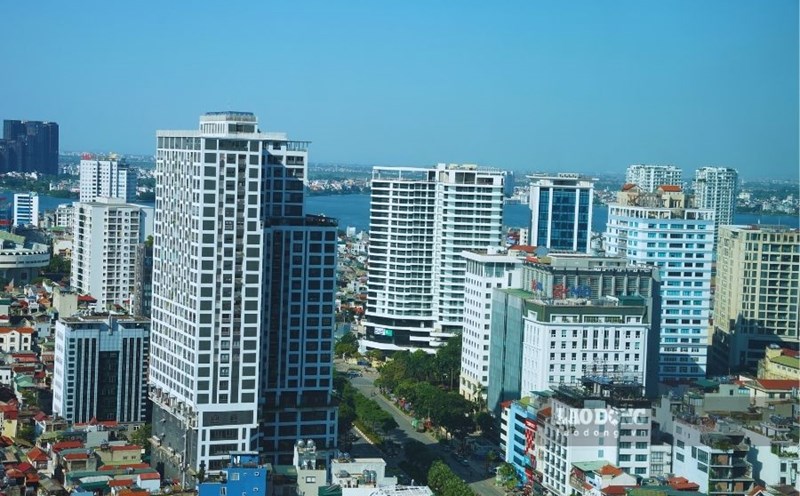
Regarding the trend in the coming time, Ms. Hang believes that apartment prices are unlikely to decrease deeply due to the impact of many input factors such as land costs, compensation costs and construction material prices all tend to increase. In addition, the supply structure is still mainly Grade A and B apartments, while Grade C apartments continue to be scarce.
Therefore, it is predicted that Grade A and B apartment prices will continue to remain high. In which, Grade A apartments tend to remain stable and may increase, while Grade B apartments are likely to adjust to a more reasonable level. The reason is that supply is shifting, as small projects outside the metropolitan area increase, while supply from the metropolitan areas decreases compared to before.
Regarding investment prospects, Ms. Hang believes that the Hanoi apartment market will still attract large demand in 2026, despite facing some challenges. This stems from rapid urbanization, strong infrastructure development and increasing housing demand, not only from Hanoi residents but also from other localities that tend to move to the Capital. Thanks to that, the apartment market is forecast to still maintain its growth momentum, although there may be periods of sideways movement or short-term adjustments.


