
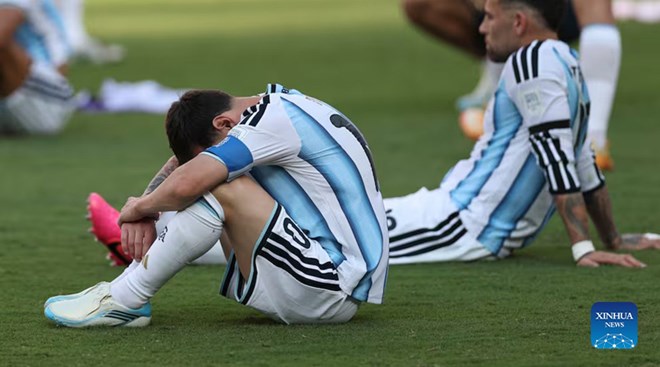
Lionel Messi burst into tears after the final whistle. Recently, he often shed tears after each match of Argentina, but the defeat to Spain in this World Cup final seems to have a different meaning. Those are definitely tears of regret, and perhaps also farewell.
If the match at MetLife stadium was really Messi's "last dance" in the Argentina national team jersey, then that ending would not have happened in the way he wanted.
Messi's illustrious international career does not close with a fairy tale, even though he just experienced an incredible World Cup. At the age of 39, the Argentine superstar still scored 8 goals, inspiring Albiceleste to advance to the final and making many people forget the burden of age.
However, in the confrontation with Spain, Messi was almost completely blocked. He did not launch a shot towards the goal until the 117th minute, only touched the ball 54 times in 120 minutes and did not create any chances for his teammates.
After six weeks of explosive play, when Messi seemed to challenge the law of time with the performance of a player at his peak form - notably the hat-trick against Algeria in the group stage - his age finally caught up with him right at the time Argentina needed their leader the most.
Perhaps that is why tears kept rolling down after the match. Messi yearns to win his second World Cup title to close his career with the image of an invincible champion. However, in front of him is a cold and effective Spain.
If this is really El Pulga's last time wearing the Argentine national team jersey, this final will not be the image that defines his career. In 207 appearances for Albiceleste, Messi scored 125 goals, had 68 assists and created countless immortal moments.
His last assist was a pass for Lautaro Martinez to head in the decisive goal in the 2-1 victory over England in the semi-finals. After that match, Messi also shed tears, but it were tears of happiness when he brought Argentina to another World Cup final.
Few people remember that a decade ago, Messi announced his retirement from the national team after losing to Chile in the Copa America 2016 final, also at the stadium in New Jersey. That was the fourth major final he failed, after the 2014 World Cup and three Copa Americas.
At that time, Messi faced much criticism for not being able to do what Diego Maradona once did for Argentina. He was seen as lacking the flame of dedication to the national team, in contrast to Maradona's emotional image.
Just a month later, Messi changed his decision and returned to the national team. Success did not come immediately, but the Copa America 2021 championship ended Argentina's 28-year title drought. A year later, he continued to lead Albiceleste to the throne at the 2022 World Cup with 7 goals and three assists, completing the legacy once built by Maradona.
If the 2022 World Cup helped Messi equal Maradona, then his performance at the 2026 World Cup may have taken him to a new level. During six weeks in the US, he once again proved why he deserves to be considered the greatest player in history.
Pele has won the World Cup three times, but all in the colors of powerful Brazilian national teams. Messi only won once and almost won a second championship, but he has repeatedly elevated a team that is not considered superior to compete for the world number one position. When Messi could not make a difference in the final, Argentina was almost powerless against Spain.
That is the mark of a great player. Messi has the ability to turn ordinary things into extraordinary and always elevate his teammates around him.


