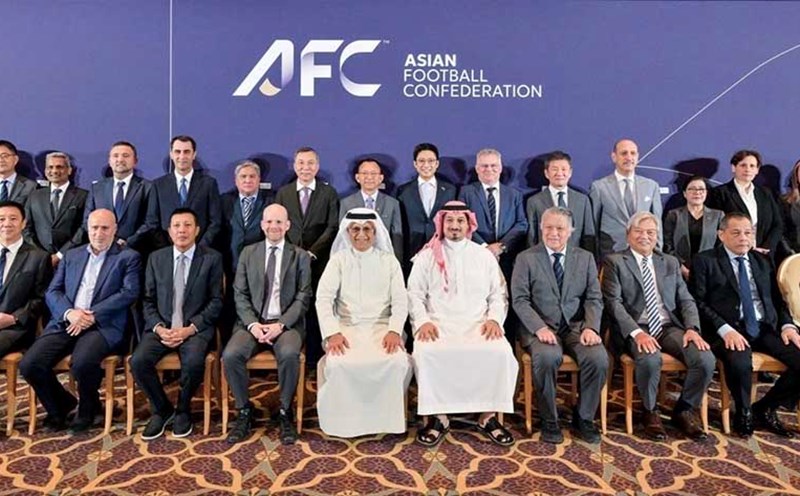
The direct impact of the Middle East conflict is limited to West Asian clubs. For several years now, Asian football has been organized regionally, with tournaments divided between East and West.
Therefore, AFC club-level tournaments in East Asia continue to take place without interruption in the first week of March.
However, the situation in West Asia is completely different. With the escalating conflict in the Middle East on February 28, the AFC is forced to switch to an emergency mode as the knockout round of club-level tournaments is approaching.
Within 24 hours, AFC announced that all first leg matches with the participation of West Asian clubs in AFC tournaments would be rescheduled.
National championships in the region are also heavily affected.Tournaments in Qatar, Bahrain, Kuwait and Lebanon have been suspended indefinitely, while matches continue to take place without spectators in Jordan.
Tournaments in Saudi Arabia, Oman, Iraq and Syria are still operating, but flights in the region are restricted.

With the season being shortened due to the 2025 FIFA Arab Cup, FIFA Intercontinental play-offs and the upcoming FIFA World Cup, member federations across the Middle East are currently working with AFC to find ways to resolve the completion of the tournaments.
Another issue is emerging before our eyes. The AFC Champions League finals will be held in Saudi Arabia next month, for the second consecutive year. Although football is not interrupted in this Kingdom and the security situation is stable, it is still necessary to see if East Asian clubs are ready to move if the conflict continues.
A proposal has been made to concentrate the knockout rounds from the round of 16 instead of the quarter-finals. However, this option also faces its own challenges. East Asian clubs have started their journey in the round of 16, and the idea of concentrated competition at a location has never been supported.
When Saudi Arabia and Qatar were chosen to host the fourth qualifying round of the 2026 World Cup last year, this decision caused fierce reactions from Indonesia, Iraq, Oman and UAE.
Therefore, AFC is in a difficult position. They cannot control the geopolitics of the region, nor can they influence government policies. At the same time, there is no guarantee that East Asian clubs will come to this region, or West Asian clubs will agree to give up the right to play at home.
This conflict has also begun to affect international football. With the FIFA World Cup intercontinental play-off scheduled to take place at the end of this month and Iraq facing an important qualifying match in Mexico on March 31, instability continues to increase.
In a statement issued by the Iraqi Football Federation, officials confirmed that they are continuously contacting FIFA and AFC about potential travel difficulties.
Head coach Graham Arnold is currently unable to leave the UAE, while some players and staff are having difficulty applying for visas to Mexico due to embassy closures.At the same time, flights over Iraqi airspace have been suspended.
For the first time in modern history, the AFC must resolve a regional conflict affecting almost all parts of the federation. As the season enters a decisive stage and the biggest World Cup in history is approaching, solutions must be found quickly, otherwise Asian football is at risk of falling into a crisis that could reshape the continental football.