
The severity of weather is assessed through the wet bush temperature index (WBGT) - a measure of heat stress, combining factors such as air temperature, humidity, wind speed and solar radiation.
At the WBGT threshold of 28 degrees Celsius - equivalent to thermal laboratory conditions - FIFPRO, the organization representing professional players, recommends that matches should be postponed.
Although not an absolutely accurate forecasting tool, Precision Fuel and Hydration's climate models show that about a quarter of the matches at this summer's World Cup could take place in conditions where the WBGT exceeds 26 degrees Celsius, while some matches are forecast to exceed 28 degrees Celsius.
The locations with the greatest risk are outdoor stadiums in the southern United States and northern Mexico, including Monterrey, Miami, Kansas City, Philadelphia, New York/New Jersey and Boston.
In May, a group of experts working in the fields of health, climate and sports science sent an open letter to FIFA, warning that players could face "worrying levels of heat stress" throughout the tournament.
When body and skin temperatures rise, the body will prioritize bringing blood to the skin surface to cool down instead of maintaining blood flow for active muscle groups.
As a result, the number of high-intensity runs decreases, the ability to perform continuous accelerations is limited and the pace of competition slows down significantly, especially at the end of each round" - Dr. Lindsey Hunt, senior sports scientist at Precision Fuel and Hydration, said.
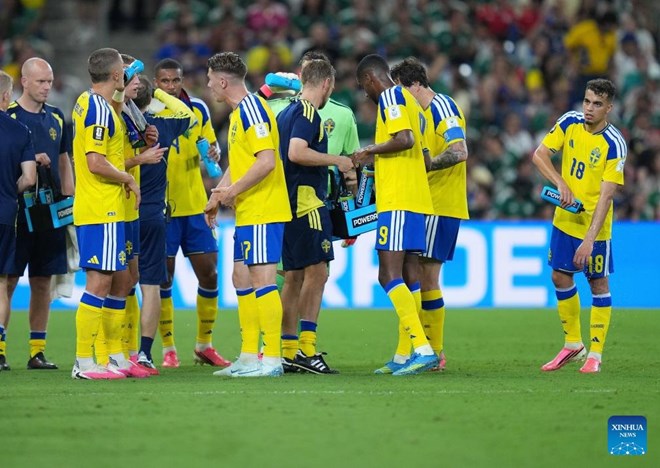
How does temperature affect performance?
Last May, after more than four hours of playing at Roland Garros under a temperature of up to 35 degrees Celsius, player Jakub Mensik collapsed on the court right after his final shot and had to leave the court in a wheelchair.
After the match, Mensik said his body had "suddenly stopped working".
The weather in Boston is significantly cooler, about 25 degrees Celsius, as Scotland kicks off the World Cup campaign with a clash with Haiti on June 13. However, even in the match taking place at 9 pm local time, North American climate conditions still leave clear impacts.
Bournemouth winger Ben Doak had an impressive performance in Scotland's 1-0 victory. After the match, when asked if he was disappointed by being substituted in the 75th minute, he gave a decisive answer.
I really need to rest" - Doak shared. "My calves almost gave up before I left the field. I had a little cramp. Honestly, I was very happy to be substituted and sit down on the bench.
Weather conditions in the US, Canada and Mexico have affected almost every aspect of the preparation process for the tournament. The head coach of the Dutch national team, Ronald Koeman, even believes that the weather is one of the factors that significantly affects the way the England national team selects personnel.
You can somewhat visualize their playing style through personnel choices. They will maximize set pieces such as corner kicks or throw-ins. Those are options that consume less energy in hot weather conditions" - Koeman said.
Meanwhile, England coach Thomas Tuchel affirmed that the team's preparation process is based more on science than changing philosophy or playing style. To adapt to the climate conditions in North America, England has implemented a specialized training program in West Palm Beach, Florida, where players often have to train in temperatures up to 90 degrees F (about 32 degrees C).


