
Lao Cai is a residential area of many ethnic minorities with a rich treasure of language and culture. In the context of increasingly strong social integration and exchange, the preservation of ethnic minority languages and writing is identified by the province as an important task to preserve community cultural identity.
According to the Lao Cai Provincial Electronic Information Portal (TTĐT), the Lao Cai Provincial Department of Education and Training said that the whole province currently has 1,695,737 people, of which ethnic minorities account for 61.08% of the population. Large-scale ethnic minorities include Mong, Tay, Dao, Thai, Nung, Giay... living from lowlands to highlands, border areas.
In many localities such as Bac Ha, Si Ma Cai, Muong Khuong, Y Ty or Pung Luong, ethnic minority languages are still widely used in daily life, traditional rituals and community activities. Some ethnic groups still preserve their own writing systems such as Dao script, Mong script, ancient Thai script; Tay and Giay people still preserve ancient Nom books to serve religious activities.
According to statistics, the rate of using ethnic languages in many communities is maintained at a high level: Mong and Dao languages about 98%; Ha Nhi language 99%; Xa Pho language 95%; La Chi language about 90%.
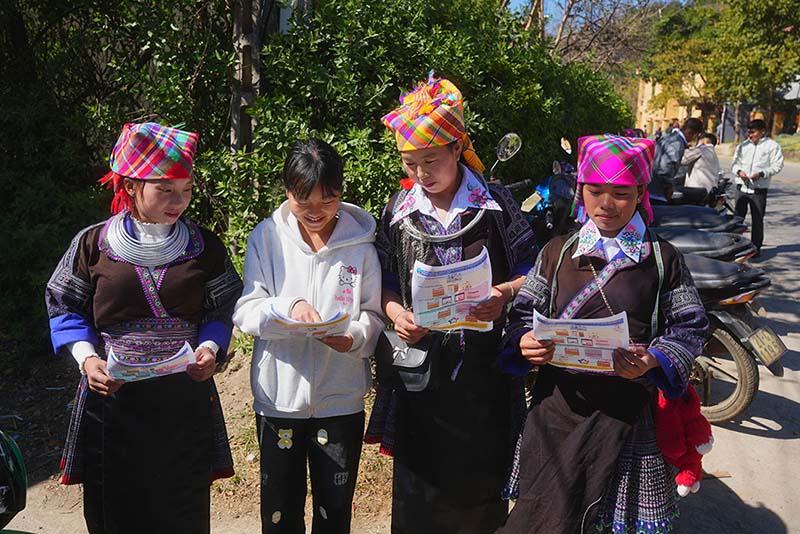
However, the urbanization process and the popularity of Vietnamese have led to a trend in many places gradually shifting to using Vietnamese for young children. The ability to read and write ethnic script of young people is not uniform, especially in ethnic minorities.
In recent years, Lao Cai has maintained teaching ethnic languages in schools. In the 2025-2026 school year, the whole province has 20 primary schools teaching Mong language with 99 classes, 2,592 students, an increase of 2 schools, 23 classes and 356 students compared to the previous school year.
In many localities such as Bac Ha, Ta Van, Sin Cheng, Cao Son, Sa Pa, Phinh Ho or Pung Luong, teaching Mong language has become regular. Students not only learn language but also learn folk songs, stories, customs and traditional culture.
The results showed that the rate of students completing the Mong language program reached 100%; the rate of reading and writing Mong characters after primary school also reached 100%. At schools organizing Mong language teaching, the rate of maintaining the number of Mong ethnic students reached 100%.
The Mong-Vietnamese bilingual education program implemented from the 2008-2009 school year continues to bring positive results. Up to now, 2,570 students have participated. In the 2025-2026 school year, the whole province maintains 3 kindergartens with 179 students and 7 primary schools with 776 students studying according to this model.
In fact, the national language and writing system are not only a means of communication but also contain history, folk knowledge and cultural identity of each community.
Currently, the whole province has 37 teachers teaching Mong language, but only 15 teachers meet the regulations, accounting for 40.5%. Many schools still have to use old textbooks and photocopy materials due to lack of new learning materials according to the 2018 General Education Program.
In the period 2026 - 2030, Lao Cai sets a target of having 32 schools, 223 classes with more than 6,000 students learning ethnic minority languages. The province will continue to train teachers, digitize materials, build a digital library and expand traditional writing classes for teenagers.


