
Thai Nguyen has long been considered the "first famous tea", where tea plants are associated with the life, culture and livelihoods of tens of thousands of households. However, before the increasing requirements for quality, food safety and traceability, the local tea industry is forced to change to maintain its brand, according to VNA.
Currently, Thai Nguyen has about 23,000 hectares of tea, ranking first in the country, bringing economic value of more than 15,000 billion VND per year. The province has issued Resolution No. 11-NQ/TU on developing the tea industry in the period 2025 - 2030, setting a target by 2030 to have at least 250 tea products (processed tea) achieving OCOP from 3 - 5 stars, of which at least 6 products achieve OCOP 5 stars; 100% of tea products participate in e-commerce. The total value of tea products strives to reach 25,000 billion VND.
Many businesses and cooperatives are supported with funds in planting, caring for, processing, packaging and brand building. Thai Nguyen tea is currently not only strongly consumed domestically but also exported to many large markets.
However, according to Mr. Vu Van Phan - Chairman of the Thai Nguyen Tea Association, tea production is still fragmented, lacking linkages, and the quality between regions is not uniform. Some establishments still produce according to traditional experience, not fully complying with safety procedures. The situation of fake and counterfeit Thai Nguyen tea brands continues to affect product reputation.
The tea industry is also clearly affected by climate change and increasingly high requirements for food safety. Mr. Nguyen Ta - Head of Thai Nguyen Sub-Department of Crop Production and Plant Protection - said that erratic weather directly affects tea yield, quality and pest and disease prevention work.
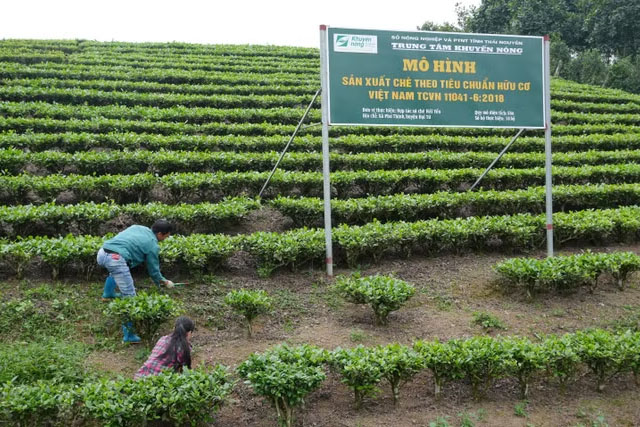
According to Mr. Ta, building concentrated raw material areas, applying VietGAP, organic standards and managing planting area codes is an inevitable requirement.
Consumers today are not only interested in delicious tea but also want to know where the product is grown, how it is produced, whether it is safe or not," Mr. Ta said.
Ms. Tran Thi Tuyet - Director of Tuyet Huong Cooperative - said that consumers are increasingly interested in designs, traceability and product quality. "Although the cost is higher, safe products are still welcomed by the market," Ms. Tuyet shared.
In parallel with quality standardization, digital transformation is becoming an inevitable trend of the tea industry. Many establishments have applied QR stamps for traceability, online sales and product promotion on social networks.
Mr. Nguyen Tien Dung - Head of Specialized Management Department, Thai Nguyen Department of Science and Technology - said that the locality currently manages 1 geographical indication "Tan Cuong" and 9 collective marks associated with tea products. In which, the "Thai Nguyen Tea" mark has been protected in the US, China, Russia, Japan, Korea; the geographical indication "Tan Cuong" is protected in the EU and the United Kingdom.
According to Mr. Dung, digital transformation not only helps with sales but also supports information transparency, quality management and brand protection. For Thai Nguyen tea to develop sustainably, the tea industry needs linkages between people, cooperatives, businesses and management agencies in building a unified traceability system.


