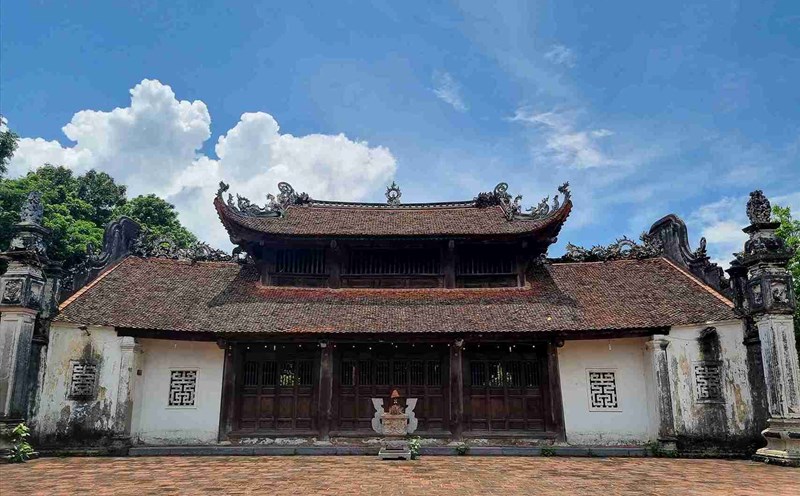
Close-up of Nam Giao stele - ancient Thang Long heaven and earth altar

Hồng Nhung |

The only remaining stone stele of the Nam Giao Thang Long troupe where the king prayed to heaven for favorable weather is recognized as a national treasure.

Nam Giao Palace Stele is currently located in the outdoor display system and memorial space at the National Museum of History. This rare artifact is a testament to the history of building and defending the country of the Vietnamese nation.

According to Dai Viet Su Ky Toan Thu, it is written: "Giap Tuat, the 15th year (1154) in September, the king went to the south gate of Dai La citadel to see the construction of Vien Khau altars" (Nam Giao). Thus, during the Ly Dynasty, the heaven-offering altars (also known as Hoan Khau altars or Vien Khau altars) were established in the capital Thang Long.

In the reign of King Le Than Tong (1619 - 1643), he restored the rituals at this temple and called it Nam Giao. Also according to Dai Viet Su Ky Toan Thu: "Previously, Nam Giao temple had a hall, but the scale was still small. Here, the King ordered more.

The main hall has square pillars, stone floors, inside and outside the floors are all built of stone, pillars, rows, horizontal panels, and ribbons are all painted with lacquer and gold, the scale of the regime is new and brilliant. Vuong again ordered the gods, Ho Si Duong, to make engravings on the stone to record this matter.

When the Nguyen Dynasty moved the capital to Hue, the Nam Giao dance in Thang Long was no longer allowed to hold rituals. In 1804, the Nam Giao dance was dismantled to use bricks and tiles to build a citadel. Here, only the stele house and this stele remained.

The stele was transferred by the French Far Eastern Museum, placed in the garden of the Louis Finot Museum in 1947 - now the National Museum of History.
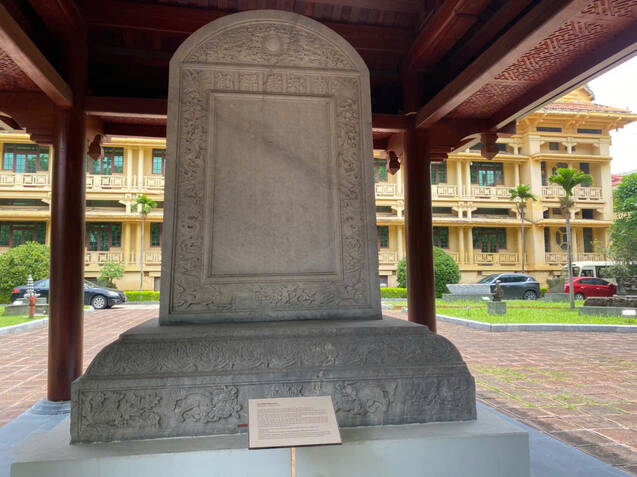
Bia dien nam giao - Bao vat quoc gia co kich thuoc lon: cao 287cm rong 157cm, gom hai phan: bia (Than bia hinh chu nhat) va de bia.
Nam Giao Palace Stele - National Treasure has a large size: 287cm high and 157cm wide, including two parts: stele (rectangular body) and stele base. Photo: Hong Nhung
Bao tang Lich su quoc gia cho biet; phan bia co tran bia hinh ban nguyet, cham noi doi rong chau mat troi. Phia tren duoc cham noi 5 chu Han “Nam Giao dien bi ki” (南郊殿碑記) hai diem ben cham noi hinh rong, phuong. Anh: Hong Nhung
The National Museum of History said; the stele has a crescent stele, embossed with a pair of dragons worshiping the sun. Above it is embossed with 5 Chinese characters "Nam Giao Dien Bi Ky" (南郊殿碑記) and two side markers are embossed with dragon and phoenix images. Photo: Hong Nhung
De bia hinh khoi chu nhat, 4 mat cham noi voi de tai trang tri hinh ky lan, su tu, hoa la bang ky thuat cham khac tinh xao. Anh: Hong Nhung
The stele embankment is rectangular, with 4 embossed faces with the theme of decorating unicorns, lions, flowers and leaves with sophisticated carving techniques. Photo: Hong Nhung
Noi dung van bia neu ro chuc nang, vi tri cua dan Nam Giao va le Te Giao la vao nam Nguyen Dan, vua cung quan than nghenh te o day, cau mua thuan gio hoa, quoc thai dan an, thien ha thai binh, giu vung nen thinh tri cua cac trieu dai. Anh: Hong Nhung
The Han script is engraved on one side, with simple, clear strokes, typical of Le Trung Hung calligraphy composed by Dr. Nguyen Tien Trieu, Dr. Ho Si Duong Lanh Chinh. The content of the stele clearly states the function and position of the Nam Giao dance and Te Giao ceremony, which is in the Lunar New Year, the king and his disciples welcome worship here, praying for favorable weather, national peace and prosperity, peaceful heaven and earth, and maintaining the prosperity of dynasties. Photo: Hong Nhung

Nam Giao lighthouse stele is a rare artifact from the time of Le Trung Hung that has been preserved to this day.

With special historical and artistic value, the Nam Giao Lantern has been recognized by the Prime Minister as a National Treasure under Decision No. 2382/QD-TTg dated December 23, 2015.

Hồng Nhung
TIN LIÊN QUAN

Vo Canh Beer - a 2,000-year-old treasure of the Champa Kingdom

|

The 2,000-year-old treasure in Khanh Hoa is the oldest trace of Buddhist contact and ancient Brahmi script in Southeast Asia.

Journey back in Vietnamese history through ancient steles

|

From the earliest literary traces to court ceremonial symbols, Vo Canh stele and Nam Giao Palace stele depict the flow of Vietnamese history over many centuries.

The original trees of Tram Gian Pagoda in Hai Phong are recognized as National Treasures

|

Hai Phong - On October 31, at the national relic of Tram Gian pagoda, the locality held a ceremony to announce the Decision to recognize the original Thuong Pagoda of Tram Gian as a National Treasure.

Special things about the 3,500-year-old Dak Son Stone Spring National Treasure in Lam Dong

|

Lam Dong - Dak Son Stone Town has just been recognized as a national treasure.

Vo Canh Beer - a 2,000-year-old treasure of the Champa Kingdom

Hồng Nhung |

The 2,000-year-old treasure in Khanh Hoa is the oldest trace of Buddhist contact and ancient Brahmi script in Southeast Asia.

Journey back in Vietnamese history through ancient steles

QUỲNH MAI |

From the earliest literary traces to court ceremonial symbols, Vo Canh stele and Nam Giao Palace stele depict the flow of Vietnamese history over many centuries.

The original trees of Tram Gian Pagoda in Hai Phong are recognized as National Treasures

Mai Hương |

Hai Phong - On October 31, at the national relic of Tram Gian pagoda, the locality held a ceremony to announce the Decision to recognize the original Thuong Pagoda of Tram Gian as a National Treasure.

Special things about the 3,500-year-old Dak Son Stone Spring National Treasure in Lam Dong

Duy Tuấn |

Lam Dong - Dak Son Stone Town has just been recognized as a national treasure.