According to the latest report from aviation data company OAG (UK), the Asia-Pacific region is emerging as the most vibrant air transit center in the world based on the total number of seats supplied on international routes throughout the year.
Leading the world is still Dubai International Airport (DXB) with 62.4 million international seats, maintaining the No. 1 position for 3 consecutive years.
Second place is London Heathrow (UK) with 49 million seats, while third place belongs to Incheon International Airport (Seoul, South Korea) with 43 million seats.
Singapore Changi ranked fourth globally with 42.6 million international seats, an increase of 3% compared to the previous year and has fully recovered to pre-pandemic levels in 2019.
OAG's report noted that the boom in the domestic markets of China, South Korea, Japan and Southeast Asia is helping Asia become the region with the largest international passenger volume in the world.
The Top 10 includes 4 airports in North America, 3 in Asia, 2 in Europe and 1 in the Middle East.
The continuous promotion of many Asian airports shows the shift of global aviation focus from Europe - North America to Asia - Middle East, especially in the context of strong international tourism demand recovering after the pandemic.
Top 10 busiest international airports in the world in 2025
Dubai International Airport (Dubai) - 62.4 million seats
Heathrow Airport (London) - 44.0 million seats
Incheon International Airport (Seoul) - 43.0 million seats
Changi Airport (Singapore) - 42.6 million seats
Amsterdam Airport Schiphol (Amsterdam) - 41.3 million seats
Istanbul Airport (Istanbul) - 41.2 million seats
Charles de Gaulle Airport (Paris) - 39.6 million seats
Hong Kong International Airport (Hong Kong, China) - 38.7 million seats
Frankfurt International Airport (Frankfurt) - 36.4 million seats
Hamad International Airport (Doha) - 32.7 million seats
It's a bit of a bit of a bit of a bit of a bit of a bit.
In Vietnam, in 2025, the aviation industry transported 83.5 million passengers, an increase of 10.7% compared to the previous year, the highest level ever.
The aviation industry transported international passengers 46.6 million times, an increase of 12%, while cargo volume reached about 1.3 million tons, an increase of 22% compared to the previous year.
Currently, the two largest international aviation gateways of Vietnam are Noi Bai (Hanoi) and Tan Son Nhat (Ho Chi Minh City).
Although not in the top of the most crowded airports, in 2025, Tan Son Nhat returned to the group of 50 airports with the best connectivity in the world with 45th place according to OAG's report.
According to OAG calculations, the airport in Ho Chi Minh City has 8,348 options - a combination of valid connection routes (connections), connecting with 94 destinations worldwide.
Vietnam is accelerating investment in aviation infrastructure, with a series of strategic projects to improve operational capacity, expand international flight networks and prepare to welcome a sharp increase in passenger volume in the coming years.
Tan Son Nhat Airport (Ho Chi Minh City) put Terminal T3 into operation from April 2025, raising the total airport capacity to about 50 million passengers/year.
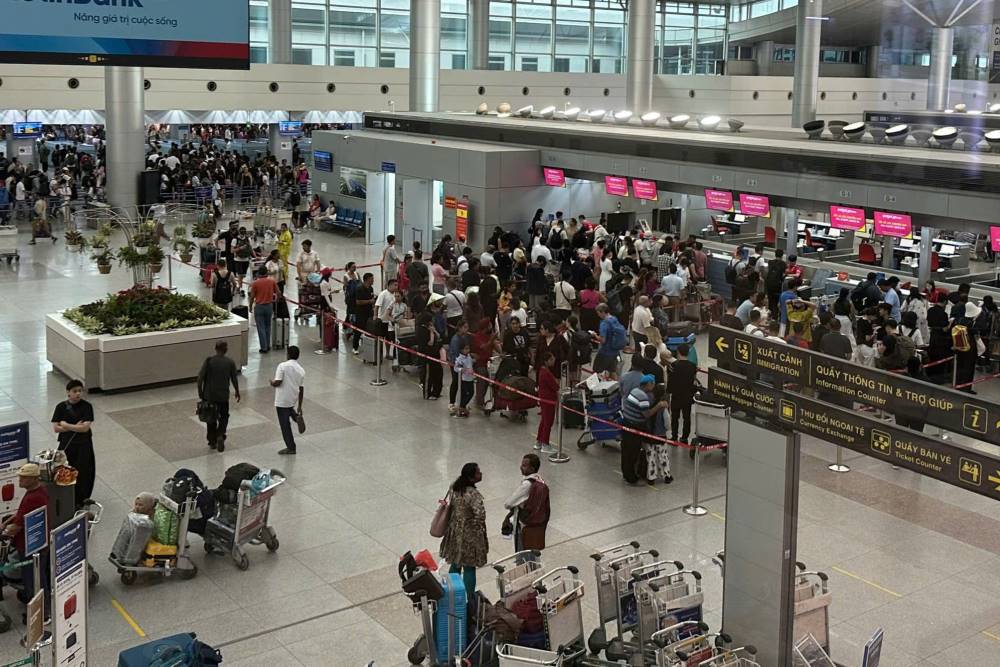
Noi Bai Airport (Hanoi) is expanding Terminal T2, with a floor area of more than 200,000 m2 and a capacity increased from 10 to 15 million passengers/year, with a maximum service capacity of 18 million passengers per year.
In December 2025, the main items of Long Thanh were technically inaugurated and welcomed the first flight, opening the commercial operation phase from 2026.
Gia Binh Airport (Bac Ninh) is planned according to a "double-use" model (economic + defense), with a capacity of 50 million passengers/year and 4 runways, contributing to reducing congestion for Noi Bai and supplementing the Northern air network.
Many local airports such as Phu Quoc, Phu Bai, Vinh, Phan Thiet, Tuy Hoa, Pleiku, Buon Ma Thuot are being promoted for investment according to the plan until 2030, contributing to expanding domestic and international flight networks, spreading socio-economic benefits.
This is an important step for Vietnam to aim to rise up to compete with global air transit centers, not only serving domestic needs but also increasing the rate of international transit.