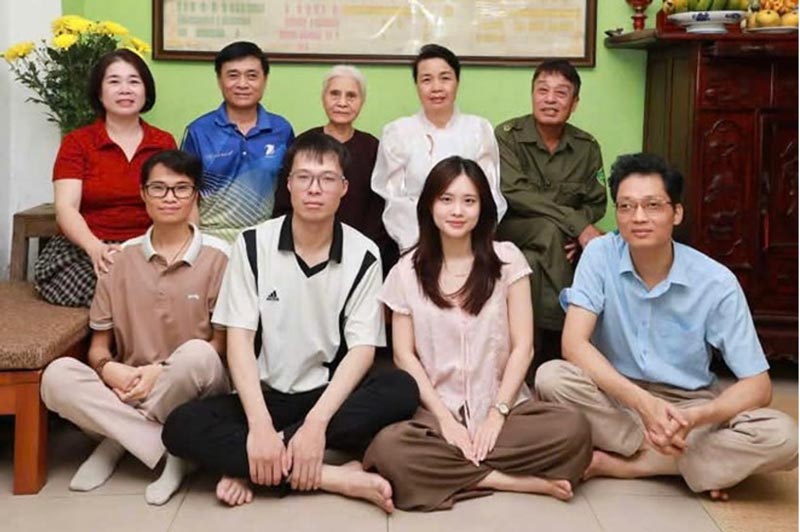
From Cultural Family to Citizen Responsibility
Holding the certificate of merit "Outstanding Cultural Family in 2026", Ms. Uong Thi Nhieu (D6 Giang Vo Collective, Giang Vo Ward, Hanoi) could not hide her pride when looking back at the achievements of years of cultivating happiness with her family.
The certificate of merit is hung in a solemn position in the house, as a milestone recognizing the cohesion and persistent efforts of each member. Every time they look at it, the whole family cherishes the values they have built and preserved together.
My family is very happy and touched to receive the certificate of merit. This is not only a source of pride but also a reminder for each member to continue to live responsibly, love, share and maintain a civilized lifestyle. Having this title is thanks to the consensus of the whole family over the years," Ms. Uong Thi Nhieu proudly shared.
Those words evoke a core thing: Family values do not come naturally. They are created from consensus, from silent efforts, from the way members treat each other every day. In modern life, when each person has their own work, pressure and worries, maintaining care, listening, and companionship becomes even more important.
According to Ms. Nhieu, family is the place to maintain common meals, teach children and grandchildren how to respect superiors and yield to subordinates, actively participate in neighborhood activities and maintain solidarity with neighbors. Those are not distant things. But it is these simple things that contribute to building a healthy and humane living environment right from each residential area.
Also in Giang Vo ward, Mr. Nguyen Chu Hoai Duc's family in D4 Giang Vo Collective is also recognized as "Outstanding Cultural Family in 2026". For him, the certificate of merit is not only recognition of efforts to build a happy home, but also a motivation for members to continue to preserve and promote the good values of the family to society.
The precious thing about families like Mrs. Nhieu's and Mr. Duc's is that they do not see the title as a reward that has ended, but see it as a reminder to continue living better. This is also the profound meaning of the movement to build a cultural family: Not running after formality, not stopping at certificates of merit, but aiming to form a sustainable lifestyle in each family and each residential area.
From a family that knows how to love and share, there will be children growing up in kindness. From a family that values responsibility, there will be citizens who know how to maintain discipline. From a family living in solidarity with neighbors, there will be a close community. From close communities, social strength will be formed. That is how the family value system contributes to the national value system.
Inseparable value systems
Decision No. 1189/QD-TTg on the Plan for synchronous deployment of national value systems, cultural value systems, family value systems and Vietnamese human standards has emphasized the criteria for family value systems with contents such as: Prosperity, happiness, progress, civilization. This decision also clearly states: "The family value system is the first environment to form and nurture human character, fostering love, respect, equality, sharing, responsibility, filial piety, loyalty and cohesion between members".
A country that wants to develop sustainably cannot only rely on economic growth rates, modern infrastructure or macroeconomic indicators. That development needs to be supported by cultural, ethical, human and lifestyle foundations. And the first place to form those values is the family.
Family is the early environment of each person. Before a child enters school, society or the working environment, children have received the first lessons from grandparents, parents, siblings. It can be a reminder to know how to greet adults, know how to share housework, know how to care when loved ones are sick, know how to keep promises, know how to live kindly with neighbors.
Those seemingly small things are the foundation of humanity. When each family knows how to cultivate love, responsibility, equality, discipline and a civilized lifestyle, society will have more citizens who know how to respect others, know how to live for the community and have the awareness to contribute to the country.
From that perspective, building a family value system is not a private matter of each home. It is a social task, an important part in the process of building a national value system. A prosperous, happy, progressive, and civilized family will contribute to creating a humane, united, disciplined and developed society.
However, the new requirement is that the components of national value systems, cultural value systems, family value systems and Vietnamese human standards have a close, unified relationship, interacting and promoting each other in the development process.
The promulgation of the Plan to synchronously implement value systems is an important step in the process of building an advanced Vietnamese culture imbued with national identity; and at the same time, arousing the aspiration to develop a prosperous and happy country.
In the new period, development is not only measured by economic growth, but also by human quality, family sustainability, cultural vitality and the ability to spread good values in society. When value systems are concretized and practiced in daily life, it will be a solid foundation for Vietnam to develop rapidly, sustainably and integrate more confidently with the world.