
Mr. Nguyen Tien Thao - Director of the Higher Education Department, Ministry of Education and Training, announced the above information on September 21.
The draft Circular amending the enrollment regulations proposed from 2027 no longer has bonus points due to training institutions self-regulating for certificates, achievements or additional criteria.
According to Mr. Thao, from 2023, the Ministry has requested equivalent conversion to reduce the difference; in 2026, it will continue to control bonus points up to 10% of the total admission score. However, when each school self-converts and self-determines bonus points, the difference is still large. Therefore, the proposal to abolish bonus points is not a sudden change in orientation, but is the next step of the roadmap for control and standardization.
Enrollment data for 2026 of the Ministry shows that more than 37,300 candidates use English certificates to get bonus points; of which over 35,900 candidates use IELTS. IELTS 6.0 is the most common level, with 8,318 candidates, but is regulated by schools into 26 different bonus points levels. In the group of majors in the top 5%, the benchmark score is high, with a benchmark of 26.09/30, more than 30% of enrolled people have bonus points; this rate in the group outside the top 25% is 9.51%.
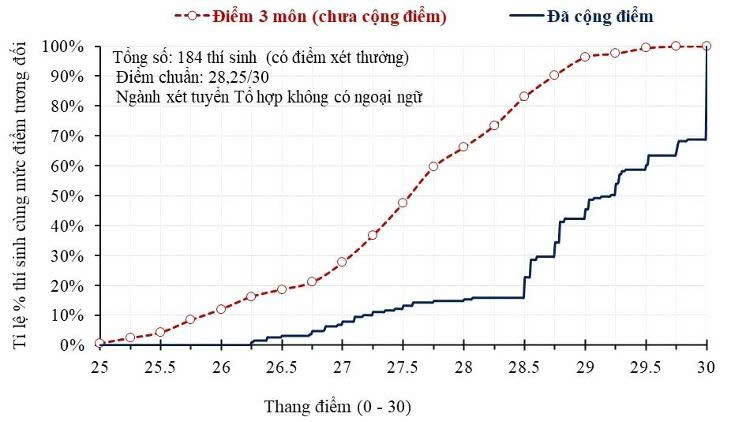
Among the three methods that do not have separate foreign language components, including considering high school graduation exam scores, reviewing transcripts and combining two results, 51.42% of candidates have bonus points with original scores lower than the admission level of the major.
Analyzing and clarifying the inadequacies, Mr. Thao pointed out the current reality that the major does not require foreign languages, but candidates with English certificates are still given bonus points. For example, for majors that only consider Math, Physics and Chemistry, a candidate with higher results in three subjects may still fail before candidates with lower professional scores but get bonus points.
The next inadequacy is that a combination already has English but the English certificate continues to be used to add points. At that time, foreign language proficiency is reflected in the combination score and also creates an advantage outside the scale. This distorts the admission order, especially in majors with high benchmark scores, where very small differences can also determine admission or not.
Current statistics show that many majors have benchmark scores around 28 but add up to 1.5 points, causing thousands of candidates with 26.5-28 points still not to be admitted just because they do not have the conditions to take high-cost certificates. This is an urgent issue directly related to fairness and needs to be adjusted immediately. Enrollment autonomy must go hand in hand with accountability and cannot legitimize a criterion that distorts competition among candidates" - Mr. Thao said.
From the above analysis, the Director of the Higher Education Department believes that bonus points can become a decisive factor in results in highly competitive industries, creating inequality in admissions. Therefore, the use of certificates and bonus points needs to be reviewed more closely.
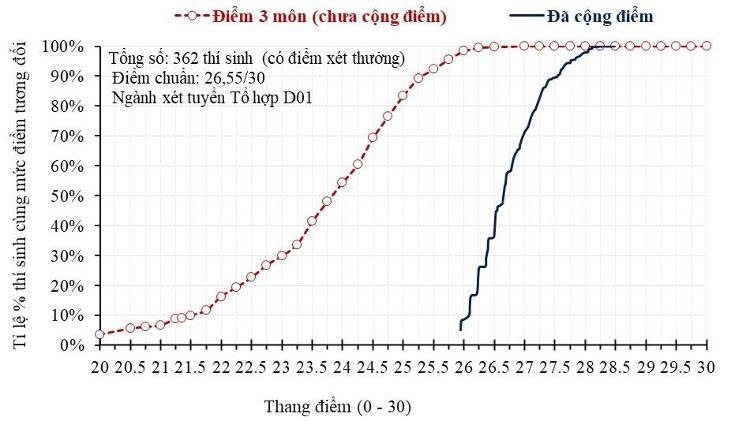
Mr. Thao acknowledged that this is an urgent adjustment to ensure that all candidates applying for the same major are evaluated according to the same input requirements, on the same scale; and at the same time make enrollment more transparent, simple and substantive.
Do not generalize "not getting bonus points" with "foreign language learning is no longer valuable
However, Mr. Thao noted that the saying "abolishing IELTS" or "no longer considering foreign language certificates" is inaccurate. The draft does not remove foreign language certificates from admissions and does not deny the achievements of excellent students. Foreign language certificates are still used to convert and replace foreign language subject scores in the admission combination according to public rules; proving the entry foreign language requirements of the foreign language training program; or being considered for recognition of modules and output standards according to regulations.
The certificate is still used to prove the entry requirements of the program in a foreign language. The proposed end is only an extra score outside the evaluation scale, especially when the foreign language is not an entry requirement or has been recorded in the combination.
Candidates who win national and international excellent student awards are still considered for direct admission if they meet the conditions of the regulations. Direct admission is also not included in the limit of three methods for each major from 2027.
The content of the proposed change is not to add points outside the main assessment scale prescribed by each school for certificates, achievements or additional criteria. The principle is that a competence must be assessed correctly for the position, recorded once and according to the same rules for all candidates applying for the same major" - Mr. Thao said.
Mr. Nguyen Tien Thao affirmed that if foreign language is a necessary input competence, the training institution must make foreign language an official component of the admission method. Candidates can use exam scores or equivalent converted certificates. Conversely, if the major only considers mathematics, physics and chemistry, adding points because there is an English certificate will include a criterion that does not belong to the input requirement to change the order of candidates.
The case of a combination that already has English subject but candidates continue to get bonus points thanks to English certificates also arises unreasonably: the same foreign language proficiency is recorded twice. The certificate has the function of confirming proficiency, not necessarily a bonus point in every major" - Mr. Thao emphasized.
Giving advice to parents and students, Mr. Thao said that "no bonus points" should not be uniformized with "foreign language learning is no longer valid". If certificates are mainly pursued to gain point advantage, learning can easily shift from developing communication, learning and working skills to exam preparation to achieve a score milestone.
Policies need to bring the motivation for learning foreign languages back to the right goal: learning truthfully, being usable and creating long-term advantages for learners" - Mr. Thao said.


