
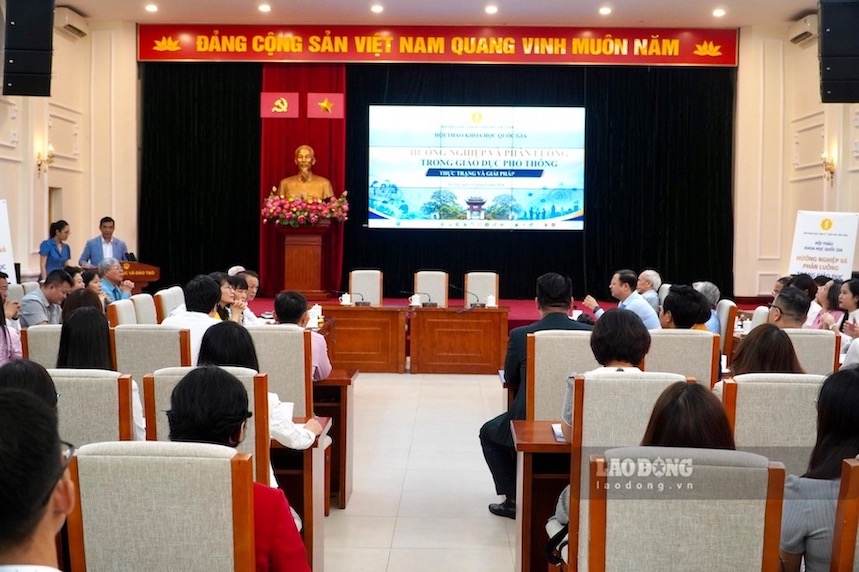
On September 19, the Vietnam Psychological and Educational Science Association organized a national scientific conference with the theme "Career guidance and streaming in general education: Current situation and solutions".
The workshop focused on assessing the current situation of career guidance and streaming after 5 years of implementing the 2018 General Education Program; and discussed solutions to improve career guidance quality, build a connecting ecosystem between general education schools and vocational education institutions, higher education and businesses.
More than 44% of students rate career experience at a low level
At the workshop, Assoc. Prof. Dr. Dinh Thi Kim Thoa, Editor-in-Chief of the Experiential Activities and Career Guidance Program, said that a survey on a sample of 708,202 people was conducted by the research group, including 12,861 managers, 45,166 teachers and 650,175 students, on the changes in career guidance education after 5 years of implementing the 2018 general education program.
As a result, management staff and teachers self-assessed the implementation of career guidance content at 4.02 and 4.14/5 respectively. Meanwhile, teachers and students rated lower, 3.64 and 3.49/5 respectively. When measuring results on students, many indicators were only at an average level.
According to her, the survey results show that students have begun to understand themselves but do not fully understand the profession. One of the reasons is that professional experience is still limited, making students' understanding of the profession still theoretically based.
This is also the index with the lowest results among the 9 surveyed indices, with an average score of 2.91/5. 44.15% of students assessed their professional experience at 1-2 levels. Teachers also said that the organization of activities to help students access real-life careers is not good.
According to Assoc. Prof. Dr. Dinh Thi Kim Thoa, if students only learn about careers within the school framework without expanding their experiences to the outside, this will affect their ability to choose a career as well as vocational guidance.
She believes that the school pays attention to career orientation education, but the issue is how to prevent this activity from becoming a movement. For real career orientation, there needs to be connection with vocational institutions and businesses for students to directly experience.
Traffic diversion must be a consequence of the career orientation process" - Assoc. Prof. Dr. Dinh Thi Kim Thoa emphasized.
From the survey results, the research group proposed to shift from measuring the number of activities to measuring results on students, to see what abilities they actually form. Career orientation needs to be implemented systematically from elementary school to middle school and high school, instead of following each event.
Three key proposals for the 2026-2031 period proposed by the research group include organizing practical career-oriented experience activities; connecting schools with the professional world through specific mechanisms; and building tools to measure learner choice capacity and evaluate implementation at schools.
Not just looking at performance
The current vocational guidance and vocational guidance work is implemented according to Circular 16/2026/TT-BGDĐT (Circular 16) of the Ministry of Education and Training.
Dr. Pham Do Nhat Tien, former Assistant Minister of Education and Training, said that the progressive point of Circular 16 is that it has approached the current career-oriented thinking, towards lifelong career-oriented education.
However, according to him, the difficulty lies in the implementation stage. Schools need to have guidance materials, clearly identify the capacity that students need to achieve after career guidance education to serve as a basis for developing programs and materials for teachers.
He also said that it is not possible to only require schools to build a career-oriented ecosystem without resources and organizational capacity. Schools need to connect with vocational education institutions, higher education institutions, businesses and community organizations so that students have the opportunity to access reality.
From the above reality, he suggested that there should be specific standards and evaluation criteria for career guidance so that inspection and evaluation do not stop at formality.
Agreeing with this view, Dr. Nguyen Tung Lam, Vice President of the Vietnam Psychological and Educational Science Association, emphasized that career orientation in schools must be linked to the ecosystem between general schools, universities, colleges, vocational schools and businesses, with the responsible participation of local authorities.
According to him, if career orientation is only implemented within the school, it is difficult to create substantial results. Students need to be connected with educational institutions and businesses to have more opportunities to access and experience the real profession.


