
After two slight recovery sessions, selling pressure increased widely in the morning session of March 19th, causing all industry groups on the stock market not to escape the correction state and the VN-Index also reversed to decrease to below the 1,700 point mark.
At the end of the morning session, VN-Index decreased by 15.35 points (-0.9%) to 1,698.48 points. Total trading volume reached more than 382.3 million units, worth 9.658 billion VND, down 5.5% in volume and 19.8% in value compared to yesterday's morning session. Block transactions contributed more than 17 million units, worth 331.4 billion VND.
The VN30 group closed the session down 21 points when there were 27 declining stocks and only 3 stocks remained: VIC, STB, VPL increased slightly. The pair of oil and gas stocks that fell sharply included PLX down 5.1% and GAS down 3.6%.
In particular, DGC shares of Duc Giang Chemical Group continued to be heavily sold off and recorded the 3rd consecutive floor-dropping session after negative information from the enterprise. Currently, DGC only matched about 0.8 million units, but the floor selling surplus is nearly 21 million units.
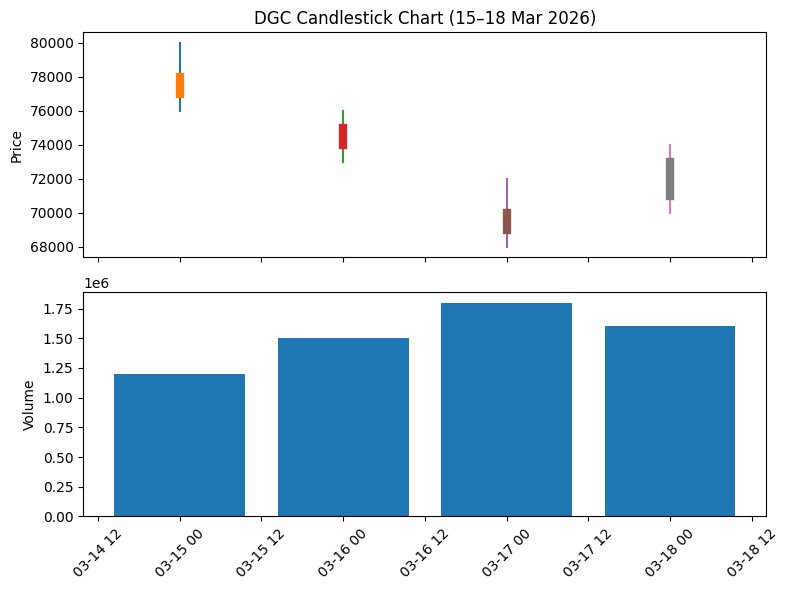
SHS Research has just updated its assessment of DGC shares of Duc Giang Chemical Group after information that functional agencies have initiated a case related to the leaders of this enterprise.
According to SHS, this is negative information, which may directly affect the process of extending the mining license of field 25 by the end of 2026. In case it is not extended, the enterprise will have to switch to buying and importing almost the entire apatite ore, instead of being more than 80% self-sufficient in input materials as before, thereby creating significant pressure on cost and profit margin.
In the long term, the risk of losing the advantage of raw material autonomy may cause DGC to be discounted and valued more heavily, while reducing the clarity in the growth prospects. This development may also set a precedent for the trend of tightening management throughout the chemical and mining industries.
In addition, prosecution information also puts significant pressure on stock price movements, and at the same time increases the risk of arising legal and environmental costs or arrears in the near future.
SHS said it will monitor some key factors in the coming time, including the possibility of ownership restructuring such as M&A deals or strategic shareholder changes in the context of volatile business hierarchy, as well as the level of stability in operational operations. However, due to the complexity of the case and the information still being updated, this securities company believes that there is not enough basis to fully assess the ability to maintain stable business operations.
Previously, SHS had issued a "Promising" recommendation for DGC based on a positive fundamental, although there were notes on legal and environmental risks. However, before the incident related to senior leaders, SHS decided to temporarily remove this stock from the recommendation list and will re-evaluate when there is more clear information.
Returning to the diễn biến of the stock market, in terms of industry groups, the real estate group reversed the general market and recorded a slight increase. Besides large code VIC still actively supported the industry group with an increase of more than 1%, many small and medium-cap codes have recovered positively. The bright spot is NVL reversing to increase sharply and closing the session at the ceiling price of 13,900 VND/share with liquidity reaching more than 17.4 million units, along with a ceiling buy order volume of up to more than 7.3 million units.
The bank-securities-steel pillar group all lost points, but still led market liquidity. In which, SHB closed the session down 0.7% with the largest matched order volume, reaching more than 28.3 million units. Meanwhile, the securities group was in the top of the deepest decline when no code maintained green color.
In the current context, experts recommend that short-term investors should maintain a defensive state, maintain a moderate to low stock ratio, limit margin use and not chase in technical recovery phases.
It is possible to consider reducing the proportion when the index recovers but cash flow does not improve significantly. Opening new positions should only be done with a small proportion when the market maintains an important support zone and more stable signals appear.


