
Comparing electricity prices during peak hours with off-peak hours
According to Decision No. 1279 dated May 9, 2025 of the Ministry of Industry and Trade, retail electricity prices according to peak hours, off-peak hours and normal hours are applied to customers who are manufacturing and business industries. Electricity prices for each time frame also depend on each voltage level.
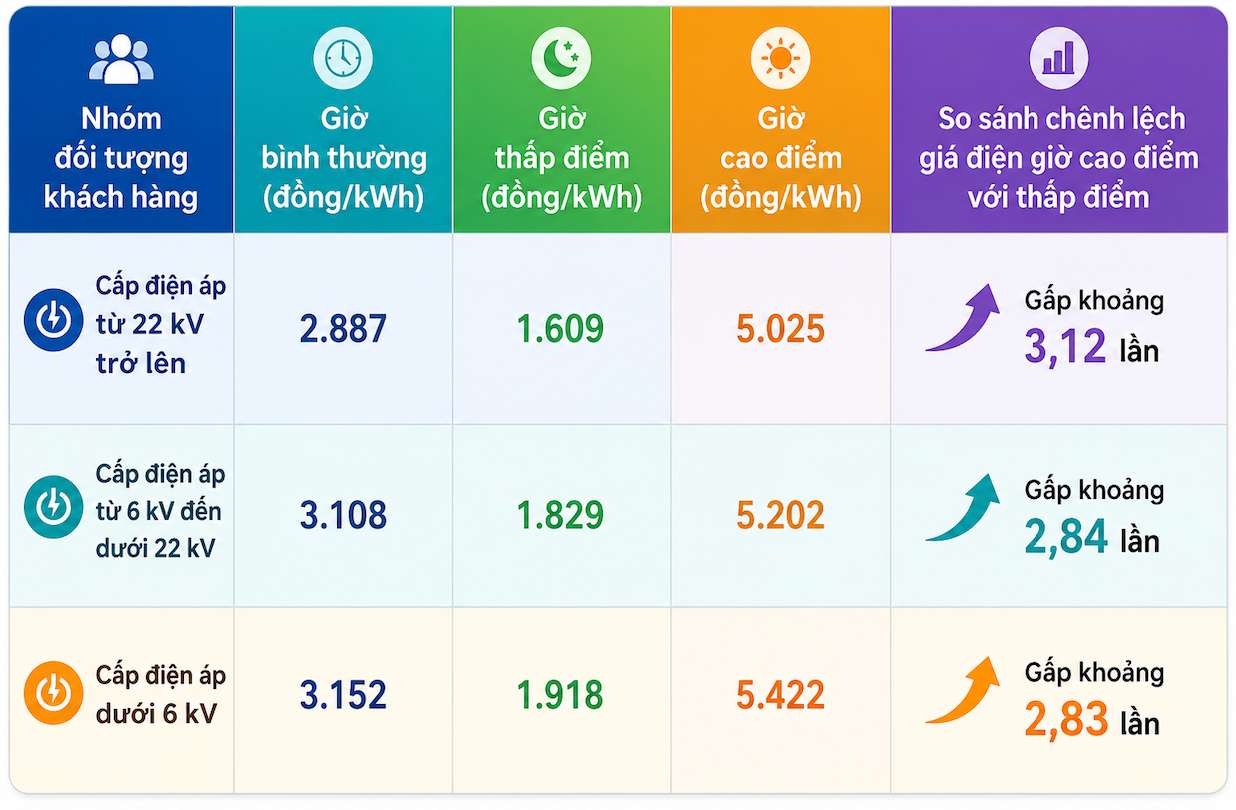
Analysis of electricity selling prices issued with Decision No. 1279 dated May 9, 2025 of the Ministry of Industry and Trade shows a very large difference between peak and off-peak hours, especially for manufacturing and trading enterprises with large electricity demand in the evening.
In the group of business customers using voltage from 22kV and above, the electricity price at peak hours is 1,609 VND/kWh, while at peak hours it is up to 5,0025 VND/kWh, which is about 3.12 times higher.
Similarly, for customers using voltage from 6kV to under 22kV, the peak hour electricity price is 5,202 VND/kWh, about 2.84 times higher than the 1,829 VND/kWh level of the low hour.
Notably, the group of business customers using voltage below 6kV - mainly small businesses, stores, and service establishments - are experiencing the highest peak hour price, up to 5,422 VND/kWh. This level is about 2.83 times higher than the low hour price of 1,918 VND/kWh.
New regulations on peak, off-peak and normal hours
On April 22, 2026, the Ministry of Industry and Trade issued Decision 963 regulating peak hours, off-peak hours and normal hours of the national power system. Accordingly, peak hours apply: Days from Monday to Saturday from 5:30 PM to 10:30 PM (5 hours/day); Sundays have no peak hours.
Normal hours are applied: Days from Monday to Saturday: from 6:00 AM to 5:30 PM and from 10:30 PM to 12:00 PM (1 day at 1:00 PM); Sunday: from 6:00 AM to 12:00 PM (1 day at 6:00 PM).
Applicable off-peak hours: from 00:00 to 06:00 all days of the week (6 hours/day).
Accordingly, both the old and new power hours have a total applied time of 5 hours/day for 6 days a week (from Monday to Saturday). However, in the new power hours, peak hours are concentrated in the evening; while in the old time, peak hours are divided into two periods of time: daytime and evening. Similarly, normal and off-peak hours of the new time frame are also changed compared to the old time frame, but the total number of hours applied in the day is still the same.
Businesses need to chart load
Recently, the National Power System and Electricity Market Operation Company (NSMO) proposed applying a new peak hour from 5:30 PM to 10:30 PM, from Monday to Saturday in June, to reduce pressure on the power system during the hot season. Currently, peak hours are calculated according to two frames including 9:30 AM - 11:30 AM and 5:00 PM - 8 PM, from Monday to Saturday. Thus, compared to current regulations, peak hours will mainly focus on the evening, the time when electricity demand increases the most during the day.
Talking to Lao Dong Newspaper, Assoc. Prof. Dr. Ngo Tri Long - an economic expert recommended that in the context of hourly electricity prices reflecting more clearly system costs, businesses cannot continue to consider electricity as a fixed cost that is difficult to control. Electricity must be managed like raw materials, labor, finance and logistics.
In the immediate future, businesses need to create load charts by hour, by day and by production department. If it cannot be measured, it cannot be managed. When data is available, businesses will know which stage consumes the most electricity, which stage is required to operate during peak hours, and which stage can be switched to normal or off-peak hours," Assoc. Prof. Dr. Ngo Tri Long said.
Next, Assoc. Prof. Dr. Ngo Tri Long said that businesses need to build operating scenarios according to electricity prices. A modern production line must not only optimize according to productivity, but also optimize according to energy costs. Stages that consume large amounts of electricity but do not require operating on time during peak hours need to be rearranged. Equipment that consumes a lot of electricity such as air compressors, pumps, refrigeration systems, heaters, central air conditioners must be controlled by data and not operated by habit.
For small and medium-sized enterprises, the State and the electricity industry need to have a simple and easily accessible consulting program. Not every enterprise has enough capacity to hire energy consultants or immediately invest in automation systems. If there is no support, hourly electricity price policies can create advantages for large enterprises, while small enterprises are under more pressure," Assoc. Prof. Dr. Ngo Tri Long said.


