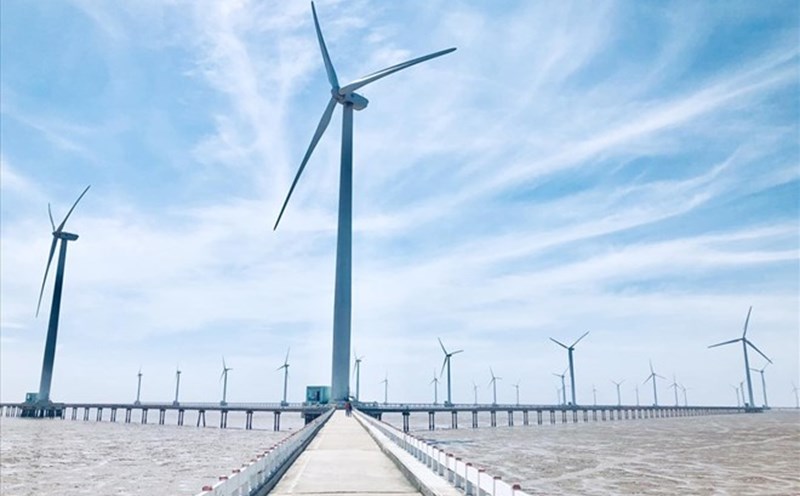
Offshore wind power development advantages
Vietnam is simultaneously facing great energy pressures. Rapid electricity demand along with industrialization and modernization and the goal of double-digit economic growth in the coming period. Meanwhile, traditional energy sources are gradually revealing limitations. In that context, Assoc. Prof. Dr. Le Quang Duyen - Head of the Faculty of Oil and Gas and Energy, University of Mining and Geology, believes that offshore wind power and energy storage systems will become new pillars of Vietnam's energy industry.
According to Assoc. Prof. Dr. Le Quang Duyen, Vietnam owns a coastline of more than 3,000 km, creating a clear advantage for wind power development, especially offshore wind power. Coastal areas in the Central and South Central regions, including Phan Thiet, are assessed to have high and stable wind quality, suitable for developing large-capacity projects.
According to Power Plan VIII, offshore wind power plays a particularly important role in the power source structure. The expected capacity will reach about 6 GW by 2030 and increase to nearly 140 GW by 2050. The proportion of offshore wind power in the power source structure increased from about 4% in 2030 to 16% in 2050.
Building a suitable electricity price mechanism
To realize the goal of developing offshore wind power associated with energy storage systems, Assoc. Prof. Dr. Le Quang Duyen said that the prerequisite is to complete the legal framework. First of all, it is necessary to soon issue decrees guiding the assignment of sea areas to serve surveys, build separate investment procedures for offshore wind power; review, amend and supplement overlapping regulations in laws related to electricity, resources and marine and island environment.
Without a clear and unified legal corridor, the implementation of offshore wind power projects will continue to face many challenges" - Assoc. Prof. Dr. Le Quang Duyen emphasized.
Regarding the price and investment mechanism, Assoc. Prof. Dr. Le Quang Duyen proposed building an offshore wind power price mechanism according to an appropriate roadmap, accompanied by direct electricity purchase and sale. According to him, stable and long-term preferential policies are the "key" to attracting large-scale capital flows, especially from international investors.
It is necessary to establish a focal agency directly under the Government, unify strategic direction, planning and development of offshore wind power, in parallel with the formation of research, training and technology transfer centers, meeting the requirements of high-quality human resources.
Regarding planning and capital, Assoc. Prof. Dr. Le Quang Duyen said that it is necessary to "go one step ahead" in offshore wind power planning, creating clear signals for the market. Vietnam needs to proactively utilize climate finance funds, long-term capital sources and strengthen cooperation with experienced countries such as the UK, Denmark, Germany and China.
Mr. Duyen said that energy storage is "an indispensable component of the power system", which can operate independently or be associated with renewable energy sources, and needs to be fully included in electricity planning. Technologies such as batteries, hydropower, heat storage or hydrogen must be researched, tested and carefully evaluated according to Vietnamese conditions; in which, the offshore hydrogen electrolysis model is currently low efficiency, and the plan to transmit electricity ashore for electrolysis needs to be comprehensively considered before deployment.
At the same time, it is proposed to allow the integration of storage systems in offshore wind power projects, apply depreciation and higher incentives for projects with storage investment. At the same time, it is necessary to synchronously plan the power grid, invest in seaport infrastructure and promote equipment localization.
Not conducting bidding but being assigned directly
From an international perspective, Mr. Bui Vinh Thang - Country Director in Vietnam of the Global Wind Energy Council (GWEC) emphasized that the mechanisms and policies in Resolution 253 clearly reflect the spirit of Resolution 70-NQ/TW with the orientation of creating institutional breakthroughs for the development of Vietnam's energy industry.
According to the spirit of Resolution 253, offshore wind power projects will not be subject to bidding but will be directly assigned. Accordingly, projects in the 2026-2030 period will be assigned by the Prime Minister, and in the 2031-2035 period will be assigned to localities. This direct assignment mechanism significantly simplifies licensing procedures, thereby allowing investors to participate in project development much faster than before.
We believe that with this mechanism, the process of deploying offshore wind power in Vietnam will have very clear changes. Vietnam's offshore wind power industry is a field that has been prepared and cherished for many years. With the new mechanisms from Resolution 253, from 2026 can be considered the time when the offshore wind power industry is officially launched" - a representative of GWEC emphasized.