
Gold price recovers
Gold prices continued to recover slightly as expectations for the possibility of reaching a ceasefire agreement between the US and Iran partly helped the market reduce concerns about inflation - a factor that had put great pressure on the precious metal in recent times.
In the morning trading session in Asia, gold prices at one point increased by 0.4% to around 4,585 USD/ounce after increasing by 0.6% in the previous session.
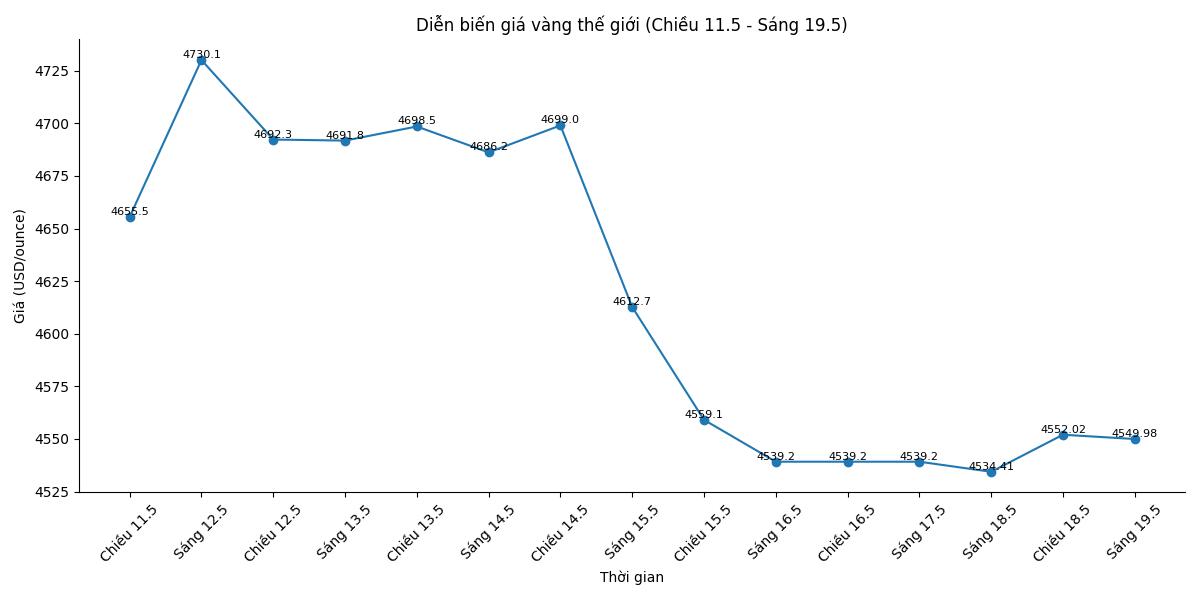
As of 10:28 am Vietnam time, spot gold price increased by 0.4% to 4,549.98 USD/ounce.
US President Donald Trump said on Monday that he had approved a plan to launch more attacks on Iran this week, but temporarily postponed it after Qatar, Saudi Arabia and the UAE asked Washington to spend more time on negotiation efforts.
According to Mr. Trump, leaders of the three Gulf countries believe that there is still a chance to reach an agreement with Iran that meets US requirements.
Previously, Axios quoted sources from the White House as saying that the latest proposal that Iran sent through Pakistani intermediaries has not shown much significant change.
However, US Treasury bond yields have remained around high levels for many years as energy prices continue to linger at high levels and maintain global inflationary pressure.
A high yield level often reduces the attractiveness of gold because this precious metal does not generate profits.
The gold market is currently still fluctuating in a narrow range since the sharp decline in the early stages of the Middle East conflict. Concerns about inflation due to rising oil prices once put great pressure on gold, but at the same time, the market also has expectations that central banks may have to ease monetary policy if economic growth weakens.
Since the conflict broke out, gold prices have now fallen by more than 13%.
Mr. Vasu Menon - strategist at Oversea-Chinese Banking Corp. believes that developments related to the Middle East, oil prices and bond yields may still continue to affect gold in the short term.
However, he still assesses gold as a useful defense tool against global economic and political fluctuations in the long term.
We still see gold as an effective risk hedging asset in the context of the world undergoing major economic and geopolitical changes," he said.
On other precious metals markets, silver prices increased by 1.2% to 78.68 USD/ounce. Meanwhile, the Bloomberg Dollar Spot Index slightly decreased after losing about 0.3% in the previous session.
Gold market sensitive to new developments in the Strait of Hormuz
According to analysts, the latest statements show that the market is still in a rather sensitive state as geopolitical tensions both support safe-haven demand for gold and increase the risk of disruption to global energy supply.
This may cause inflation to continue to linger high and force central banks to maintain a more cautious monetary policy.
These concerns are clearly reflected in the interest rate market. According to CME Group's FedWatch tool, investors currently assess that the probability of the Fed raising interest rates before the end of the year has exceeded 50%.
This change mainly stems from inflationary pressure related to energy prices in the context of prolonged US-Iran tensions.
High interest rates are often disadvantageous for gold because this precious metal does not generate profits, creating significant pressure on the short-term outlook of the market, although geopolitical factors still support risk hedging needs.
Although gold and silver recovered slightly in the first session of the week, analysts believe that both metals are still in a fairly sensitive and volatile state in the face of new information from the Middle East.
According to many experts, for gold and silver to form a sustainable upward trend instead of just technical recovery in a downward trend, the market needs to see two important factors, including a clear cooling down of US-Iran tensions and the Hoarmuz Strait being fully reopened for energy transportation.
Hormuz is still one of the world's most important energy transport routes as most of the global oil and liquefied natural gas transit through this region every day.
The disruption of operations in the strait not only affects the energy market but also has a widespread impact on the supply chain and global price levels.
Analysts believe that as long as geopolitical tensions persist and energy supplies are unstable, the precious metals market will continue to fluctuate sharply according to new information from the Middle East – supported by defensive sentiment but also under pressure from inflation and high interest rate prospects.


