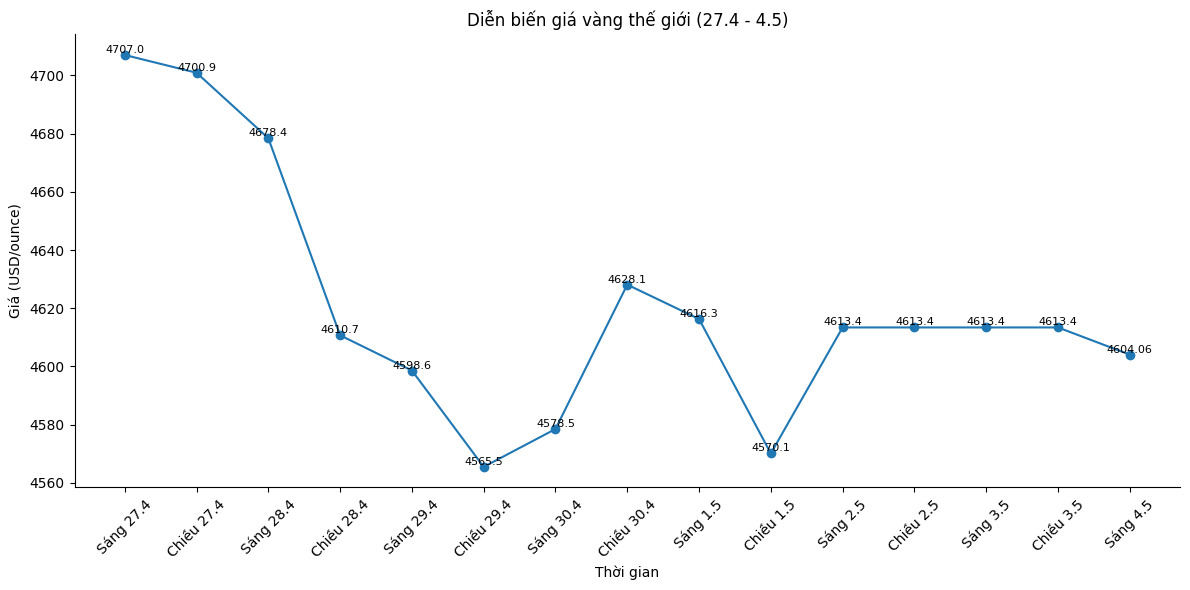
Gold prices went sideways after recording a second consecutive week of decline, amid investors monitoring the progress of negotiations between the US and Iran, as well as President Donald Trump's plan to support ships passing through the Strait of Hormuz.
Gold prices traded around 4.620 USD/ounce. On social media, Mr. Trump said that the US will begin leading some ships unrelated to the Iranian conflict through the Strait of Hormuz from the beginning of this week, and mentioned "positive" exchanges with Tehran.
This information was released after Mr. Trump said on Saturday that Iran's latest peace proposal may not have met US expectations. Prolonged conflict has kept energy prices at a high level, reducing expectations of central banks early cutting interest rates - a disadvantage to gold, a non-performing asset. Since the conflict broke out at the end of February, gold prices have fallen by about 12%.
In the near future, the market will focus on the US Treasury Department's borrowing plan for the next three months, statements from US Federal Reserve (Fed) officials, along with a series of important economic data, notably the monthly jobs report. This information is expected to provide more signals about interest rate trends and the US fiscal situation.
However, many experts still maintain a positive view on the long-term outlook for gold, as buying power is still maintained even during the price adjustment period. The latest data from the World Gold Council shows that central banks have increased gold reserves at the fastest pace in more than a year in Q1. At the same time, Tether Holdings SA continues its buying streak, becoming one of the largest gold holding organizations in the world besides banks and countries.
At 09:46 am Vietnam time, spot gold prices slightly decreased by 0.1% to 4,604 USD/ounce. Silver prices increased by 0.3% to 75.57 USD/ounce, while platinum and palladium also recorded increases. The Bloomberg Dollar Spot Index - a measure of the strength of the USD - decreased by 0.1%.