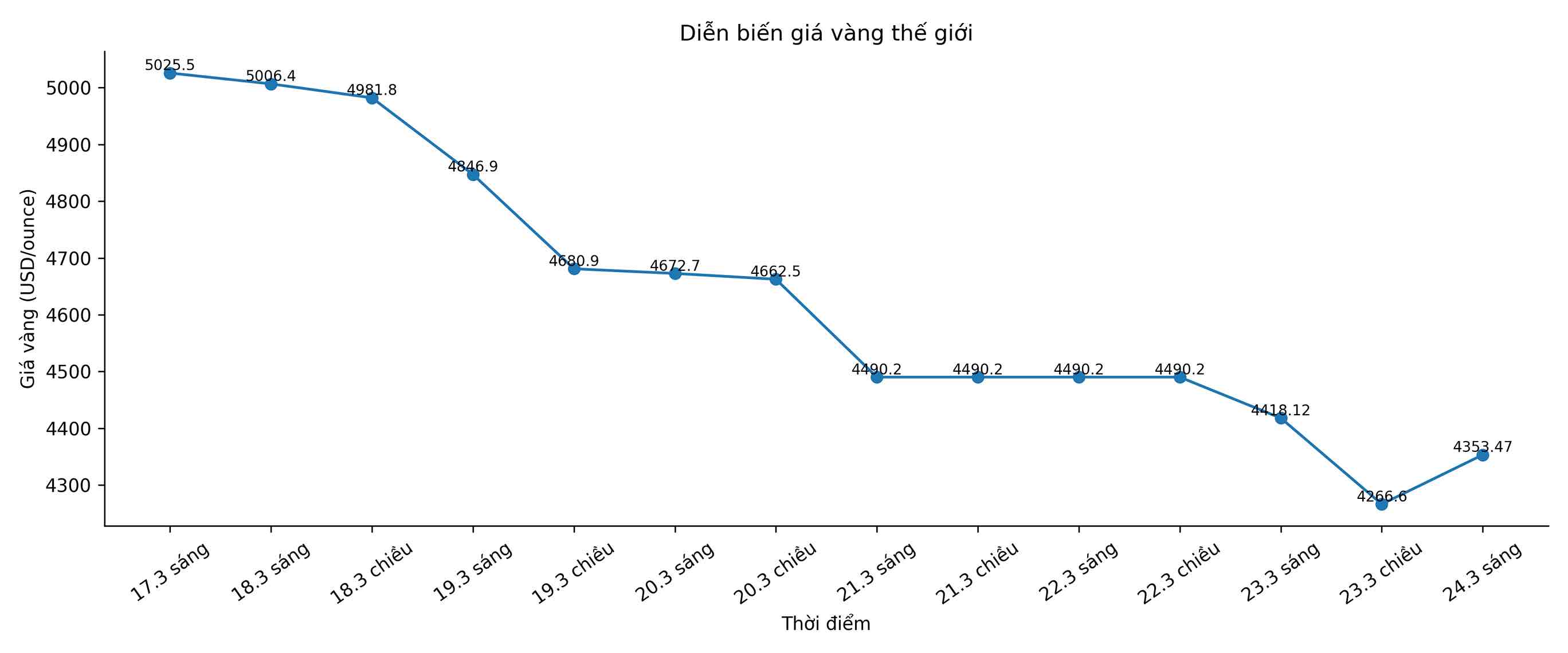
Gold prices narrowed their sharp decline after US President Donald Trump announced the postponement of plans to attack Iranian energy facilities for 5 days, after what he described as positive exchanges aimed at ending the conflict.
Spot gold prices at one point rebounded before turning down by about 2% as Iran denied information about exchanges. Silver prices recovered, erasing a previous decrease of more than 10%. The US stock market rose while US Treasury bond yields and the USD weakened. Investors also adjusted their policy expectations of the US Federal Reserve (Fed) in a less tighter direction than before.
Analysts at Citigroup believe that gold is currently trending to move similarly to a risky asset in many periods of strong fluctuations in the financial market over the past two decades. According to this analysis group, this development is even clearer in the context that gold prices have attracted speculative cash flow and quite strong individual investors in the past 6 months.
Mr. Donald Trump said that the US and Iran could jointly control the Strait of Hormuz – an important energy transport route that is almost disrupted, and said that this shipping route could soon be cleared if exchanges yield positive results.
Previously, on social media, Mr. Trump said that the US and Iran had "very positive and constructive" exchanges regarding the possibility of ending the conflict in the Middle East. However, Fars news agency quoted sources from Iran as saying that the country has not had any direct or indirect exchanges with the US President.
The negative diễn biến of gold prices in recent times partly reflects the increasing demand for cash holdings of investors as the global financial market fluctuates strongly. At the same time, the shift of the USD and the expectations of monetary policy are also creating more pressure on the precious metal.
Some experts also believe that the conflict in the Middle East may slow down central bank gold buying activities in the short term. Central banks have maintained a strong upward trend in gold reserves since 2022, but the buying rate has shown signs of gradually decreasing since the beginning of this year.
Mr. Bernard Dahdah – Analyst at Natixis said that some central banks may have sold gold to support the stability of the domestic currency or balance financial resources in the context of strong market volatility.
Meanwhile, Mr. Daniel Ghali - Strategy at TD Securities said that the conflict in the Middle East has disrupted the flow of capital previously re-allowed to gold from the USD surplus in some countries. However, the long-term outlook for gold prices is still assessed as positive, although in the medium term the market may continue to be affected by investor portfolio restructuring activities.
On the exchange-traded fund market, SPDR Gold Shares ETF (GLD) – the world's largest gold ETF recorded active placement of sell options on a significant scale. The implied fluctuation of the fund in 3 months has increased sharply, reflecting the expectation that the market will still maintain high volatility in the coming time.
Spot gold price decreased 1.9% to 4,353.47 USD/ounce. Silver prices rose 1.7%, while the Bloomberg Dollar Spot Index - a measure of USD strength - fell 0.4%.