
World gold prices fall sharply
World gold prices broke through the psychological milestone of 4,000 USD/ounce in the trading session on June 24, after weeks of pressure from the USD, bond yields and expectations that the US Federal Reserve (Fed) will continue to maintain a tough monetary policy.
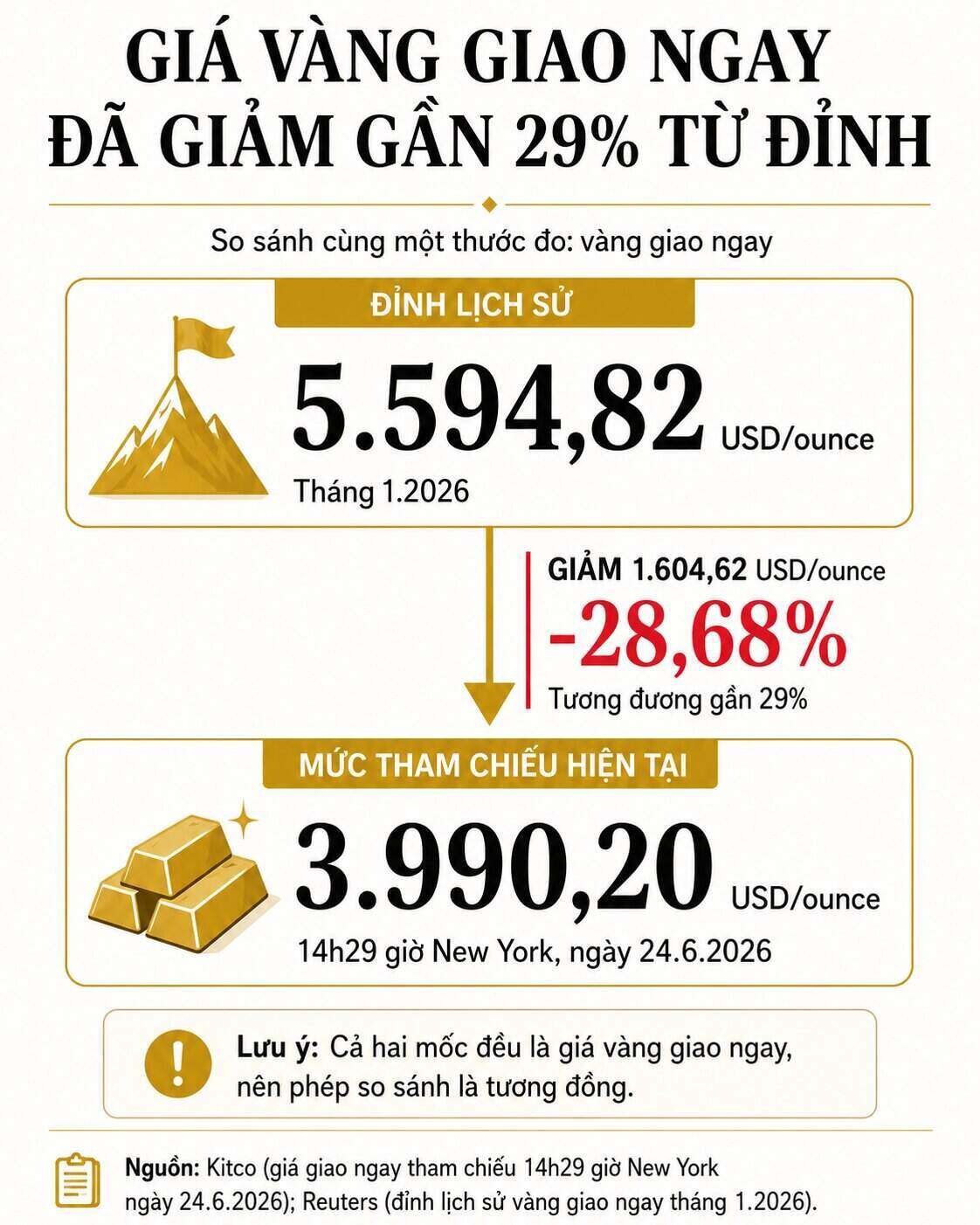
At 14:29 New York time, spot gold prices at Kitco stood at 3,990.20 USD/ounce, down 119.80 USD, equivalent to 2.91%. US gold futures contracts traded around 4,000.20 USD/ounce, losing 149.20 USD, equivalent to 3.6%.
Compared to the historic peak of nearly 5,595 USD/ounce set at the end of January, gold prices have decreased by about 1,605 USD, equivalent to nearly 29%.
Notably, the decline occurred right at the time when a series of major banks and financial institutions strongly adjusted their forecasts for precious metals.
Forecast cut of the strongest gold price up to 22%
aggregated data shows that Deutsche Bank is the organization with the strongest adjustment in the group of newly released gold price forecasts.
The figures show that caution is increasing widely, instead of just appearing in a single organization.
Deutsche Bank lowered its Q3 average forecast to 4,300 USD/ounce, 22% lower than the previous estimate. Q4 forecasts were also lowered by about 17%, to 4,800 USD/ounce.
Goldman Sachs cut $500 from year-end forecasts, gold price from $5,400 to $4,900/ounce. The adjustment was made after the bank no longer expects the Fed to cut interest rates in 2026.
Meanwhile, BMO Capital Markets lowered its average gold price forecast for the second half of the year by about 5%, to 4.625 USD/ounce. ING also lowered its Q3 forecast from 4,850 to 4,300 USD and Q4 forecast from 5,000 to 4,600 USD/ounce.
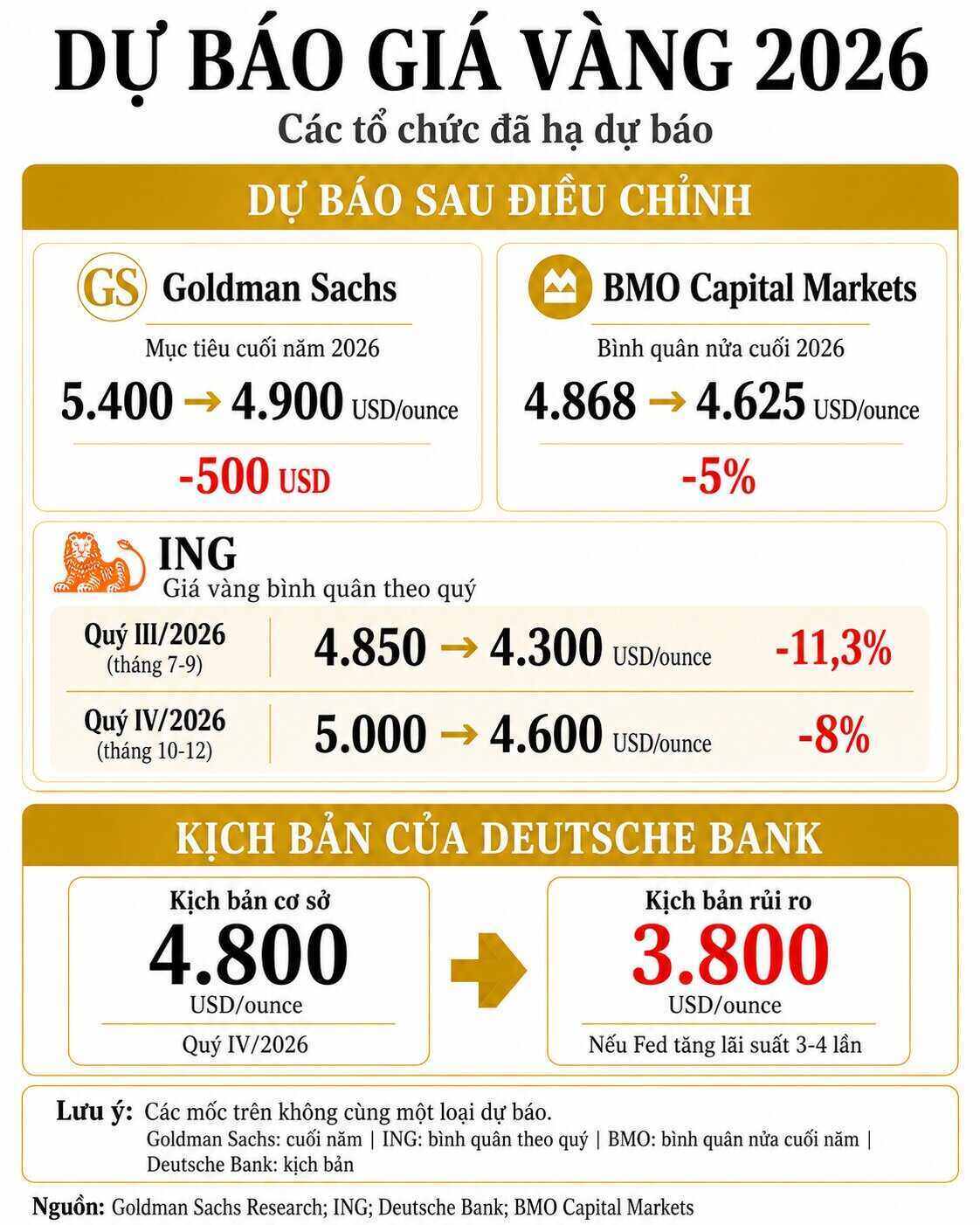
It should be noted that the above milestones are not completely similar. Deutsche Bank, ING and BMO mainly offer average quarterly or semi-annual prices, while Goldman Sachs' figure is a forecast at the end of the year. However, the general trend is still clear: the target price range is being pulled down significantly.
Banks have not yet predicted gold will "collapse
Although simultaneously cutting forecasts, most of the underlying scenarios of organizations are still higher than the current spot price of about $3,990/ounce.
The forecast level of 4,300 USD of Deutsche Bank and ING is about 7.8% higher than the current price. The forecast of 4,600 USD of ING is 15.3% higher, while the level of 4,625 USD of BMO is nearly 16% higher.
Two higher forecasts are 4,800 USD from Deutsche Bank and 4,900 USD from Goldman Sachs, respectively higher by about 20.3% and 22.8% compared to the current price.
Thus, the data does not show that banks have completely shifted to the view that gold prices will continue to plummet. Instead, they are narrowing down recovery expectations and eliminating part of the previously predicted increase in the context that the Fed may cut interest rates.
Even Goldman Sachs' highest forecast of 4,900 USD/ounce is still about 12% lower than the nearly 5,595 USD peak set in January. This shows that the possibility of gold quickly returning to the old record level is being underestimated.
BMO still forecasts gold may surpass 5,000 USD/ounce in Q1/2027. This bank believes that gold buying demand associated with a downward trend depends on the USD and the accumulation activities of central banks may continue to support the market in the long term.
Deutsche Bank also assessed that central bank buying demand is a significant pillar that remains, in the context of capital flows from gold ETFs and weakening demand in some Asian markets.
The 3,800 USD mark is less than 5% away
Unlike baseline forecasts, the 3,800-3,500 USD/ounce zone is given as risk scenarios if monetary policy becomes tougher or gold prices break the technical support zone.
Deutsche Bank believes that the Q4 forecast at 4,800 USD is built on the assumption that the Fed will keep interest rates unchanged. If the US central bank implements three to four waves of interest rate hikes, gold prices may fall back to around 3,800 USD/ounce.
Expert Ilya Spivak of Tastylive also warned that after the 4,000 USD mark is broken, the next target may be 3,800 USD, further in the 3,500 USD/ounce zone.
From the spot price of $3,990.20, the $3,800 threshold is only about $190 lower, equivalent to 4.8%. The $3,500 scenario is about $490 lower, corresponding to an additional decrease of 12.3%.
This makes the 3,800 USD mark no longer a scenario too far in terms of amplitude, although it is not yet a basis forecast for major banks.
The chain of reasons putting pressure on gold is quite consistent. Increased energy prices increase concerns about inflation; expectations of the Fed reducing interest rates are replaced by the ability to keep interest rates high or continue to raise interest rates; bond yields and the USD are rising; while capital inflows into gold ETFs are weakening.
In the short term, the 4,000-4,100 USD/ounce zone continues to be considered the area that determines the trend. If the price does not recover soon and maintain above this zone, loss-cutting and selling trends may increase downward pressure.
The upcoming US PCE inflation data will be the next test. A higher-than-forecast result could strengthen expectations that the Fed will maintain high interest rates, while cooling data will create an opportunity for gold prices to regain the $4,000/ounce range.


