
Gold prices continued to fall in the trading session on June 24 when the wave of technology stock sell-offs on Wall Street forced many investors to narrow their holdings of precious metals to compensate for losses in other assets.
Spot gold prices fell below the 4,100 USD/ounce mark after losing 1.7% in the previous session, recording the lowest closing level in two weeks.
As of 09:57 am Vietnam time, spot gold price decreased by another 2.83%, to 4,066.3 USD/ounce.
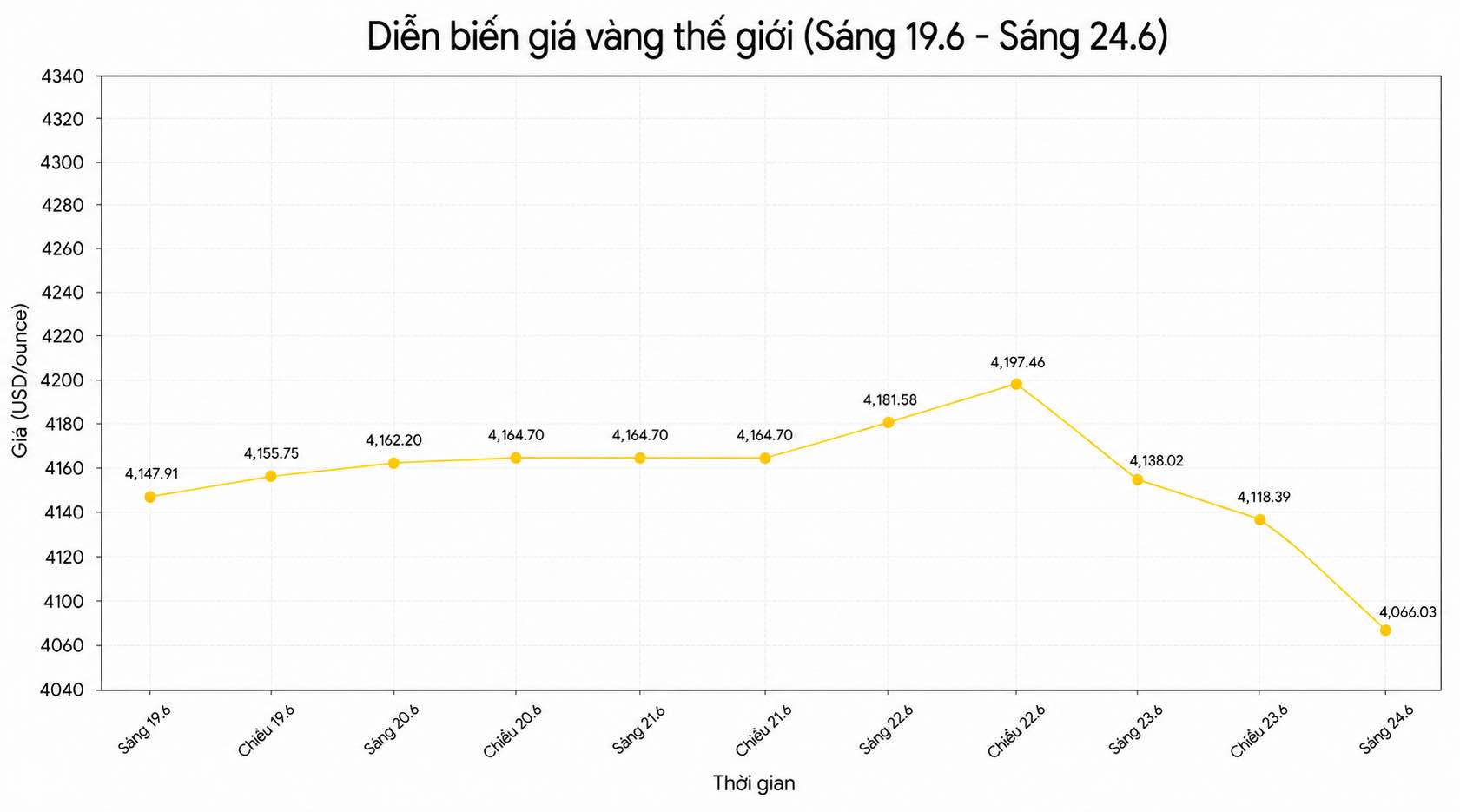
Gold's decline took place in the context of increasing volatility in global financial markets. US government bonds rose in the session on June 24, while the USD strength index rose 0.4%.
The strengthening USD makes gold more expensive for investors holding other currencies, thereby reducing buying demand.
Although often considered a safe haven asset, gold tends to decrease in price in strong sell-offs on many markets because this is one of the assets with high liquidity, easily convertible into cash to compensate for losses in other investment portfolios.
Cautious sentiment continued to spread in Asian markets on June 25 as investors worried that the prolonged upward momentum of technology stocks, especially businesses benefiting from the artificial intelligence (AI) wave, may have gone too far from the basic foundation.
Pressure from the stock market appeared in the context that gold has already suffered many disadvantages from the prospects of US monetary policy.
Investors are increasingly concerned that inflation risks are still present, forcing the US Federal Reserve (Fed) to maintain a tough stance and may continue to raise interest rates in the near future.
The "hawkish" statements of new Fed Chairman Kevin Warsh at a recent policy meeting have caused the market to sharply adjust expectations about interest rates, thereby overshadowing the positive impact of the temporary peace agreement between the US and Iran signed last week.
Higher interest rates increase the opportunity cost of holding gold and other precious metals because these are non-performing assets.
On the other precious metal market, silver prices fell 1.1% to 60.86 USD/ounce.
Platinum and palladium prices also simultaneously went down.
Meanwhile, the Bloomberg Dollar Spot Index – a measure of the strength of the USD against a basket of major currencies – remained almost unchanged after rising sharply in the previous session.
The market is currently focusing its attention on important US economic data, especially the Personal Consumption Price Index (PCE), to assess whether inflationary pressure will continue to be maintained and how it will affect the Fed's policy roadmap in the coming months.


