
Creating invoices when selling goods and providing services
Based on Clause 1, Article 4 of Decree 123/2020/ND-CP (amended and supplemented in Decree 70/2025/ND-CP), the principle of invoice issuance is clearly defined:
When selling goods and providing services, sellers must prepare invoices to hand over to buyers, regardless of the type of business or household business, and regardless of the scale of revenue.
According to this regulation, business households with revenue of less than 500 million VND/year when selling goods and providing services still have to prepare invoices to deliver to customers, including in cases of: Promotions, advertising, sample goods; Giving, giving away, giving away; Paying for salary; Internal consumption (except for internally circulated goods serving production)
One note is that households with revenue of less than 500 million VND/year are not required to use electronic invoices generated from cash calculators.
Business households and individuals doing business with revenue from 1 billion VND/year or more; Operating in the fields of retail, food, restaurants, hotels, passenger transport, entertainment, personal service... are required to use electronic invoices generated from money calculators connected to tax authorities (According to Article 11 of Decree 123/2020/ND-CP (amended and supplemented in Decree 70/2025/ND-CP)
Invoice types
Invoices are accounting documents prepared by organizations and individuals selling goods and providing services to record goods sales information and provide services to customers. Invoices are expressed in the form of electronic invoices or invoices ordered and printed by tax authorities.
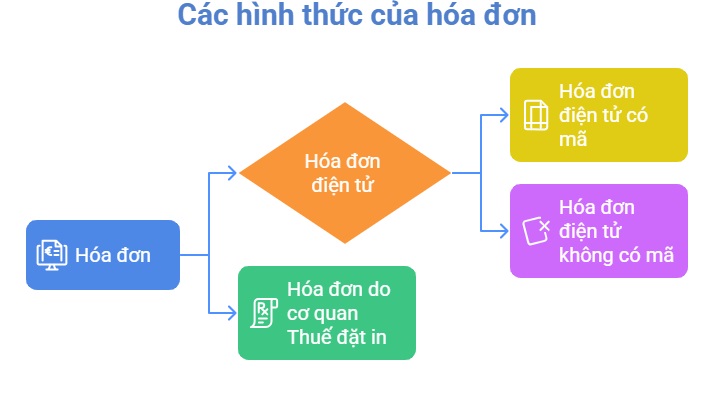
According to Article 8, Decree 123/2020/ND-CP supplemented by Point c, Clause 5, Article 1 of Decree 70/2025/ND-CP, invoices in Vietnam are divided into the following types:
- Value Added Invoice (VAT Invoice)
VAT invoices are for organizations declaring taxes by deduction method when carrying out activities of selling goods, providing domestic services, international transportation, exporting goods, providing services abroad or exporting into non-tariff zones and cases considered as exports, e-commerce business activities, digital platform-based business and other services of suppliers abroad without a permanent establishment in our country.
This is an important invoice in the VAT system, helping businesses declare and deduct input tax. When issuing invoices, businesses must clearly state the VAT rate (8% or 10% depending on the item) and the total VAT amount to be paid.
This invoice must have complete information about the seller, buyer, goods/services, payment amount, seller's digital signature and factors as prescribed by law.
- Sales invoice
Sales invoices are used by organizations and individuals to declare taxes in a direct way, including sales activities, domestic service provision, international transportation, export of goods, service provision abroad and export into the non-tariff zone.
Sales invoices do not have a separate VAT line because taxes have been included in the selling price. This is a common type of invoice for small businesses, individual business households, and units calculating taxes by direct method.
Businesses using sales invoices are not allowed to deduct input VAT as when using VAT invoices.
- E-commerce bill
Based on Point c, Clause 5, Article 1 of Decree 70/2025/ND-CP supplementing Article 8 of Decree 123/ND-CP supplementing the type of e-commerce invoice. This is an invoice applied to organizations, businesses or individuals (exporters) who export goods and services abroad and meet the conditions for transferring commercial invoice data by electronic means to the tax authority. E-commerce invoices meet the content regulations and formatting regulations according to the provisions of Articles 10, 12 of Decree 123/2020/ND-CP.
In case the exporter does not meet the conditions for transferring commercial invoice data electronically to the Tax authority, the exporter can choose to prepare an electronic VAT invoice or an electronic sales invoice.
- Electronic invoices for sale of public assets
Based on the regulations amended by Point d, Clause 5, Article 1 of Decree 70/2025/ND-CP, this electronic invoice for sale of public assets is used when selling or transferring public assets in accordance with the provisions of law on management and use of public assets.
- Electronic invoices for national reserve sales
Electronic invoices for the sale of national reserve goods are used when agencies and units under the system of state reserve agencies carry out the sale of goods belonging to national reserves in accordance with the law.
Electronic invoices for the sale of national reserves help ensure strict management of goods exports from the national reserve, transparency in transactions related to reserves. The use of these invoices is in accordance with the guidance of the Ministry of Finance to ensure legality.
- Other invoices
Some specific areas use separate types of invoices, including: stamps, tickets, cards, air freight bills, international freight fee collection documents, bank service fee collection documents.
These types of invoices have forms and content according to the provisions of law and international practices. They are designed to suit each industry, helping businesses and functional agencies easily manage related financial transactions.
- Documents are managed as invoices
Some documents are issued and managed as invoices to serve the internal operations of the enterprise, including warehouse clearance slips for internal transportation and warehouse clearance slips for agent sales.
These documents do not replace VAT invoices or sales invoices but are only used to track the circulation of goods. They help businesses control the process of transporting goods between warehouses, branches or agents without incurring immediate tax obligations.
Invoice forms
According to Article 3 of Decree 123/2020/ND-CP, invoices are expressed in two main forms: electronic invoices and invoices printed by the Tax authority. The selection of appropriate invoice forms depends on the type of enterprise and the provisions of law.
- Electronic invoice
Electronic invoices are the most common form of invoices today, initiated, created, sent, received, stored and managed by electronic means.
According to the provisions of Decree 123, from July 1, 2022, all businesses, economic organizations, and business households must use electronic invoices to completely replace paper invoices.
- Invoice is printed by the Tax authority
Invoices ordered for printing by tax authorities are invoices expressed in paper ordered for printing by tax authorities to be sold to organizations and individuals who are eligible and eligible to purchase invoices from tax authorities according to regulations for use when selling goods and providing services.
Violations of invoice regulations will be penalized
The Government has just issued Decree No. 310/2025/ND-CP amending and supplementing a number of articles of Decree No. 125/2020/ND-CP dated October 19, 2020 of the Government stipulating penalties for administrative violations related to taxes and invoices.
This Decree has many new points, detailing the principles and penalties, especially for violations of invoices.
The act of not making invoices as prescribed shall be fined from a warning to a maximum of 80 million VND (see more HERE)
The fine for business households for making invoices at the wrong time can be up to 70 million VND (See more HERE)
It's a bit of a bit of a bit of a bit of a bit of a bit.


