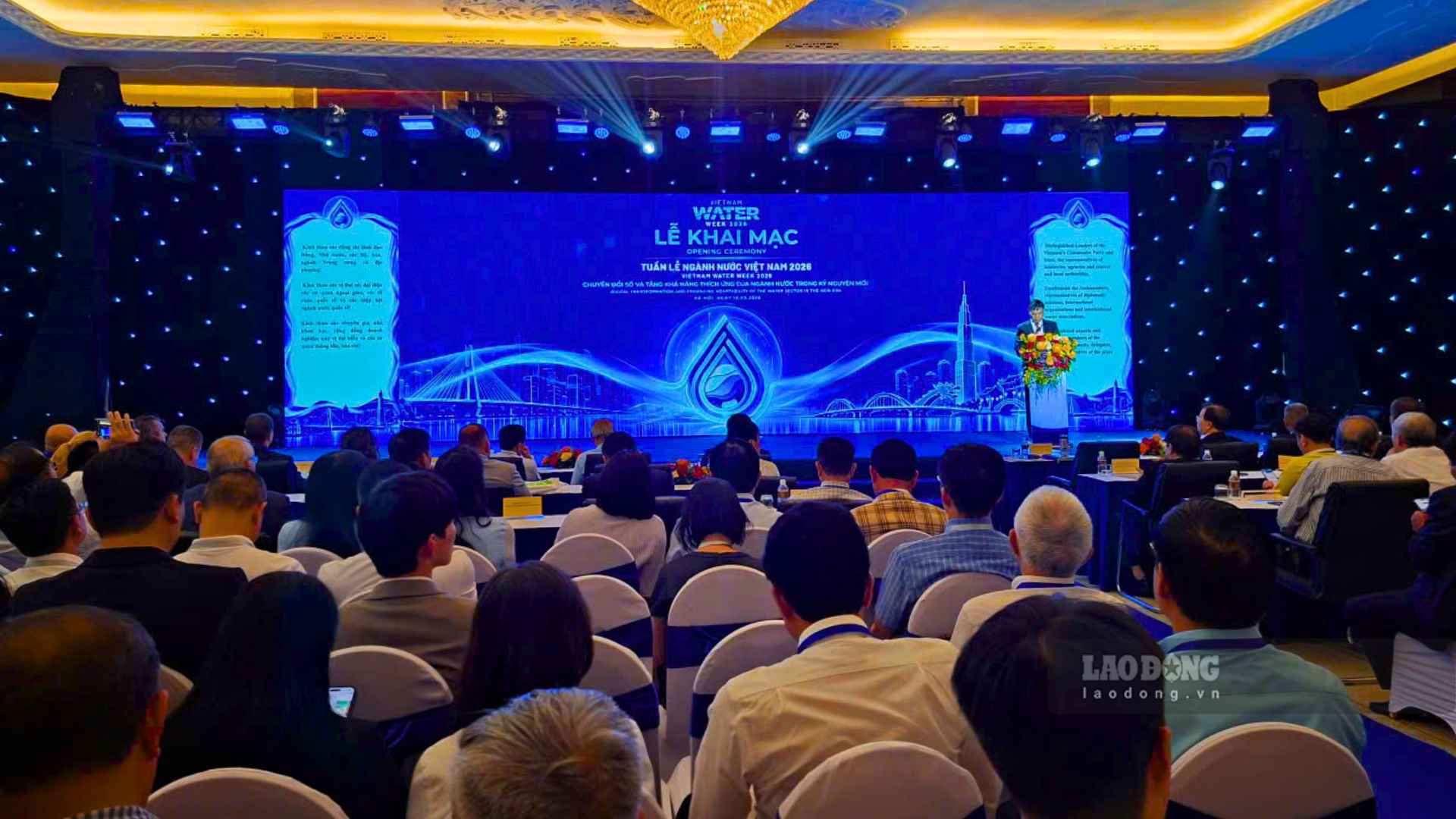
On September 16, the Vietnam Water Supply and Discharge Association (VWSA) held the Opening Ceremony of Vietnam Water Week 2026 at the Vietnam-Soviet Friendship Labor Culture Palace, 91 Tran Hung Dao, Hanoi.
Speaking at the opening ceremony, Mr. Bui Xuan Dung - Deputy Minister of Construction said that in the current period, the requirement for the water sector is not only to continue investing and completing infrastructure but also to improve service quality, management efficiency, ensure safe, continuous operation and proactively adapt to increasing risks.
According to Deputy Minister Bui Xuan Dung, for the water sector, digitization needs to be directly linked to asset management needs, forecasting water demand, controlling losses, optimizing energy, monitoring water quality, warning of incidents and improving service quality for people. Along with technology investment, it is necessary to focus on standardizing data, connectivity between systems, information security and network security, ensuring technology truly effectively supports management and production, and business.
Besides digital transformation, adaptability needs to be considered throughout from planning, investment preparation, design, construction to operation management. For water supply, it is necessary to pay more attention to source safety, contingency and connectivity, mutual support between systems. For drainage, it is necessary to approach according to basins, associated with ground elevation, irrigation systems, rivers and lakes, rainwater storage and regulation space, suitable to the specific conditions of each city and locality.
To implement the above requirements, investment resources are a very important issue. Besides state resources, it is necessary to continue to improve mechanisms to effectively mobilize social resources, promote the role of the private sector, public-private partnerships, green finance and other legal capital sources," Deputy Minister Dung said.
Before the new requirements, Deputy Minister Bui Xuan Dung wished agencies, localities, businesses and water sector partners to focus on a number of key tasks.
First, continue to improve the quality and continuity of water supply and drainage services; strengthen risk management, ensure safe water supply; gradually improve the efficiency of wastewater collection and treatment and flood control in accordance with the conditions of each locality.
Second, promote digitization, standardization of specialized databases and application of technology suitable to actual needs.
Third, improve the adaptability of water supply and drainage infrastructure to climate change and water source risks.
Fourth, diversify and effectively use investment resources; strengthen public-private partnerships, international cooperation, research, technology transfer and high-quality human resource development.
According to Dr. Nguyen Ngoc Diep - Chairman of the Vietnam Water Supply and Drainage Association, digital transformation in the water sector is not simply investing in more software or equipment. The core of digital transformation is to use data to better manage, forecast earlier, reduce losses and energy consumption, control water quality more closely and serve people more conveniently. Technology only has real value when it solves practical problems.
Along with digital transformation, adaptability must become a consistent requirement in planning, investment and operation. Each locality, each business needs to be proactive in the face of drought, saltwater intrusion, water source pollution, flooding and emergencies; ensuring essential services are maintained safely and continuously in all circumstances," Dr. Nguyen Ngoc Diep emphasized.
Vietnam Water Sector Week, taking place from September 16-18, 2026 with the theme "Digital Transformation - Enhancing the adaptability of the Water sector in the new era", the event officially opens a series of professional activities, exhibitions and focal point and prestigious cooperation connections of the Vietnam Water sector every year.
The Vietnam Water Industry Week exhibition area is nearly 4,000 m2 wide, gathering 180 organizations and businesses with 250 booths, along with the participation of organizations, businesses, experts and partners from 20 countries and territories.