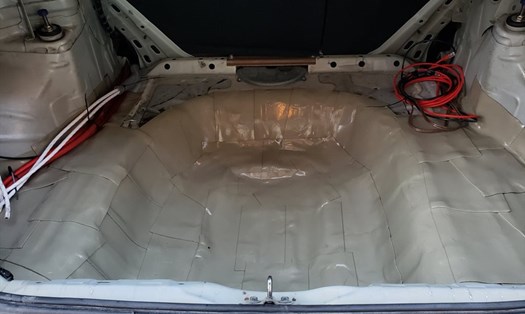
Many car owners choose to paste soundproofing materials to reduce noise, but the actual effectiveness depends on the sound source, treatment location and type of material used.
According to advice from the Ninety Eight Auto Repair, Maintenance and Care Center (Cat Lai ward, Ho Chi Minh City), one of the commonly handled locations is the inside of car tire panels such as doors, floors or luggage compartments.
When the metal plate vibrates, it can create or transmit sound into the cabin compartment. Shock absorbers pasted on the surface can limit the vibration of the metal plate, thereby reducing part of the noise and vibration.
However, it is necessary to distinguish between shock-absorbing materials, soundproofing materials and noise-canceling materials. Shock-absorbing materials mainly limit the vibration of the structure; soundproofing materials have the effect of preventing sound transmission through the structure; while noise-canceling materials help absorb sound energy in the space. Therefore, it is not necessary to just apply more materials to make the cabin quieter.
For car floors, the construction process also needs special attention. To handle this area, in many cases, seats, carpets and some interior details must be removed. If the material is not suitable, the glue is not guaranteed, or the construction is not technically correct, water and moisture may be trapped under the material layer.
The car floor may be in contact with water from shoes, moisture, water leaking in due to leaks, or in cases where the car is flooded. If this area is not dried and checked properly, long-term moisture accumulation can create conditions for mold and corrosion of metal.
However, this risk mainly appears when materials are inappropriate, construction is not technically correct, obscures the drainage position or affects the original corrosion-resistant protective layer of the vehicle.
In addition, car noise does not only come from one source. Noise can arise from tires and road surfaces, engines, powertrains, suspensions, undercarriage, wind or vibration of the body. Therefore, if only one area is handled, the overall cabin improvement may be insignificant.
The effectiveness of the material also depends on the sound characteristics to be processed. Some materials have good vibration reduction in certain frequency ranges, while sound-absorbing materials are suitable for other purposes.
After processing, the sound spectrum in the cabin may change because some noise components are reduced more than others.
Some modern cars also use active noise reduction technology. The system uses a microphone and controller to create appropriate sound signals, reducing some noise sources in the cabin, similar to the principle of active noise reduction on headphones. This technology is often effective with relatively stable noise sources, but cannot eliminate all noise.
Therefore, before spending a lot of money to soundproof the entire car, car owners should identify the source of noise and choose the appropriate option. Intervening too much not only increases the car's weight but can also generate risks if dismantling, handling, anti-humidity and anti-corrosion are not done technically correctly.