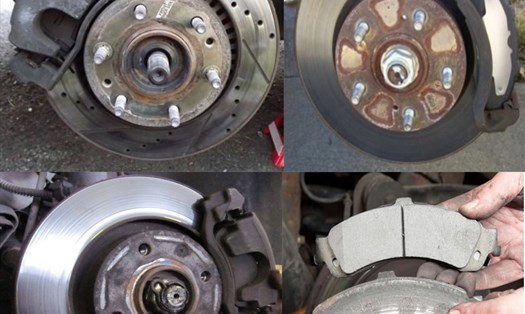
According to Mr. Tran Minh Tien - lecturer of Automotive Technology, Dung Quat College of Technology (Quang Ngai), brake pads are wearable parts during braking and need to be checked periodically.
There is no fixed mileage mark applied to all vehicles. Vehicles that regularly travel in urban areas, having to brake and stop continuously, can cause brake pads to wear out faster than vehicles mainly running on highways.
Some basic signs on the brake pads such as the car brand logo, product code, manufacturer information and clear, sharp technical symbols can help users identify and compare whether the product is genuine or not.
The friction material of the brake pad is designed according to each product, usually a mixture of many components. Including lead, adhesives, and metals.
If the metal content is too high, it may indicate that the brake pad quality is not really good," Mr. Tien said.
Also according to Mr. Tien, in some cases, magnets can be used as a reference test to check the presence of iron material on the brake pad surface. If the friction material contains iron or metal components with high magnetic properties, the magnet can create attraction at a certain level.
Poor quality brake pads often have higher metal content. When the amount of metal exceeds the allowed level, brake pads can cause brake discs to wear faster," Mr. Tien analyzed.
To check, Mr. Tien instructed users to use a small magnet, insert it close to the friction tip of the brake pad. If the magnet does not attract or the attraction force is very weak, it may show that the amount of magnetic metal in the brake pad is not high.
Conversely, if the magnet attracts strongly and clings to the friction chamber surface, this may indicate that the brake pad contains a higher magnetic metal content.
Mr. Tien also pointed out that when changing brake pads, car owners should prioritize products with clear origins, correct spare parts codes for each car model and purchase them at reputable dealers or repair facilities.
More importantly, technicians need to check both the inner and outer brake pads, because both sides may be unevenly worn if the brake caliper, piston or slider have problems. At the same time, it is necessary to check the thickness of the brake pads, surface condition and brake disc thickness according to the manufacturer's limits.
Periodic inspection and proper use of spare parts help maintain braking efficiency, limit abnormal wear and ensure safety during operation.