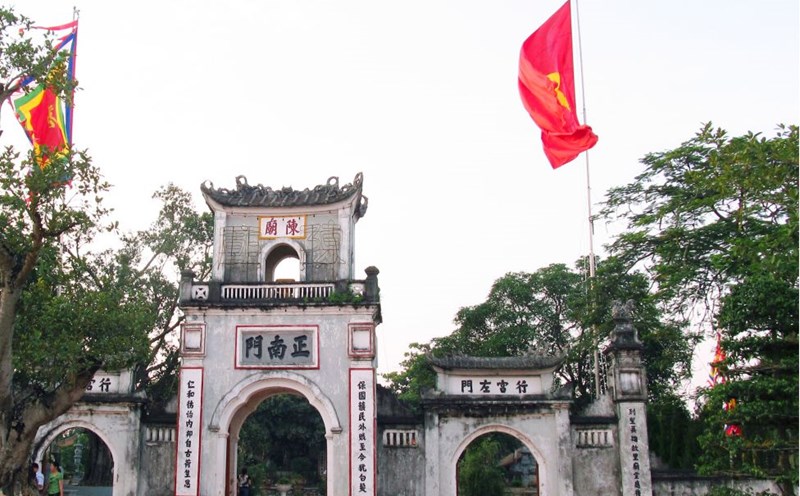
From the boy Dam Xa to the National Master of the Ly Dynasty
Saint Nguyen, whose real name is Nguyen Chi Thanh, was born in 1065 in Diem Xa village. He was a real historical figure, lived under the Ly Dynasty, and was one of the leading monks in the monks and nuns of that time.
Legend has it that Nguyen Chi Thanh was intelligent from a young age, eager to learn and had great ambition. After practicing the Dharma, he took the Dharma name Minh Khong. His life was associated with many great contributions to national history in all 3 aspects: Buddhism, Medicine and Economics.
Regarding Buddhism, he went to many places to build pagodas, paint statues, cast bells, contributing to revitalizing Buddhism during the Ly Dynasty. History books record that he built up to 500 pagodas.
In medicine, his greatest merit recorded in the "Dai Viet Su Ky Toan Thu" is the miraculous cure of the disease of "tiger transformation" for King Ly Than Tong in 1136.
Thanks to this merit, he was conferred the title of National Master (master of the whole country) by the king, was given fortune to eat for several hundred households, and was exempted from personal tax. In terms of economy and culture, he was honored as the ancestor of the bronze casting profession in Vietnam.
After he passed away in 1141, to commemorate his great merits, the people built a temple right on the foundation of Vien Quang Pagoda (Vien Quang Pagoda) built by him in 1121. That is Duc Thanh Nguyen Temple today.
Landmark location and sacred feng shui
Duc Thanh Nguyen Temple is located on a land plot 100m long, more than 40m wide, located right on the old foundation of the ancient Vien Quang Pagoda. According to feng shui theory, the temple is built in the South direction, overlooking the winding Hoang Long River. This is the land formation "Tua son dap thuy" (back leaning on the mountain, feet stepping on the water), bringing stability and prosperity.
Looking from afar, the temple appears with a majesty but ancient appearance, hidden under the canopy of hundred-year-old ancient trees, creating a peaceful space, completely separate from the noise of the city. This location is not only convenient for waterway traffic in the old days but also located in the expanded Hoa Lu Ancient Capital Relic Complex, creating a seamless spiritual cultural connection.
What makes the core value of Duc Thanh Nguyen Temple is architecture. Unlike many temples restored with modern reinforced concrete, Thanh Nguyen Temple still retains almost intact wooden architecture from the Later Le Dynasty (17th - 18th centuries) and the Nguyen Dynasty.
The entire building is designed in the style of "Noi cong ngoai quoc" - a traditional court architecture style, forming a "Cong" shape inside and is surrounded by a "Quoc" shape frame outside.
The first highlight when entering the temple is Vong Lau (bell gate) built right next to the Hoang Long River bank. However, the main architecture starts from the outer Nghi Mon and inner Nghi Mon. Passing through the ancient Bat Trang tiled dragon courtyard is the main worship area. On both sides of the courtyard are two Vong Vu rows, where officials used to prepare costumes before entering the holy ceremony.
Tien Duong Tower (Bai Duong) consists of 5 compartments, a place that converges the quintessence of 17th-century wood carving art. Ancient artisans breathed soul into each wooden fiber, turning bars, levers, lines, and columns into vivid paintings. The main decorative themes are "Four Spirits" (Long, Ly, Quy, Phuong) and "Four Preciousnesses" (Tung, Cuc, Truc, Mai).
Connecting Tien Duong and Chinh Tam is Thieu Huong tower (water pipe), where incense offerings and solemn worship items are placed. The space here is quiet, incense smoke billowing, creating a feeling of sacred mystery.
Chinh Tam is the most important place, placing a statue to worship Saint Nguyen. The statue is carved with precious agarwood, the size is almost the size of a real person, depicting the portrait of Saint Nguyen in a meditative position. His face is compassionate, his eyes are bright, exuding the wisdom of a high-ranking monk who is righteous.
Behind the statue of Duc Thanh Nguyen are articles of worship for his parents and ancestors, expressing the nation's morality of "When drinking water, remember the source". In addition, the temple also preserves many precious artifacts such as: Sac phong of feudal dynasties (Le, Tay Son, Nguyen), stone steles, bronze bells and ancient ritual items. Especially the pair of stone sau (nghe da) worshiped in front of the temple gate and the pair of stone elephants worshiping, imbued with the artistic style of the Le Trung Hung era, both brave and lively.
Every year, from the 8th to the 10th day of the 3rd lunar month, local people jubilantly organize the Nguyen Temple Festival. This is one of the largest festivals in Ninh Binh province, attracting tens of thousands of pilgrims.
The highlight is the procession of water from the Hoang Long River to the temple to worship Saints. The procession with flags covering the sky, gongs and drums resounding, headed by lion dance and dragon dance teams, followed by a palanquin Bat Cong carrying water. This ritual expresses the wish for favorable weather and bumper crops of rice farmers. In addition, there is also the Sac Khuc ceremony and the Nam Quan and Nu Quan ceremony solemnly performed according to ancient royal court rituals.
Besides familiar folk games such as human chess, tom diem, tug of war, wrestling, the most unique feature of the Nguyen Temple Festival is the custom of "running the zither" dance and the cheo performance "The King's Master Cures King's Diseases". This play recreates the event of National Master Nguyen Minh Khong curing diseases and transforming into a tiger for King Ly Than Tong, thereby educating children and grandchildren about the talent and virtue of the Saint, and praising medical ethics and compassion.
Having gone through nearly a millennium with many ups and downs of history and the harshness of time, Duc Thanh Nguyen Temple still majestically shines down on the Hoang Long Giang River. The temple is not only the pride of Ninh Binh people but also a precious heritage of the entire nation.
Preserving and promoting the value of Duc Thanh Nguyen Temple is the responsibility of today's generation, so that the stories about the talented National Master, about the exquisite wood carving art and festivals imbued with national identity will be forever passed down, like the Hoang Long River still diligently flowing into the great sea.
Duc Thanh Nguyen Temple is not only a place for religious activities but also a vivid "museum" of history and art. In 1989, the temple was ranked by the Ministry of Culture and Information (now the Ministry of Culture, Sports and Tourism) as a National Historical, Architectural and Art Relic. Currently, the temple is located in the buffer zone of Trang An Scenic Landscape Complex - a World Cultural and Natural Heritage recognized by UNESCO.
It's a bit of a bit of a bit of a bit of a bit of a bit.
It's a bit of a bit of a bit of a bit of a bit of a bit.