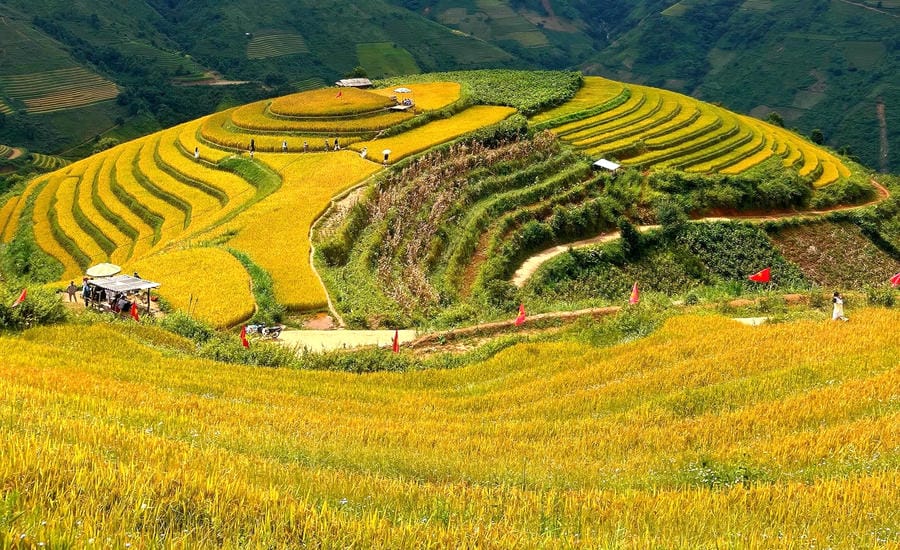
Ngoc Chien, the rice season passes through each village
The morning in Ngoc Chien begins with the sound of rice threshers. In the fields in Luot, Muong Chien, Na Tau, Phay, Ke villages, people go to the fields early. Rice is cut, threshed, and packed in bags; straw is collected, and new rice is spread under the sun.
In Ke village, Mr. Sung A Ki just harvested more than 2 tons of ordinary rice. "Wherever the rice is ripe, take advantage of harvesting it. Dry it and then bring it home for preservation. Whichever house finishes first, go help another house" - Mr. Sung A Ki said.
The harvest season is therefore not just a private matter of each family. In these days, the pace of labor is also the time when people meet more often, share work and experience, from choosing harvest time to drying and preserving rice after harvest. People with strength contribute, people with machines support machines, and take the fields to the end of the crop one by one.
Ngoc Chien currently has more than 650ha of rice, concentrated in Luot, Muong Chien, Na Tau, Giang Phong and Ke villages. Plain rice usually ripens first, while sticky rice - a specialty rice variety preserved through many generations - usually stands in the field for another 10-15 days.
Mr. Lo Van Thoa - Vice Chairman of Ngoc Chien Commune People's Committee said that each crop, the whole commune harvests about 7,500 tons of rice of all kinds, mainly sticky rice.
For the Thai people in Ngoc Chien, rice is not only a product of the fields. When new sticky rice comes home, new rice is cooked, sticky rice is cooked, young rice flakes are made; new rice celebration rituals also begin. That is the occasion for people to thank heaven and earth, remember their ancestors and meet the community.
From rice grains, the crop season is therefore extended to the story of culture and life. Since then, specialty rice varieties have not only brought production value but have become a part of the community's memory.
Xim Vang, terraced fields on the mountainside
If the harvest season in Ngoc Chien is spread in valleys and fields along streams, then in Xim Vang, rice is sown on the curves of the mountains.
At an altitude of nearly 1,500m, the villages of Song Chong, Xim Vang, Hang Cho, and Trong Tau enter the ripe rice season. Terraced fields follow each other along the mountainside, where they are already golden, where they are still green, forming layers of color that change according to the ripening of the rice.
But terraced fields here are not just landscapes. That is the achievement of many generations of H'Mong people who reclaimed soil and rocks, built embankments, led water and kept soil on the high mountainsides.
According to Mr. Nguyen Xuan Bac - Chairman of the People's Committee of Xim Vang commune, the whole commune currently has over 320ha of rice fields, concentrated in Song Chong, Hang Cho and Xim Vang. The reclamation and investment in a water drainage ditch system help the production area gradually expand.
In Hang Cho village, nearly 70 hectares of terraced fields are in ripe season. Ms. Hang Thi Se's family has 1.5 hectares of rice. For farmers, the golden season is first and foremost the season of labor.
This year, the irrigation water is abundant, and the rice is developing well. People are focusing manpower to harvest. If customers come, we can introduce how to harvest, break rice and people's jobs" - Ms. Se shared.
From familiar jobs, Xim Vang brings a part of the harvest season into experiential activities. Visitors can hold a sickle to harvest rice, smash rice, play bamboo shooters, crossbow shooting, enjoy cuisine and learn about the life of the H'Mong people.
It is worth mentioning that those experiences do not need a pre-built space. Fields are still fields, rice is still harvested, and paddy is still followed by people to their homes. There, the beauty of the golden season is inseparable from life. What tourists see on the mountainside is also the result of labor, of the way people keep land, keep water and pass on production experience.
When the golden season of highlands becomes a tourism story
The golden season in Son La is not only Ngoc Chien and Xim Vang. From Muong La, Song Ma, Sop Cop, Yen Chau, Van Ho to many other highlands, the ripe rice season creates a unique landscape season.
But if tourists only come to take photos and then leave, the value of the golden season stops at the scenery. Localities are aiming to link the harvest season with life experiences, so that tourists stay longer and people have more opportunities to create livelihoods.
In Ngoc Chien, the journey can start from the field, connecting to the story of sticky rice, new rice, sticky rice, young rice flakes and stilt house life. In Xim Vang, visitors can learn about terraced fields, how the H'Mong people cultivate on the mountainside, participate in some seasonal work and enjoy local cuisine.
At that time, tourism is not outside of agriculture but goes with agriculture: Fields create products, people create products, culture creates stories and tourism connects those values with tourists.
During a trip to Xim Vang, Ms. Nguyen Thi Minh Thu, a tourist from Hanoi, was impressed not only with the terraced fields but also with the harvest season atmosphere.
Standing in the middle of the rice field, watching people harvest and doing some work myself makes the trip closer" - Ms. Thu shared.
Golden season can therefore become a part of tourism livelihoods in the highlands. However, development needs to go hand in hand with infrastructure, services, environmental sanitation and respect for community rhythm. More importantly, it is necessary to preserve the original values: sticky rice variety, processing method, new rice celebration rituals in Ngoc Chien; terraced fields preserved through many generations in Xim Vang.
After each golden season, what is worth keeping is not only the photos, but also the grains of rice, customs and community life that make up the landscape of the highlands.