
When Tim Cook concluded his opening speech at WWDC 2026 in Apple Park, it was not simply the conclusion of an annual technology event. Shortly after, Apple confirmed that John Ternus - Senior Vice President of Hardware Engineering, would take over the CEO position from September, turning WWDC 2026 into Tim Cook's last major product launch as head of the corporation.
Since taking over the leadership role from Steve Jobs in August 2011, Tim Cook has steered Apple for 15 years. Under his leadership, the company expanded its product portfolio with Apple Watch, AirPods, Apple Pay, strongly developed services such as Apple Music and iCloud, and promoted a strategy of self-developing silicon chips. Apple also became the first company to reach a market capitalization of 1 trillion USD in 2018, then surpassed the 3 trillion USD mark and reached the threshold of 4 trillion USD in 2025.
However, Tim Cook's farewell moment took place in the context that Apple is facing one of the biggest challenges in many years: the artificial intelligence race. Therefore, WWDC 2026 is both an opportunity to look back at the legacy of the veteran CEO and a time for the market to assess Apple's adaptability to the new technology wave.
Apple CEO's farewell
The central character of WWDC 2026 is the new generation Apple Intelligence. On stage, Tim Cook introduced an AI architecture called Apple Foundation, built on a platform connecting devices, local cloud computing and public cloud systems.
The most notable point is that Apple for the first time brought Google Gemini into its AI ecosystem through a relationship described as "deep cooperation". This decision shows a change in Apple's artificial intelligence development strategy. Instead of continuing to pursue the ambition to build a completely independent AI system as proposed in 2024, the company chose to partner with partners to compensate for the limitations of the model platform.
Apple still emphasizes the overall design control of the Apple Foundation, while reaffirming that its own cloud system can be verified by external organizations to ensure data security. The company's new focus is no longer the race to develop an AI model from scratch but to create a seamless product experience based on the strength of integrating hardware and software.
Tim Cook's last moment on stage was also more personal than usual. In the pre-recorded video, Apple spent two minutes for this CEO to share his feelings and look back on his leadership journey. He called this one of the most glorious moments in his term.
Looking back over the past 15 years, Tim Cook has turned Apple into a business with outstanding profitability, possessing strong cash flow and a solid ecosystem. He also became the CEO with the longest term in office in the company's history. Although not associated with iconic product revolutions like the time of Steve Jobs, Tim Cook is recognized as the person who turned Apple into an efficient operating machine with an unprecedented global scale.
Questions for the apple family's future
However, Tim Cook's farewell did not completely take place in a winning atmosphere. Apple Intelligence is still the most controversial topic after WWDC 2026.
According to Dan Newman - CEO of The Futurum Group, this is one of the notable weaknesses of Tim Cook's term. He believes that Apple has had the opportunity to prove its ability to take advantage of the advantages of billions of users and convince software developers about Siri's future. However, what was presented was assessed as not creating a clear breakthrough.
Apple introduced Siri AI with the ability to communicate context-based, check schedules, access data from applications and support users in calls. However, many features are said to be similar to technologies that have appeared on Google products. Visual Intelligence features and context-based search capabilities are also compared to existing solutions.
Market reaction shows caution. After the AI announcements, Apple shares fell by about 4%. Analyst Gene Munster said that the reason stems from the fact that many promises have not yet been fulfilled.
As John Ternus prepares to take over as CEO, he will face a series of challenges. The iPhone upgrade cycle is lengthening, AI is changing the way people interact with technology and legal pressure on the App Store is increasing in Europe and America. After 15 years under Tim Cook, the biggest question is no longer how successful Apple has been, but where the company will find the next growth momentum in the AI era.
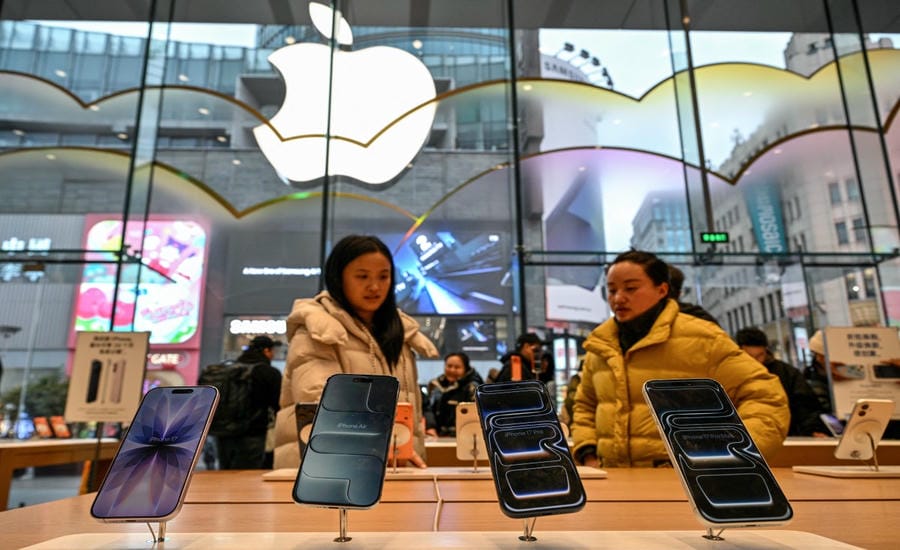
After 15 years, the responsibility of deciphering a series of Apple's thorny problems is now placed on John Ternus's shoulders, and the answer will soon be revealed at the iPhone launch event taking place in the next 3 months.
Investors rewarded Apple's global expansion and stable performance under Tim Cook with record valuations. Driven by the popularity of the iPhone and the growth in its services, in 2018, Apple became the first company to reach a market capitalization of 1 trillion USD.


