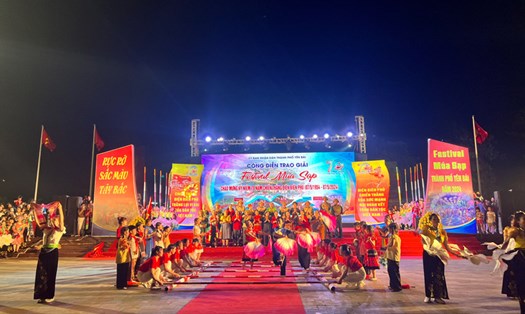
Bamboo whistling in the middle of the village festival season
The Thai people in Son La have a saying: "Muong village joyfully welcomes Spring, girls and boys dance sap dancing excitedly on the yard". That simple saying vividly depicts the position of sap dancing in the spiritual life of the people. Not simply a cultural activity, sap dancing is also a symbol of joy, connection and aspiration for a prosperous and happy life.
According to folk artisans, sap dance originated from the working life of the Thai people. Familiar bamboo and rattan trees in daily life are created by people into performance props. Over time, from a form of community entertainment, sap dance gradually became a unique cultural feature that is indispensable in traditional festivals.
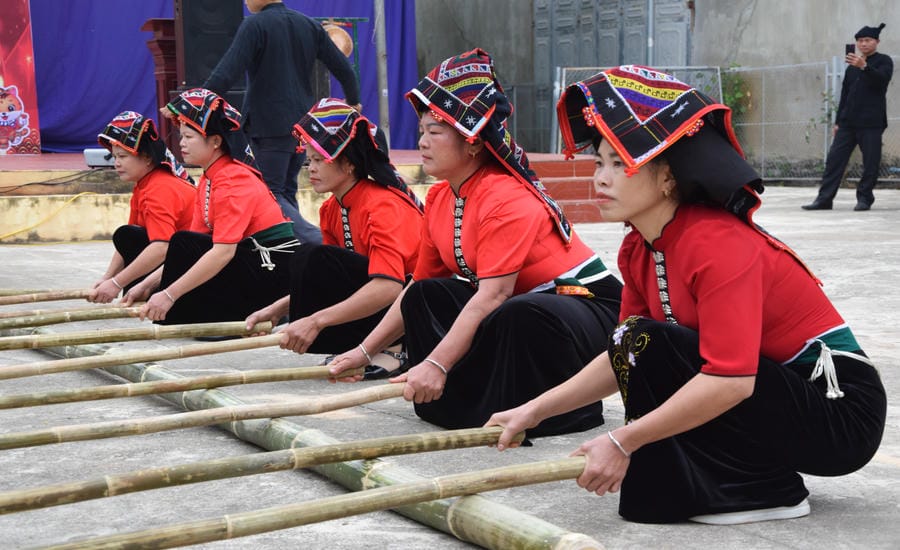
To prepare for a bamboo pole dance performance, people use two main bamboo poles placed parallel as supports, above are pairs of bamboo or bamboo small poles arranged perpendicularly. Participants are divided into two groups, one group sits on both sides performing the task of tapping the poles in a unified rhythm, the other group directly dances on the poles.
The sound of bamboo hitting each other creates a pleasant sound, sometimes leisurely, sometimes urgently. The dancer must observe the opening and closing rhythm of the bamboo sticks to steer accurately, avoiding being clampped by clams. From simple dance steps, the performer can transform into many formations such as vertical jump, horizontal jump, diagonal jump or create circles, bringing attractiveness to viewers.
To add softness, Thai girls often combine Piêu scarf or fan dances during performances. In traditional costumes with cóm shirts, black skirts and the characteristic Piêu scarf, rhythmic steps on the stalls create a rich cultural picture of the Northwest mountains and forests.
Sạp dance - a dance of connection and transmission
The special feature of bamboo dance is that there are no age limits or participants. From the elderly, young people to young children, everyone can immerse themselves in the joyful rhythm of bamboo. This is what has helped this type of folk art become a bridge connecting the community through many generations.
Mr. Lu Van Thanh, from Tum village, Yen Chau commune, said that bamboo dance has long become a familiar cultural activity of the Thai people during festivals, weddings, housewarmings or happy days of the village.
Every time the sound of bamboo poles echoes, people gather together. People who know how to dance perform, people who do not know how to be guided to participate together. Bamboo pole dance not only brings joy but also helps people become more attached, united and proud of their national cultural identity," Mr. Thanh shared.
According to Mr. Thanh, in the past, bamboo dance did not have background music like now. Participants both tapped bamboo and sang folk tunes of the Thai ethnic group. Today, although modern music is added to create a vibrant atmosphere, the core values of the dance are still preserved intact.
Not only is it a community cultural activity, sạp dance is also a place to send deep humanistic values. In the bustling sound of sạp, boys and girls have the opportunity to meet, exchange, and learn about each other. The graceful steps on the sạp display show the dexterity, optimism, and love of life of the Thai people.
Today, the teaching of sạp dance to the younger generation is still maintained by many families and communities. Children growing up in the sound of khen, drums and sạp beats have early become familiar with the traditional dances of their ethnic groups.
Lo Thi Bich Thuy, from Gian village, Muong Bu commune, said that since 2nd and 3rd grade, she has followed grandmothers and mothers to learn sạp dance in the village yard. Initially, she was still unfamiliar, but thanks to guidance, she gradually became proficient and loved the traditional dance of her ethnic group.
Currently, Thuy regularly participates in cultural activities of the school and the locality. "Sạp dance helps me understand more about Thai ethnic culture. I hope this dance will continue to be preserved and passed down to future generations," Thuy shared.
Preserving the soul of Thai culture amidst modern life
Along with the development of social life, bamboo dance still maintains strong vitality in the Thai community in Son La. From urban areas to remote areas, bamboo dance is always present in traditional festivals, cultural festivals of ethnic groups and community exchange programs.
In recent years, many schools in Son La have incorporated sạp dance into extracurricular activities and arts, contributing to helping students understand and be more proud of national culture.
Lo Thi Lan, a student at Son La Provincial Ethnic Boarding School, shared: "I regularly participate in sạp dance in school arts activities. Through practice sessions, I understand more about the cultural beauty of the Thai ethnic group and feel proud to contribute to preserving and introducing traditional dances to friends.
Not only preserved in the community, bamboo dance has also become an attractive experience at festivals and cultural and tourism events. The bustling sound of bamboo and cheerful dance steps always attract a large number of people and tourists to participate.
Participating in sạp dance at Yen Chau Mango Festival, Mr. Nguyen Gia Hung, a tourist from Thanh Hoa, shared: "This is the first time I have experienced sạp dancing with the Thai people. At first I was quite confused because I was not used to the rhythm, but thanks to the enthusiastic guidance of the people, I quickly immersed myself in the festival atmosphere. This is a very interesting experience, helping me understand more about the cultural beauty of the Thai ethnic people.
With high community spirit, bamboo dance is not only a performance but also a space for exchange and connecting people. Through many generations, this folk dance has been preserved by the Thai people in Son La, becoming a symbol of solidarity and national cultural identity.