
I accidentally learned about Ninh Van fishing village thanks to a tree - a lonely tree standing alone at the end of the trail leading down to a mini beach bumpy with large stone blocks like a buffalo. The leisurely and natural beauty of that tree exudes peace in the heart, and initiates a small adventure at the beginning of the year.
Leaving crowded and noisy Nha Trang behind for about 60km in the South - North direction, turning right onto the road leading to Van Phong Bay, suddenly a mesmerizingly beautiful mountain pass road appears before your eyes, winding up and down under the interspersed forest canopy, occasionally revealing the scene of white waves hitting rocky banks or white clouds rolling up high mountains.
The beautiful pass road across the mountain range is the natural boundary between Van Phong Bay and Nha Phu Bay, which was newly opened around the early 2010s. Before that, to get here, you could only go by sea. Perhaps, that's why Ninh Van fishing village has the opportunity to "be quiet and discreet".
It's just the beginning of the week, and it's not yet the long April 30 - January 5 holiday, so the road is very deserted, only encountering a few herds of goats and cows wandering and grazing without needing to be pastoral. The road suddenly soared to a high point, then gradually drooped down, until a village gate appeared - Ninh Van village.
Nestled at the southeast foot of Hon Heo peninsula, 3 sides facing the sea, Ninh Van (Dong Ninh Hoa ward, Khanh Hoa province) is a pure fishing village, although it is also tentatively moving into the tourism service industry. This place still retains its pristine and peaceful beauty thanks to the harmonious natural scenery between mountains, forests and the sea.
Fortunately, although there have been tourists here, staying in a rare serviced homestay or staying at people's houses, Ninh Van fishing village is still "keeping" the rustic and simple features of a traditional coastal village located in a small niche of Van Phong Bay, sheltered by mountains with arched hands.
Straight on the road from the village gate, along both sides of the road are yellow bell trees blooming, but they are not shade trees, so the road is white under the bright sunshine all year round in the South Central Coast sea area.
At the end of the road is a concrete pier reaching out alone, but it is the vital link between people and the sea. At the foot of the pier is a beach that is not too wide but very clean, enough space for children to play in the sand or swim with jade blue water, clear and see through the bottom.
Outside the pier are fishing boats painted blue, the bow of the boat is painted with fish eyes anchored waiting for a new trip. They float with the rhythm of the waves, making their eyes sparkle as if teasing the group of composite basket boats also bobbing nearby.
The fishing village has layers of houses neatly arranged horizontally and vertically. Only houses located close to the beach are chosen according to the terrain to place themselves. In front are filaos and coconut trees forming a screen, casting shade down on the row of stone benches to become a gathering place for villagers.
All create a picture of a simple, close and harmonious fishing village with nature because there are no "tall and majestic" constructions that break the landscape. Life here takes place slowly and gently, making strangers feel like they are traveling through space to return to a lost time.
If you are looking for convenience and comfort, you probably should not come here. Ninh Van fishing village has absolutely no banks, ATMs, convenience supermarkets or entertainment venues. 4G signal is sharp but electricity is also fluctuating, which can be lost at any time depending on technical conditions.
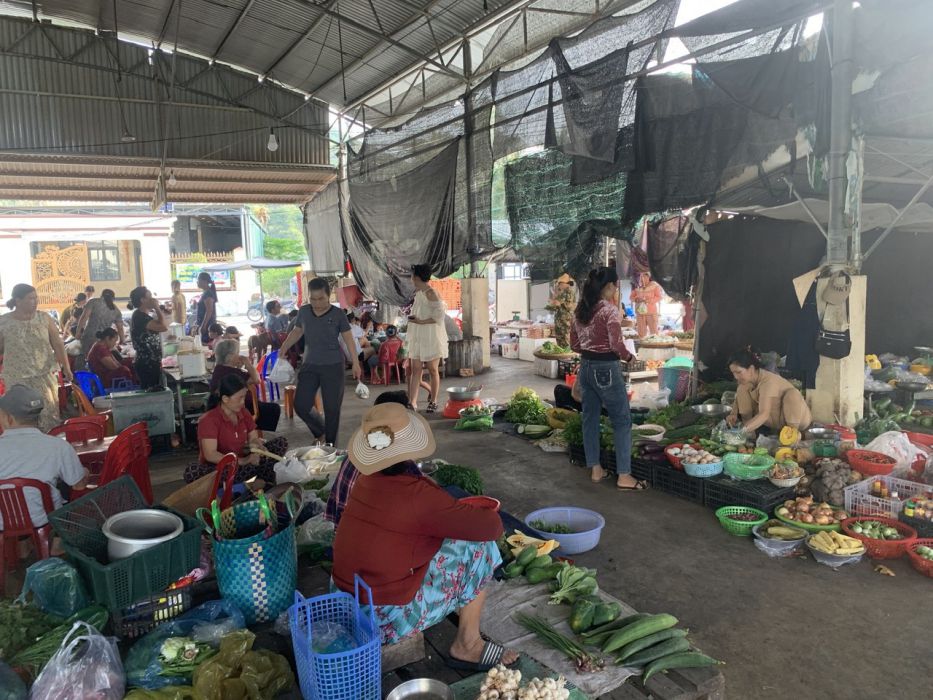
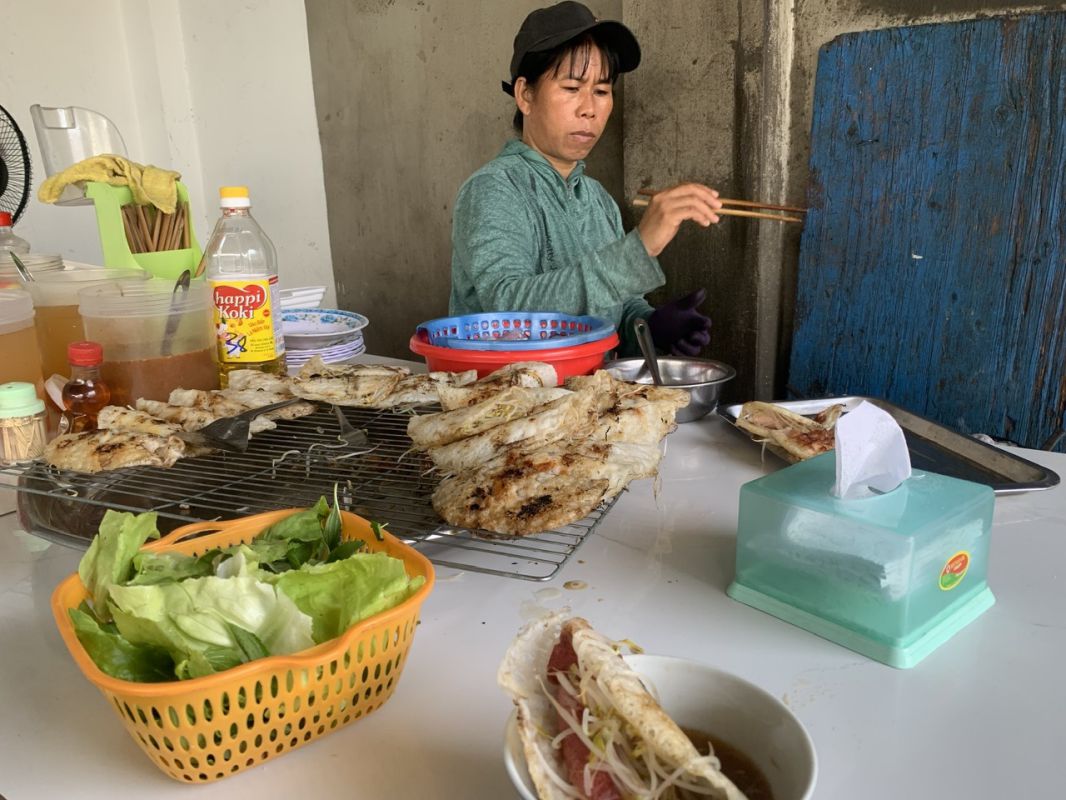
Instead, there is a traditional market that meets from early morning until late noon, along with grocery stores selling all kinds of "ba ram" and food stalls in the style of "Aunt Tu sells breakfast, Mrs. Tam sells dinner" with local dishes such as banh canh, bun ca, hu tieu xuong, banh loc, banh can...
I have never seen anywhere where money is as expensive as at Ninh Van market. You can eat a full meal for a family of 4 with about 100,000 VND. A plate of banh beo cha lua with scallion oil 10,000 VND, a serving of banh xeo with squid 7,000 VND, a bowl of fish noodle soup 15,000 VND, a cup of sweet soup banh lot 5,000 VND, a bunch of fresh mixed fish 30,000 VND.
The time when the fishing village is most noisy is in the morning, but that is the noise of happiness, not causing discomfort. From early dawn, meaning around 5 am, dawn has risen on the sea surface and fishing boats at night know when to return.
At about 6 am, people in the village and tourists were present at the fishing port area to pick up ships to buy seafood. When the ship docked, a bustling sound arose: The sound of the ship owner controlling fishermen to cast anchor and tie ropes; the announcement of what kind of fish they caught today, the calls of women running the market, the sound of ship engines, motorbikes, and trucks chirping like bees.
The sea does not disappoint people's expectations, so it generously bestows fresh squid on their skin, fresh shrimp jumping wildly, fresh fish with clear eyes like children's eyes, fresh blue crabs with clutches dancing... Wherever goods are dumped, people flock there to choose and buy and sell.
About an hour later, people disappeared, everything became peaceful again. People brought food home to cook breakfast, for example, a bowl of fresh instant noodles with squid that could not be found anywhere with a price not even equal to the price of a liter of gasoline elsewhere. The pressure of money suddenly disappeared, and life became as beautiful as a dream.


