
Ready for commencement day
Talking to Lao Dong Newspaper, Mr. Vu Van Dien - Standing Vice Chairman of Quang Ninh Provincial People's Committee - affirmed that the locality is actively coordinating with relevant units to organize the groundbreaking ceremony of a modern transport infrastructure project, which is of great significance in reshaping the development structure of the entire Northern region. This is a particularly meaningful event for Quang Ninh and the whole country in the new development phase. Currently, the ground preparation is basically completed; departments and branches continue to coordinate in deploying reception, logistics, ensuring security and order, health, electricity and water...
According to Mr. Dien, when put into operation, the railway line will shorten the travel time between Hanoi and Quang Ninh to about 30 minutes, while opening up a new development space for the entire region.
In recent days, the government and people in the project areas passing through have expressed their excitement, expecting the railway line to be deployed and put into operation soon in 2028.
The route passes through areas such as Mao Khe, Hoang Que, Yen Tu, Uong Bi, Dong Mai, Ha An and Tuan Chau (Quang Ninh), including Yen Tu station located near Yen Tu scenic area. According to the plan, the project needs to recover about 28ha of land, involving 210 households.
Local authorities have established a steering committee, working group and deployed a 100-day and night peak campaign, focusing on completing cadastral records, determining land origin, propagating policies and preparing compensation, support, and resettlement plans.
Mr. Bui Hoang Giang - Provincial Party Committee member, Secretary of Yen Tu ward - shared that people highly agree with the project implementation policy and are ready to hand over the site when the procedures are completed. Quang Ninh plans to spend more than 2,500 billion VND on site clearance to serve the project.
Regional development momentum
From an infrastructure perspective, this project also has the meaning of completing the multimodal transport ecosystem for Quang Ninh. This locality already owns a system of seaports, international airports and a relatively synchronous high-speed network. However, the lack of high-speed railways makes connectivity not really optimal. When the railway line comes into operation, the infrastructure picture will be completed, creating a superior advantage in logistics and attracting investment.
One of the sectors directly benefiting is tourism. For many years, although Ha Long has a great attraction, travel is still a factor that tourists, especially international tourists, consider. When travel time is only about 30 minutes, Ha Long can completely become a one-day destination from Hanoi. This not only increases the number of visitors but also creates conditions for developing high-class tourism types such as long-day resorts, MICE tourism or high-class experience services.
According to forecasts, passenger volume may reach more than 2 million arrivals immediately after operation and increase to over 15 million arrivals by 2050. However, according to experts, the deeper impact of the project lies in the real estate market and population distribution. In the context that Hanoi is under great pressure on population and infrastructure, the trend of population expansion to neighboring areas not only helps reduce the load on the central city but also creates new development momentum for satellite localities. At the same time, the railway line also promotes the movement of high-quality labor.
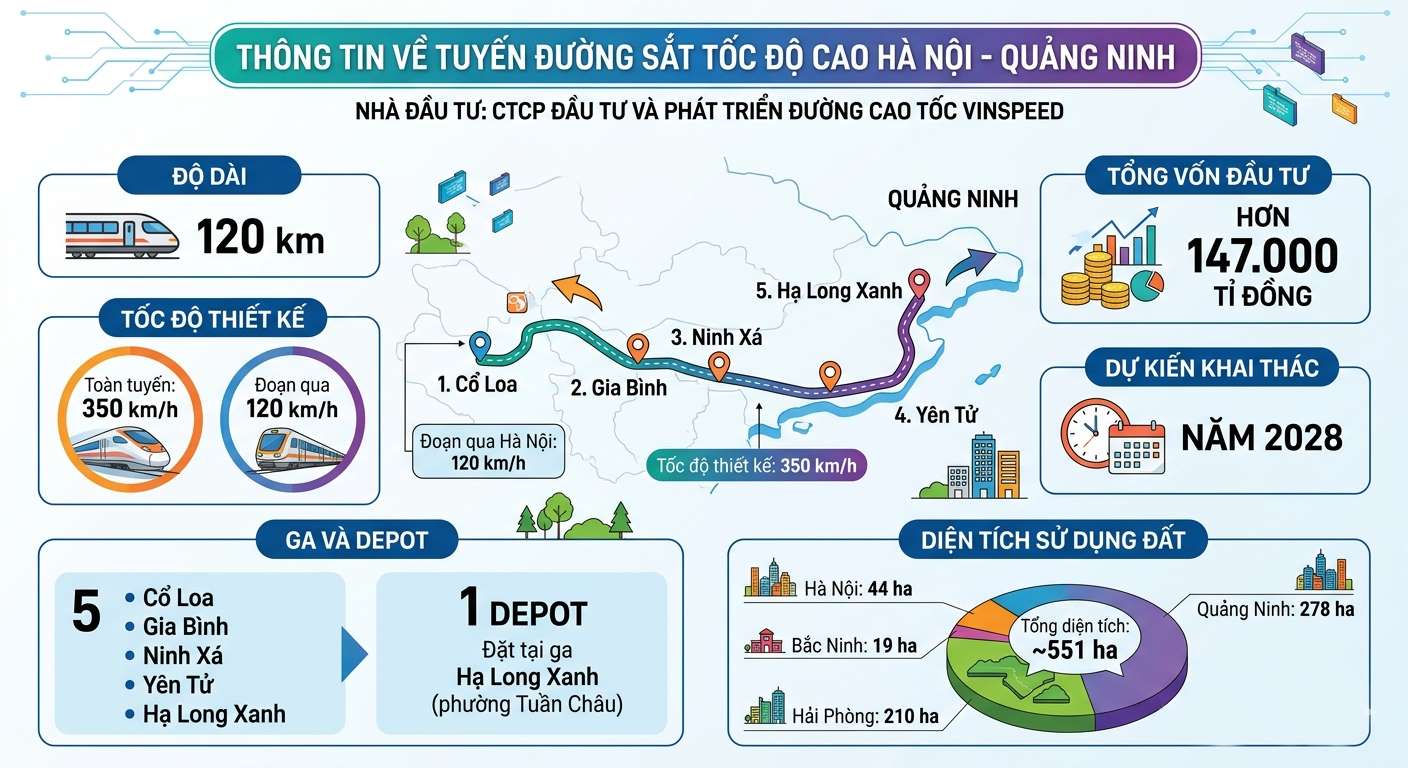
When travel becomes convenient, businesses can expand operating space, attracting human resources from many different localities. According to the design, the route has its starting point at Co Loa station (Hanoi), ending point at Ha Long Xanh station; passing through Gia Binh transit stations (Bac Ninh), Ninh Xa (Hai Phong), Yen Tu (Quang Ninh) and having a depot at the final station.
On April 10, Hai Phong City Department of Construction informed that the Chairman of Hai Phong City People's Committee had directed the Departments of Construction, Finance, Agriculture and Environment, Industry and Trade, Culture, Sports and Tourism; City Military Command; City Police; People's Committees of some communes and wards on the route plan and station location of the Hanoi - Quang Ninh high-speed railway project section passing through Hai Phong City.
Accordingly, Hai Phong City People's Committee requests relevant departments, agencies, branches, and localities to coordinate and guide the Investor (Vinspeed High-Speed Railway Investment and Development Joint Stock Company) in the implementation of project procedures (land, environment, construction...) in accordance with current legal regulations; organize management and supervision of project implementation and promptly report and propose handling of problems (if any).
Previously, the Hai Phong Department of Construction had agreed on a plan for the route direction and location of the station of the railway project through the city as requested by the Investor. Regarding the route direction: The railway section through Hai Phong City passes through communes and wards: Tran Phu, Hop Tien, Le Dai Hanh, Bac An Phu, Nhi Chieu. The total length of the route through Hai Phong city is about 33.1km. Mai Chi
The project is about 120.4km long, invested by Vinspeed High-Speed Railway Investment and Development Joint Stock Company (under Vingroup Corporation). The design speed of the main line reaches 350km/h, the section through Hanoi is about 120km/h. In the total length of the line, about 4km goes on land, the rest is mainly viaducts and overpasses.
* Sharing about the development of high-speed railway projects, Mr. Nguyen Tri Duc - Chief of Office of the Ministry of Construction - said that in the past time, the Ministry has actively issued regulations and standards to serve the development of high-speed railways and urban railways. In the fields of science and technology, innovation, digital transformation and construction materials, the Ministry of Construction has reviewed the system of lists, standards, and regulations related to railways in the first quarter of 2026.
In the coming time, the Ministry will continue to complete a set of standards specifically for high-speed railways, creating a favorable technical corridor for the implementation of similar projects. Previously, the Ministry of Construction had appraised the Hanoi - Quang Ninh project proposed by VinSpeed, assessing that it was basically consistent with the Railway Network Plan.
* Associate Professor, Dr. Luu Duc Hai, Director of the Institute for Urban Research and Infrastructure Development, Vietnam Construction Association, assessed: The road is not simply a traffic project. The project opens up a new approach in inter-regional infrastructure organization, creating momentum for urban economic development and tourism in the Northern region.
Analyzing in more depth the "elevation" option, Associate Professor, Dr. Luu Duc Hai said that the investment rate for the elevated bridge is many times higher than the traditional embankment roadbed. Operation and maintenance work also pose high requirements. Periodic inspection of more than 3,400 bridge piers and hundreds of kilometers of bridge girders requires the application of modern technology such as smart sensors, unmanned aerial vehicles. Overhead maintenance operations are complex and costly compared to the ground. However, this option is considered a strategic choice.
Exchanging costs for sustainability helps reduce the impact on the landscape, limit the division of development space, and create space for long-term urban planning. Considering the project life cycle from 50 to 100 years, this is the optimal solution to balance infrastructure development and environmental protection. Hieu Anh


