
Recently, many subjects have appeared impersonating officials and staff in charge of logistics of agencies and units to contact stores, business households and small businesses, ordering goods in large quantities.
According to the Bac Ninh Provincial Police Electronic Information Portal, subjects often learn about the store's information in advance on social networks, Google Maps or advertising pages.
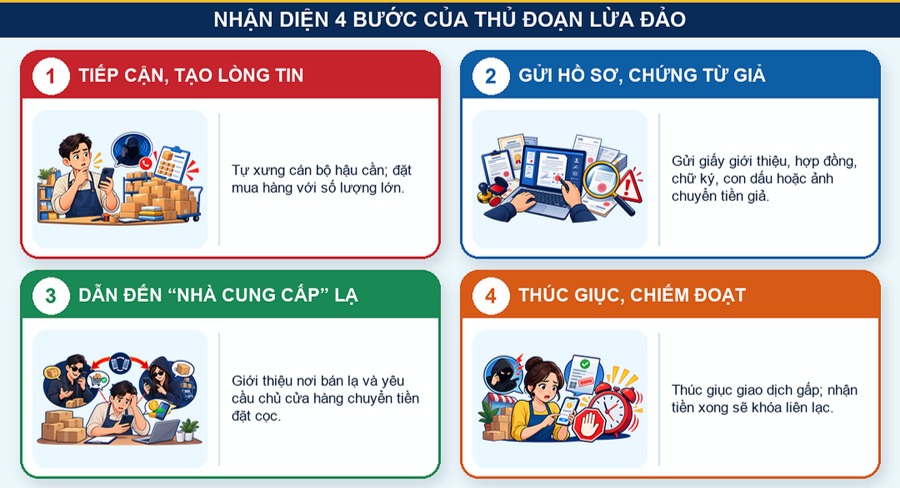
After that, they called or texted, introducing themselves as officials in charge of purchasing and logistics of a unit; and at the same time requested to buy a large quantity of stationery, equipment, supplies or high-value items.
To create trust, subjects use avatars, letters of introduction, order documents, contracts or documents in the form of documents of agencies and organizations.
These documents can be forged using image editing software, using unit names, signatures, seals or information copied from the internet. When gaining trust, the subjects continue to ask the store to provide additional special items that the store does not have available.
After that, the subject actively introduced a "supplier" and said that this is a unit that has cooperated before, and can deliver goods immediately at preferential prices.
In fact, both the orderer and the "supplier" belong to the same fraud group. The "supplier" will ask the store owner to transfer the deposit or pay in advance to keep the goods.
When the store owner transfers money to the "supplier", the subjects immediately lock the messaging account, turn off the phone or continue to give reasons to request additional money transfers. When the incident is discovered, the victim may have been appropriated a very large amount of money.
To prevent the above tricks, the Department of Cyber Security and High-Tech Crime Prevention, Bac Ninh Provincial Police recommends that people and business establishments need to raise their vigilance when receiving requests to order large quantities of goods from strangers.
Business establishments need to directly verify with relevant agencies and units through officially announced phone numbers, not verifying by phone numbers provided by orderers.
Absolutely do not transfer deposit money to personal accounts or "suppliers" who have never transacted, have not verified addresses and legal status. Only deliver goods or make payments after checking and confirming that the actual money has been recorded on the account; do not base on screenshots, notification messages or money transfer documents sent by the buyer.
People and businesses also need to avoid accessing strange links, scanning QR codes of unknown origin or installing applications according to instructions from strangers.
When suspicious signs are detected, it is necessary to immediately stop the transaction, keep all messages, phone numbers, bank account information and related documents to provide to the Police agency. In case money has been transferred, it is necessary to immediately contact the bank to request support to prevent the transaction.


