
The deployment of the AI camera system has helped Hanoi City strengthen urban order and environmental sanitation monitoring during the Lunar New Year. Thanks to the combination of technology, grassroots forces and public utility services, many central streets maintain a green, clean, and neat appearance despite the increased number of people.
During the Binh Ngo Lunar New Year, at many relics and entertainment spots in Hanoi, images of residual garbage and messy sidewalks are almost gone. Instead, there is a neat, green, and clean urban space. This result has a significant contribution from the deployment of AI camera systems in monitoring urban order and environmental sanitation.
From the 3rd day of Tet, Hoan Kiem Lake area and the Old Quarter began to be bustling with people and tourists traveling in spring. Although the number of people increased, the central streets still maintained the order and order characteristic of the Capital.
It is easy to see that waste is no longer in the situation of "filled up and then cleaned up". After peak hours, environmental sanitation forces are arranged to work in shifts, strengthen sweeping, washing roads, and quickly collecting at crowded places. Records in the days leading up to Tet show that the urban appearance is cleaner and more airy than usual thanks to maintaining synchronous sanitation.
Director of the Center for Agricultural Technology and Environment (Hanoi Department of Agriculture and Environment) - Ngo Thai Nam said that the plan to ensure environmental sanitation during Tet is built methodically, suitable to the reality of each area. From February 15, the city adjusted the collection time of domestic waste to 8 pm daily to avoid congestion during peak hours, and at the same time requested to increase the collection frequency throughout the holidays, not allowing garbage congestion or environmental incidents to arise. Flexible operation helps streets become more open, and collection work is not overlapped.
In parallel with that, Hanoi City strengthens the application of technology in monitoring, detecting and handling violations of urban order and environmental sanitation, limiting recurrence, and gradually forming self-awareness in the community.
From December 13, 2025, Hanoi City Police will operate an AI camera system with 1,837 cameras on 25 streets and 195 key intersections. After a month of operation (from December 13, 2025 to January 12, 2026), the system has recorded, reviewed and censored images of 6,351 cases with sufficient grounds to send handling notices.
According to Hanoi City Police, the goal of deploying AI cameras is "prevention is the main thing", not focusing on increasing penalties, aiming to build sustainable compliance habits in society.
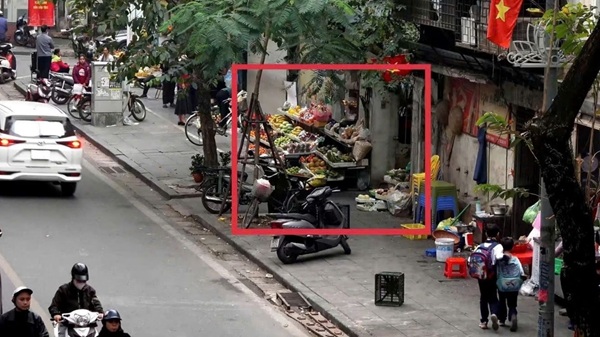
The commander of O Cho Dua Ward Police said that the ward's camera system operates 24/7, recording acts of encroachment on sidewalks and roadways as a basis for handling. The reality of the days leading up to Tet shows that AI-integrated cameras not only serve traffic management but also contribute to maintaining urban order and discipline. The situation of encroachment on sidewalks and illegal parking has decreased significantly thanks to a closed operating chain: AI monitoring - ward's quick response - strong public utility services - people jointly maintaining.
AI cameras help quickly identify points where violations arise, support grassroots forces to handle "the right person, the right behavior, at the right time", increase deterrence and prevention. When images become objective bases, reminders and handling are more transparent, limiting the situation of "recurrence when there are no forces". Thanks to that, urban order and environmental sanitation are not interrupted during shifts but maintained regularly throughout the holidays.
In addition to monitoring, the "environmental logistics" work is organized to run in the right urban pace. Many areas deploy sanitation at a high level, operating 24/24, strengthening sweeping, washing roads, and sidewalks; and remotely monitoring quality with smart cameras and GPS to promptly handle arising points.
According to Ms. Ngo Thanh Loan - Director of the Center for Recycling and Environmental Communication (Hanoi Urban Environment One Member Limited Liability Company), in order for collection work to take place smoothly, people need to dispose of garbage on time and in the right place, tighten trash bags, and not litter on sidewalks and roads. When the community complies well, the pressure on environmental forces will be significantly reduced.
Reality shows that AI technology is not isolated but is connected to the rapid response of local authorities and the collection capacity throughout Tet of public utility forces. When the "magic eye" of supervision goes along with the rhythm of flexible collection and community awareness, Hanoi is not only clean in the few days of Tet but also aims to maintain a neat and civilized urban appearance - a "green, clean" approach with a new management mark.


