
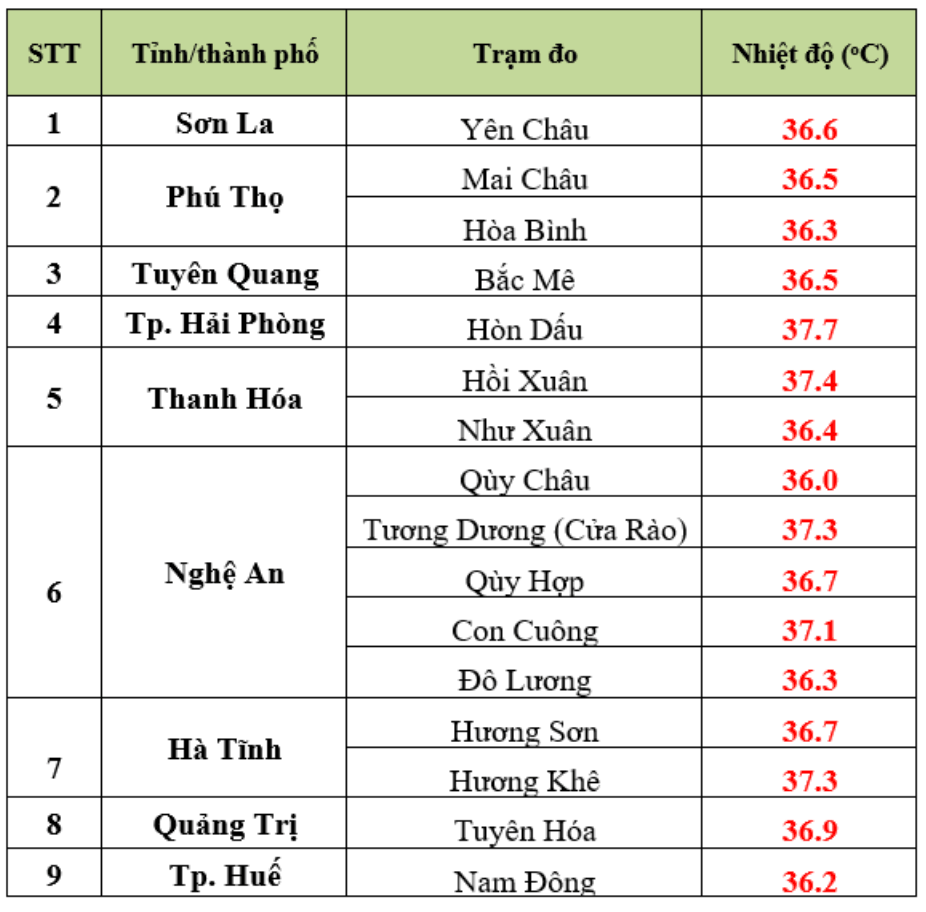
According to the National Center for Hydro-Meteorological Forecasting, on June 2nd, the Northern region will be hot with temperatures at 13 o'clock commonly 35 - 36 degrees C, with some places above 36 degrees C such as the following monitoring stations: Yen Chau (Son La) 36.6 degrees C, Mai Chau (Phu Tho) 36.5 degrees C, Bac Me (Tuyen Quang) 36.5 degrees C,... Relative humidity at 13 o'clock commonly 55 - 60%.
The area from Thanh Hoa to Da Nang city and eastern Quang Ngai province is hot, with intense heat in some places with temperatures at 1 PM commonly 35 - 37 degrees C, in some places above 37 degrees C such as the following monitoring stations: Hoi Xuan (Thanh Hoa) 37.4 degrees C, Tuong Duong (Nghe An) 37.3 degrees C, Huong Khe (Ha Tinh) 37.3 degrees C,... Relative humidity at 1 PM is commonly 50 - 55%.
Northern region on June 3rd, hot sunny, in some places intense hot sun with the highest temperature commonly 35 - 37 degrees C, in some places above 37 degrees C. Relatively low humidity commonly from 50 - 55%.
On June 4, the midland and delta areas of the Northern region will be hot with the highest temperature commonly 35 - 36 degrees C, in some places above 36 degrees C. The relative lowest humidity is commonly from 55-60%.
On June 5, the Northern Delta region will have hot weather, from June 6, widespread hot weather will increase again.
According to the 10-day weather forecast bulletin, the meteorological agency forecasts that the heat wave in the North will last until around the end of June 8.
The area from Thanh Hoa to Da Nang city and eastern Quang Ngai province on April 3-4, there will be hot and intense heat, especially intense in some places with the highest temperature commonly 36-38 degrees C, in some places above 39 degrees C. The relative lowest humidity is commonly from 45 - 50%.
From June 5th, hot weather will expand to the eastern areas of Gia Lai and Dak Lak provinces and is likely to last for many days to come.
Warning level of natural disaster risk due to hot weather is level 1.
Due to the influence of hot and intense heat combined with low humidity in the air, there is a risk of fires and explosions in residential areas due to increased electricity demand and the risk of forest fires. In addition, hot weather can also cause dehydration for the human body when exposed to high temperatures for a long time.
Note that the forecast temperature in hot weather bulletins and the actual perceived temperature outside can differ from 2 - 4 degrees Celsius, or even higher depending on the condition of the buffer surface such as concrete and asphalt roads.


