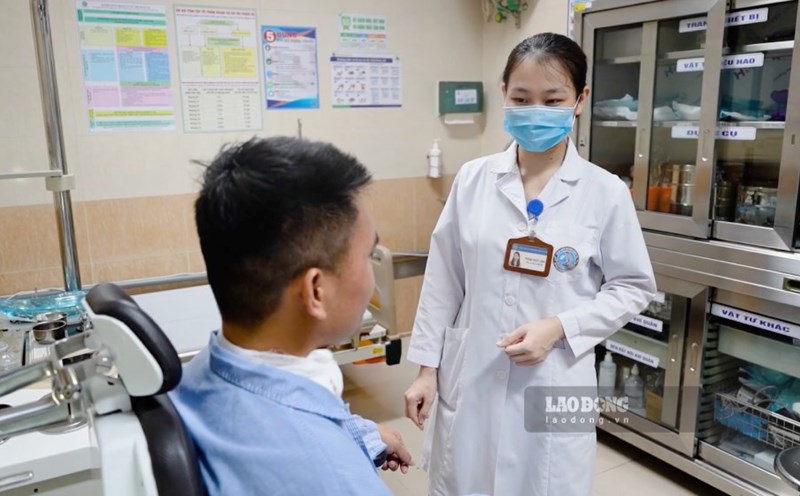
Patient N.V.H. (82 years old, residing in Hiep Binh ward, Ho Chi Minh City) was admitted to the hospital on August 29 in a state of dizziness, nausea and fatigue. About 1 hour before admission, symptoms appeared after the patient went to the toilet and was taken to the hospital for emergency treatment by his family.
Through examination, doctors determined that the patient had respiratory failure, circulatory failure, acute kidney failure, septic shock and left liver abscess due to a foreign object. The condition was severe, with a risk of multiple organ failure and life-threatening.
The family initially wished to transfer the patient to a higher level. However, after being explained by the doctor about the severity and requesting early intervention, the family agreed to let the team of the General Surgery Department perform surgery immediately at the hospital.
During laparoscopic surgery, doctors discovered an abscess in the left liver, about 3 x 4 cm in size, containing a lot of cloudy brown pus. Checking inside the abscess, the team discovered a foreign object resembling a fish bone, about 3 cm long.
The foreign object is removed. Doctors treat the abscess, drain and control the source of infection.
After surgery, the patient was transferred to the Intensive Care Unit for continued treatment and monitoring for 3 days. When the condition stabilized, the patient was transferred to the General Surgery Department.
By the 8th day after surgery, the drainage tube was removed, the patient recovered well, ate and walked normally and was discharged on the 10th day.
According to MSc. Dr. Tran Nam, Department of General Surgery, Thu Duc General Hospital, liver abscess is a condition where the liver tissue is damaged, necrotic, and pus reservoirs are formed. Most cases are due to bacterial or parasitic infections. Liver abscess due to digestive foreign objects is a rare complication.
Sharp foreign objects such as fish bones, poultry bones, or small bone fragments can be swallowed but the patient does not recognize them. In some cases, the foreign object penetrates the stomach or intestines, moving to nearby organs, causing infection and forming abscesses.
It is noteworthy that patients may not remember or not feel the moment of swallowing the foreign object. This makes it difficult to determine the initial cause of the disease.
Doctors recommend that people need to see a doctor when abnormal symptoms appear such as prolonged or recurrent abdominal pain, fever, chills, nausea, vomiting, loss of appetite, fatigue. In particular, elderly people should not be subjective or self-treat for a long time at home.
If the infection progresses severely, the patient may suffer from sepsis, septic shock and multiple organ failure, life-threatening.
The above case shows that small foreign objects such as fish bones can also cause serious complications if they penetrate the digestive tract and move to nearby organs. Early detection and treatment of infection sources is important in limiting complications and the risk of death.