
A 50-year-old male patient had just undergone his second heart transplant just days after the first transplant failed due to primary organ dysfunction.
First heart suddenly malfunctions
The male patient was admitted to the hospital in a state of end-stage heart failure due to dilated cardiomyopathy. Despite active treatment, the heart's blood pumping function was seriously reduced, the rate of left ventricular discharge was only 22%. The patient continuously had difficulty breathing, chest tightness and faced the risk of death if heart transplants were not performed in time.
On July 25, the patient received a heart transplant from a brain-dead donor. In the early hours after the surgery, all developments were relatively favorable. The donated heart beat again, contractility was good, and hemodynamics were stable. However, less than 24 hours later, the situation suddenly deteriorated.
The contracting function of the transplanted heart decreases rapidly, almost completely disappearing. Patients are forced to use ECMO - an extracorporeal circulation and respiratory support system - combined with intensive resuscitation measures.
Doctors urgently looked for the cause. The results of coronary angiography and heart muscle biopsy ruled out causes related to coronary artery or acute transplant discharge. Finally, the patient was diagnosed with primary organ dysfunction (PGD), a particularly serious complication after heart transplantation.
In the next 48 hours, despite intensive treatment, the transplanted heart still showed no signs of recovery. The patient's condition quickly progressed to multiple organ failure, with an extremely poor prognosis.
Difficult decision: Should I have a second heart transplant?
At that time, Central Military Hospital 108 received a case of brain death donating multiple organs.
The donor's heart is assessed to be in the expanded standard group, not an ideal choice. Donors with a history of hypertension, kidney failure; thick left ventricle wall, heart function also have worrying indicators.
Meanwhile, the patient has undergone a major surgery, is suffering from multiple organ failure and depends on ECMO. Bringing the patient into the operating room once again is a huge challenge.
Colonel, Dr. Ngo Vi Hai - Head of Thoracic Surgery Department, Head of the heart transplant team - said that this is an extremely difficult choice. The donated heart is not really ideal, while the patient's condition is very serious, with multiple organ failure, so the ability to endure another major surgery is extremely difficult. However, the first transplanted heart has completely failed functioning, with no possibility of recovery. If there is no action, the patient has almost no chance of survival.
An emergency consultation was organized with the participation of leading experts in the hospital. The question is: Should the heart just donated be used to perform a second heart transplant, in order to save a patient who is on the verge of life and death?
Major General, Assoc. Prof. Dr. Pham Thai Giang - Deputy Director of Central Military Hospital 108 - said that the second heart transplant for the same patient in a short time is a particularly rare situation.
The first heart transplant was already difficult, but the second transplant was even more difficult. The patient had just undergone a major surgery, is suffering from multiple organ failure and had to undergo surgery in an emergency. However, facing the choice between accepting the patient's death and performing a risky major surgery, we decided to choose early retransplantation," said Major General, Assoc. Prof. Dr. Pham Thai Giang.
After consultation, the doctors decided to accept the risk to find a last chance of survival for the patient.
The major surgery in a patient with multiple organ failure
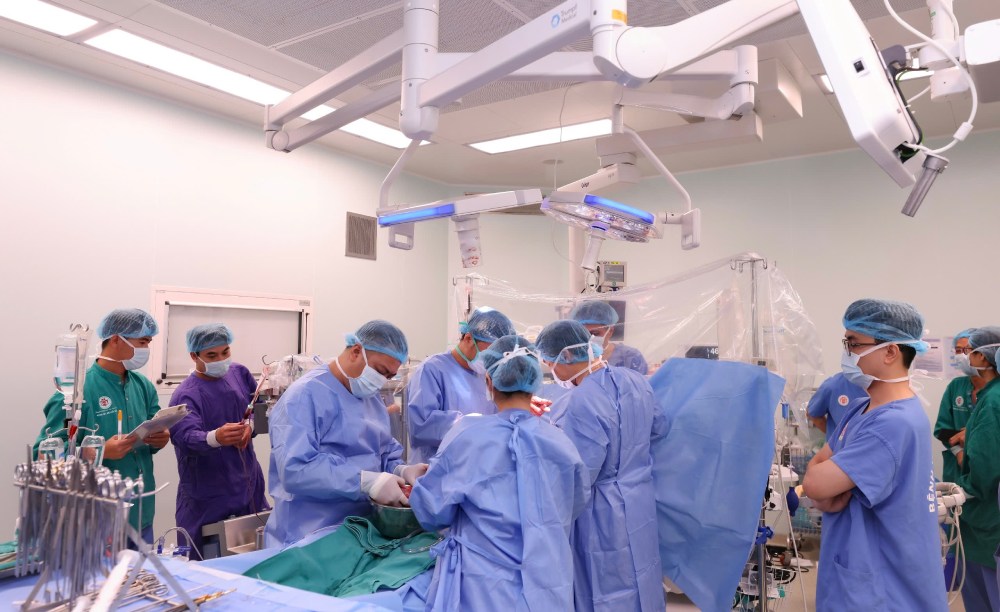
On July 28, the second heart transplant was performed. This is the time when the patient is in a particularly critical condition. The first heart transplant is almost non-functional. The patient had to undergo ECMO on the third day, continuous urology and blood filtration, accompanied by the risk of blood clotting disorders, bleeding and acid-base imbalance.
The patient's lungs were spreading with inflammation, with collapsed lungs. The patient was also in a coma for many days, and the risk of brain damage after surgery was very high.
Colonel, Assoc. Prof. Dr. Nguyen Minh Ly - Head of the Department of Anesthesia and Resuscitation - said that the pressure on the team is very great because the cause of the complete failure of the first transplanted heart has not been clearly identified. Throughout the surgery, doctors had to control each circulatory, respiratory, cerebrovascular, organ function, blood clotting and fluid balance indicators.
Dr. Ngo Vi Hai added that after the previous surgery, the tissues in the graft area were no longer intact, making dissection and grafting much more complicated. The surgical team had to concentrate highly and closely coordinate with the anesthesia, resuscitation, and machine operation departments to minimize any errors.
When the second heart starts to beat again, the patient's hemodynamics gradually stabilizes.
Gradually recovering after critical days
After the second transplant, the patient continued to go through a challenging recovery phase.
The contracting function of the new heart is initially weak. The patient continues to need ECMO, then is further supported by aortic convection balloons, continuous blood filtration and mechanical ventilation. The risks of bleeding, infection and multiple organ failure are always present.
However, the function of the transplanted heart gradually improved. On the 8th day after the transplant, the patient was successfully detoxified from ECMO. By the 10th day, the patient had his endotracheal tube removed. On the 11th postoperative day, the patient no longer needed aortic balloon support.
Currently, the patient's health has had positive changes. The patient is currently awake, has good contact and cooperation, and is starting to practice rehabilitation such as standing, sitting in a chair and cycling. Functional organs are also gradually recovering. However, this is the second heart transplant case, having experienced many severe complications and a long recovery time, so the patient still needs to continue to be monitored and treated closely.


