
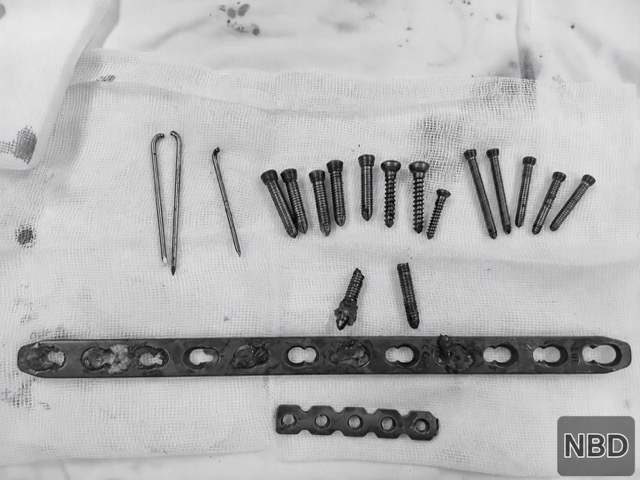
According to medical records, after nearly 4 years of wearing nails and screws in the calves and ankles on both sides, a young woman who had surgery to combine bones in the calves and ankles on both sides with nails and screws, the patient needed to remove the bone fixator.
Through examination and X-ray, doctors determined that the bone had healed well, meeting the conditions for surgery.
BSCKII. Nguyen Bao Dung - Operations Manager of the Department of Traumatology and Orthopedics, Hoc Mon Regional General Hospital said: "During the surgery, doctors discovered that the bone calf had developed, covering and clinging very tightly to almost the entire surface of nails, splints and screws. The bone calf is the process by which the body self-cultivates and regenerates new bone tissue to heal the cracked or broken bone.
This makes it difficult for ordinary tools to easily remove tools as expected. The crew had to use an additional C-arm brightening screen to help accurately locate tools during operation.
Some screws, due to being lying down for a long time and being tightly attached to the bone, have had their heads blown out when twisted, making the conventional screw removal tool no longer effective. If not handled appropriately, this situation can lead to not being able to remove the entire tool or requiring more intervention, while increasing the risk of damage to the surrounding healthy bone.
After surgery, all bone fixation instruments were safely removed. The patient recovered well, no fractures or fractures were recorded.
Difficulties in removing instruments after a long time are not uncommon situations. After surgery, many patients feel no pain, walk normally, so they do not continue to be re-examined. Some cases do not know when to assess to remove instruments," Dr. Bao Dung added.
Doctors recommend that it is not mandatory to remove nails and screws. The time to remove the device depends on the location of the fracture, type of fracture, type of device, degree of osteogenesis, age, health condition and needs of each patient.
If removed too early when the bone is not yet solid, the fracture site may lose the necessary mechanical support, increasing the risk of refraction, displacement, slow bone healing, or prosthetic joint.
Conversely, if removal is indicated but left for too long, the bone may develop to cover the instrument. At that time, surgery may be more difficult, prolong the operating time, and increase the risk of screws getting stuck, headflowing, instrument breakage, or damage to healthy bones.
Even after removing the device, the patient should not immediately exercise vigorously. The positions where screws were placed still leave gaps on the bone and need time to recover.
In the first 2-3 months after surgery, patients need to limit carrying heavy loads, exercise vigorously, play opposing sports and especially avoid falling. Re-examination and X-rays should be performed according to the doctor's appointment.


