
Thousands of patients regain exercise thanks to comprehensive pain relief regimen
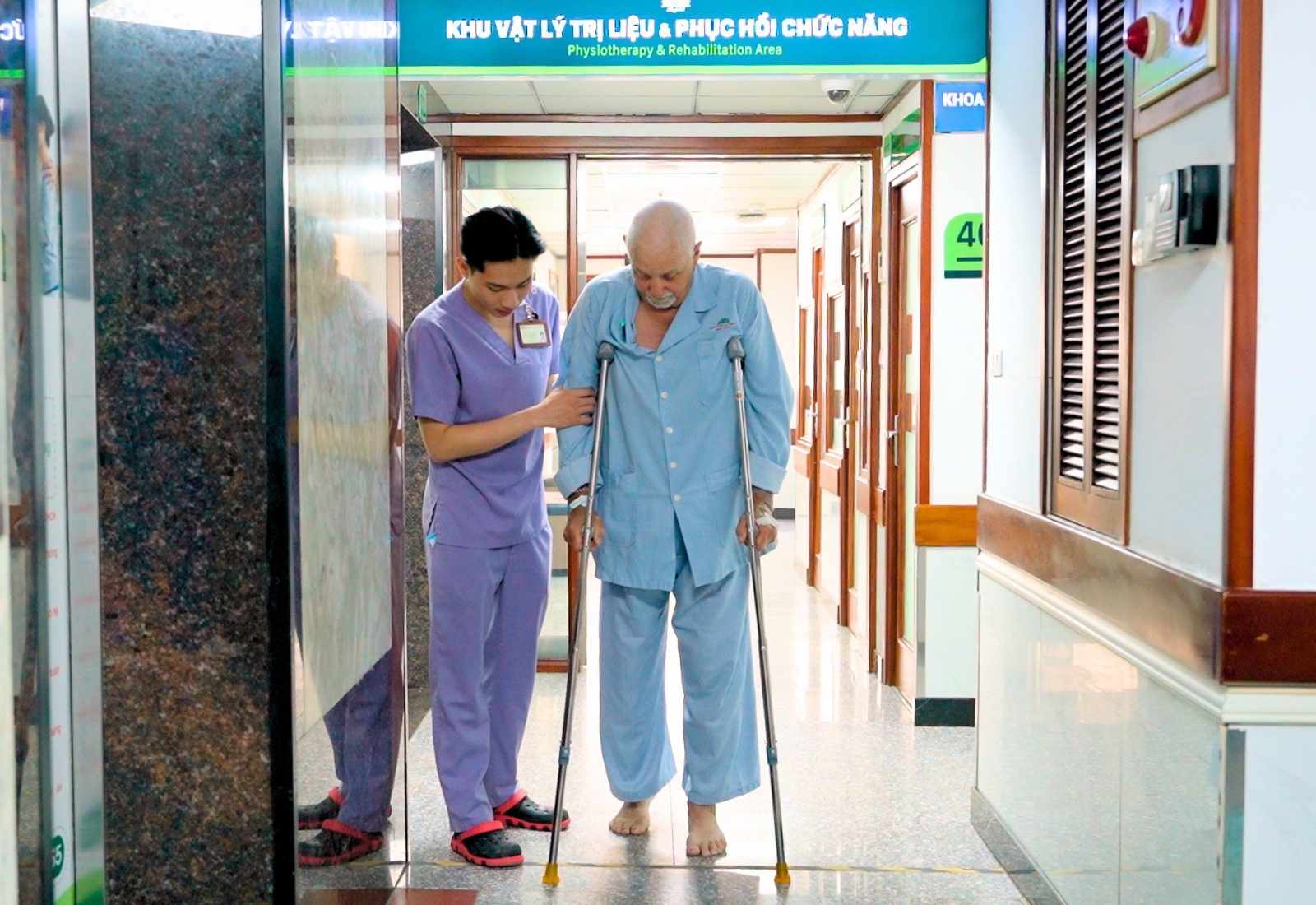
Just 2 days after hip replacement surgery, Mr. Seaborn Wayne (72 years old, Australian nationality) has relieved pain, stood up on his own, walked gently and started a specialized rehabilitation program.
Previously, Mr. Seaborn went to the hospital for a sharp pain in his hip joint every time he walked, but when resting, it was almost painless, so he thought his condition was not serious.
Through clinical examination and magnetic resonance imaging, Dr. Pham Van Cuong - Head of General Surgery Department, Hong Ngoc General Hospital diagnosed the patient with grade IV hip osteoarthritis, accompanied by necrosis of the femur head and spinal cord injury, requiring hip replacement surgery.
The surgical team removed the necrotic femur, replaced it with a high-strength artificial hip joint, compatible with the body, and at the same time used the remaining good bone to regenerate the pituitary space, helping to restore the structure and increase the strength of the joint.
“I am really surprised to be able to stand up and walk so early after surgery. When exercising, I also don't feel any pain, so I am very comfortable and confident,” Mr. Seaborn shared.
Ms. Huong (49 years old, Hanoi) was hospitalized in a state of lateral fracture of the left arm bone and elbow bone causing pain and complete loss of movement.
This is a complex lesion in the elbow joint area, with the risk of affecting the ulnar nerve, so surgery combined with fractured bone is needed, and at the same time, the elbow joint is adjusted to the correct anatomical position and the ulnar nerve is maximally protected.
Right before surgery, doctors developed a suitable pain control plan, helping Ms. Huong reduce anxiety and feel more comfortable during treatment.
After surgery, the patient continued to have pain control combined with early functional recovery, gradually regaining mobility.

Pain management in bone and joint surgery
According to research published in the US National Library of Medicine (NLM), about 80% of surgical patients experience postoperative pain.
Pain not only affects physical health but also makes patients worried, reluctant to exercise, becoming a very big barrier in the process of functional rehabilitation.
Therefore, the trend of modern bone and joint surgery is not simply aimed at the goal of "healing" lesions but also focuses on comprehensive pain control to help restore movement according to the principle: Limit invasion, minimize pain and restore function early.
Depending on the type of injury, the doctor chooses the appropriate surgical path and intervention technique, prioritizing minimally invasive methods, small surgical paths to accurately handle the injury, while maximizing the preservation of muscle tissue and anatomical structure.
On that basis, pain reduction strategies are proactively implemented right from before and during surgery, combining anesthesia, anesthesia and appropriate pain relievers for each stage, helping to effectively control pain, limit side effects and create conditions for patients to exercise early.
Early exercise is an important next step in the treatment process. Immediately after surgery, patients are instructed on a rehabilitation program suitable for each type of surgery, gradually restoring motor range and limb function.
Pain during and after surgery affects the patient's psychology, mobility and recovery progress.
Therefore, pain control needs to be built into a plan throughout the treatment process, from examination, pre-operative assessment, surgery to post-operative care. When pain control is effective, patients can exercise earlier.
In fact, with many joint replacement surgeries, patients can stand up, practice walking after about 24 hours, continue functional rehabilitation and gradually return to normal activities after about 1 week" - Dr. Cuong said.


