
Mouth distortion, face distortion after a cold day
The prolonged cold spell in the North not only caused the number of cases of respiratory diseases to increase, but also recorded many cases of people suddenly having their mouths and faces distorted, having to be hospitalized in a state easily confused with stroke. Doctors warn that this may be a symptom of peripheral VII nerve paralysis due to cold, and needs to be detected and treated early in the "golden time".
At the Department of Traditional Medicine and Rehabilitation, Central Tropical Diseases Hospital, patient P.N.C (11 years old, Hanoi) was brought to the hospital by his family in a state of mouth deformity, stiff facial muscles, unable to smile, and left eye not closed.
According to the family, the day before, while going to school, C took off his jacket, only wearing a thin jacket all day in the severe cold weather. Through examination, doctors diagnosed him with paralysis of the peripheral VII nerve due to cold.
Doctor Le Nguyen Long, Head of the Department of Traditional Medicine and Rehabilitation, said that after a week of treatment with drugs combined with physical therapy and rehabilitation, the child's facial muscle movement ability has improved significantly.
Easily confused with stroke
Not only young children, the elderly are also a group susceptible to the disease. Patient N.V.N (58 years old, Hanoi) after a few days of cold weather developed sore throat, swelling and pain in the left ear area and was diagnosed with otitis media at a nearby medical facility. However, after 3 days of treatment without improvement, he began to distort his mouth, talk hard, and did not close his eyes tightly.
Fearing a stroke, his family took him to the National Hospital for Tropical Diseases. The results of the CT scan of the brain helped rule out brain blood vessel damage. Doctors determined that he had paralysis of the left outer peripheral nerve VII due to complications of acute otitis media, accompanied by vocal cord paralysis.
The patient has a history of high blood pressure for many years and some underlying diseases that have caused the immune system to decline. After 10 days of treatment with anti-inflammatory drugs, reduced edema combined with physical therapy to restore facial muscle function, his condition improved significantly.
Similarly, patient B.T.T (83 years old, Hanoi) after returning from breakfast showed signs of mouth distorted to the left, right eye not closed. When admitted to the hospital, she was diagnosed with paralysis of the right peripheral VII nerve.
Cold weather is the trigger
According to Dr. Le Nguyen Long, nerve VII controls facial muscle movements, and also participates in the transmission of taste, secretion of tears and saliva. Because it passes through a narrow bone canal in the temporal bone, this nerve is very sensitive and prone to edema.
When the head, face, and neck area is suddenly exposed to cold, blood vessels contract, causing local anemia, activating an inflammatory reaction, leading to edema and nerve compression, disrupting the transmission of impulses to facial muscles," Dr. Long analyzed.
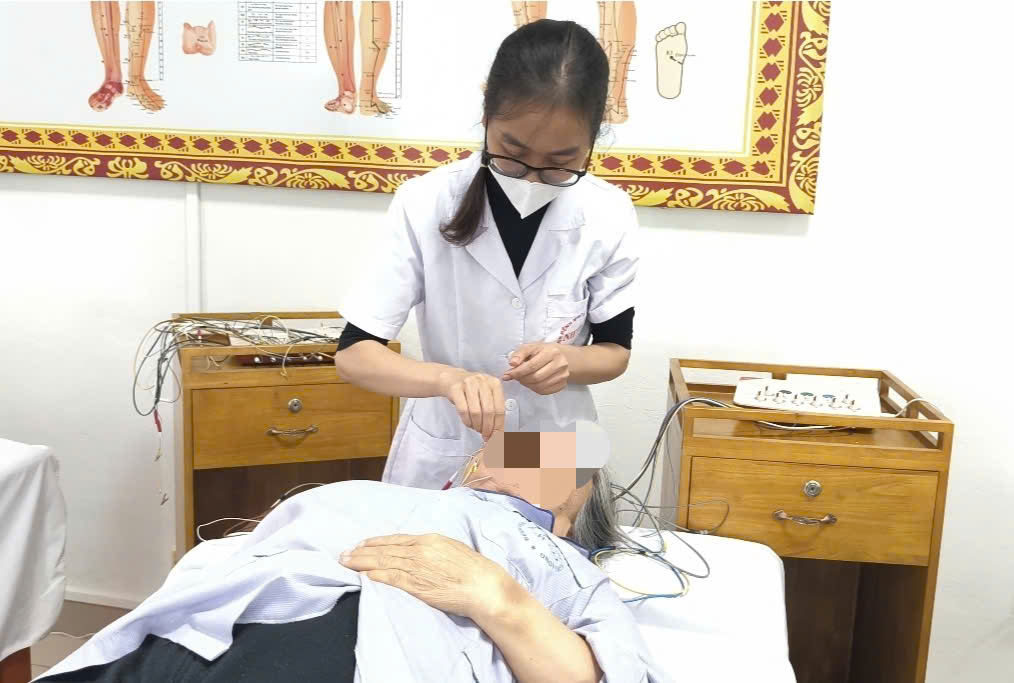
In addition, cold weather also creates conditions for viruses, especially herpes simplex type 1 (HSV-1), to reactivate. This is a virus that exists and is hidden in the facial nerves of many healthy people. When reactivated, the immunocompromised response increases sharply, causing more severe neural edema, causing sudden onset of facial paralysis.
Patients often experience symptoms very quickly, possibly right when waking up in the morning they already see a distorted mouth, misaligned laughter, difficulty speaking, tears or tears on the paralyzed side, unclosed eyes, accompanied by subtle pain behind the ears. The symptoms progress in a few hours to one or two days but do not cause consciousness disorders.
Dr. Long noted that facial paralysis due to cold often does not accompany weak limbs, numbness of the other half of the body or central language disorders such as stroke. However, due to facial distortion quite similar to stroke, patients are easily confused, leading to late hospitalization or incorrect treatment.
The golden time in treating peripheral VII nerve paralysis is the first 72 hours, to reduce edema, protect the myelin sac and increase the ability to fully restore facial muscle motor function," Dr. Long emphasized.
How to prevent disease in the cold season
To prevent disease in the cold season, people need to keep their heads, faces, and necks warm; avoid direct cold winds; do not bathe late at night, do not suddenly pour water on their heads and faces. When there are signs of mouth deformity, face deformity, and eyes not closed, they need to go to a specialized medical facility for examination and timely treatment. Patients need to protect their paralyzed side of the eye, combine medication with physical therapy, acupuncture and facial muscle exercise, and do not self-treat according to folk methods.
It's a bit of a bit of a bit of a bit of a bit of a bit.


