Nearly 86% of the world's population experiences a dark moment on December 7

Thanh Hà |

On December 7, Vietnam time, nearly 9 out of 10 people around the world will experience a moment of dark night.

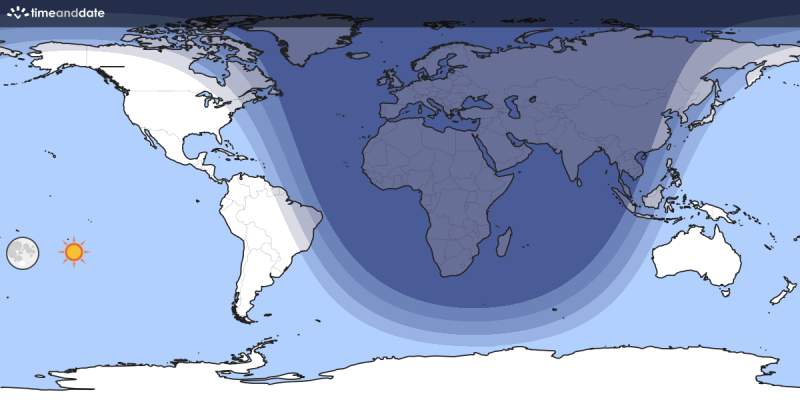
According to EarthSky, based on algorithms and data from the Earth Science Information Center at Columbia University, USA, the time of maximum darkness occurred at 19:56, UTC on December 6, 2022 (ie 2:56 a.m. on December 7, Vietnam time).

At that time, the sky will be completely dark with about 85.92% of the world's population. At that time, darkness will rule the three most populous continents on Earth: Asia, Africa and Europe (with very small exceptions).

At 7:56 p.m. on December 6, UTC time, like any other time, the Sun will light up half of the world, the other half will sink into darkness and those who live there will spend the night.

However, up to 85.92% of the world's population will be immersed in the darkness of December 6, because the most populous areas in the world will be in the dark half of the Earth at that time. At this time, almost all of Asia - home to about 60% of the population - will be in the dark.

Meanwhile, South America, New Zealand and most of Australia will see the sunlight. Although it is a large area of land, this area is relatively sparsely populated. North and South America together account for only about 13% of the global population.

Also in this December, in addition to June 6, humanity has 2 other memorable days, December 21 and 27.

At 9:44 p.m. on December 21, UTC (ie 4:44 a.m. on December 22, Vietnam time), most of the Earth was at dawn, which affected 88.14% of the world's population.

Meanwhile, at 10:39 p.m. on December 27, UTC (ie2,39 a.m. on December 28, Vietnam time) was the peak of darkness. At that time, 86.11% of the world's population will experience nighttime (85.23%) or daylight (0.88%).

Thanh Hà
RELATED NEWS

China has another breakthrough in the world's largest artificial sun

|

China completes the core of the world's largest "artificial sun" - creating a new breakthrough in core technology.

Welcoming the first sunrise in 2022 next week

|

The first lunar ecstasy of 2022 will occur on April 30 and can be observed in the South pole, the southernmost tip of South America, the Pacific and the Atlantic.

Not enough grounds to apply personal income tax to gold bar transfer transactions

|

The State Bank proposes to collect personal income tax on gold bar transfers, the Ministry of Finance believes that there are not enough grounds to regulate details.

Official answers for the 10th grade entrance exams in Hanoi

|

On the afternoon of June 2nd, the Hanoi Department of Education and Training announced the answer keys for the 10th grade public high school exams for the 2026 - 2027 school year.

Trade unions participate in building new production forces, creating sustainable jobs for workers

|

This is the sharing of Mr. Tran Duc Thich - Chairman of the Trade Union of Vietnam Post Corporation before the 14th Congress of the Vietnam Trade Union.

Unlocking the source of creativity for union members from patriotic emulation movements

|

Can Tho - Emulation movements organized by the Trade Union are increasingly going deeper into reality, helping union members and workers promote the spirit of creativity.

Hanoi has not yet finalized the time to ban gasoline vehicles in Ring Road 1

|

Hanoi - The city continues to study and absorb opinions to complete the draft resolution on low-emission zones in Ring Road 1.

China has another breakthrough in the world's largest artificial sun

Khánh Minh |

China completes the core of the world's largest "artificial sun" - creating a new breakthrough in core technology.

Ở Việt Nam có xem được nhật thực ngày 30.4 không?

Thanh Hà |

Nhật thực đầu tiên của năm 2022 diễn ra ngày 30.4. Mặc dù sự kiện thiên văn kỳ thú này sẽ không được quan sát ở Việt Nam nhưng người yêu thiên văn có các phương án để quan sát trực tuyến.

Welcoming the first sunrise in 2022 next week

Song Minh |

The first lunar ecstasy of 2022 will occur on April 30 and can be observed in the South pole, the southernmost tip of South America, the Pacific and the Atlantic.