
Scientists have just put forward a breakthrough hypothesis about how the Great Pyramid of Egypt was built. The study - led by Dr. Simon Andreas Scheuring, Weill Cornell Medicine University (New York) - suggests that ancient Egyptians used a pole system combined with a sliding counterweight to lift giant stone blocks high, instead of just relying on external slopes as traditionally explained.
In an article published in Nature, Dr. Scheuring wrote that the construction based on architectural analysis and stone structure of the pyramid "has clear physical advantages" and is sufficient to explain the extremely fast construction speed of the project.
The Great Pyramid consists of about 2.3 million limestone blocks, of which the smallest block weighs about 2 tons, and the largest blocks exceed 60 tons.
According to the calculations of the research group, the entire structure was built in about 20 years. This means that on average, every minute a stone block is placed in position - a pace that has puzzled archaeologists for decades to find answers.
Previous theories mainly suggested that ancient Egyptians used a system of slopes built on the outside, building pyramids in layers from bottom to top.
However, Dr. Scheuring and colleagues believe that this "rudimentary" method is unlikely to allow raising and installing such heavy rocks at dizzying speeds that have been speculated.
Instead, the research team calculated that this architectural miracle could only be achieved if "pulley-like systems, operating with counterweights sliding down sliding slopes," were used.
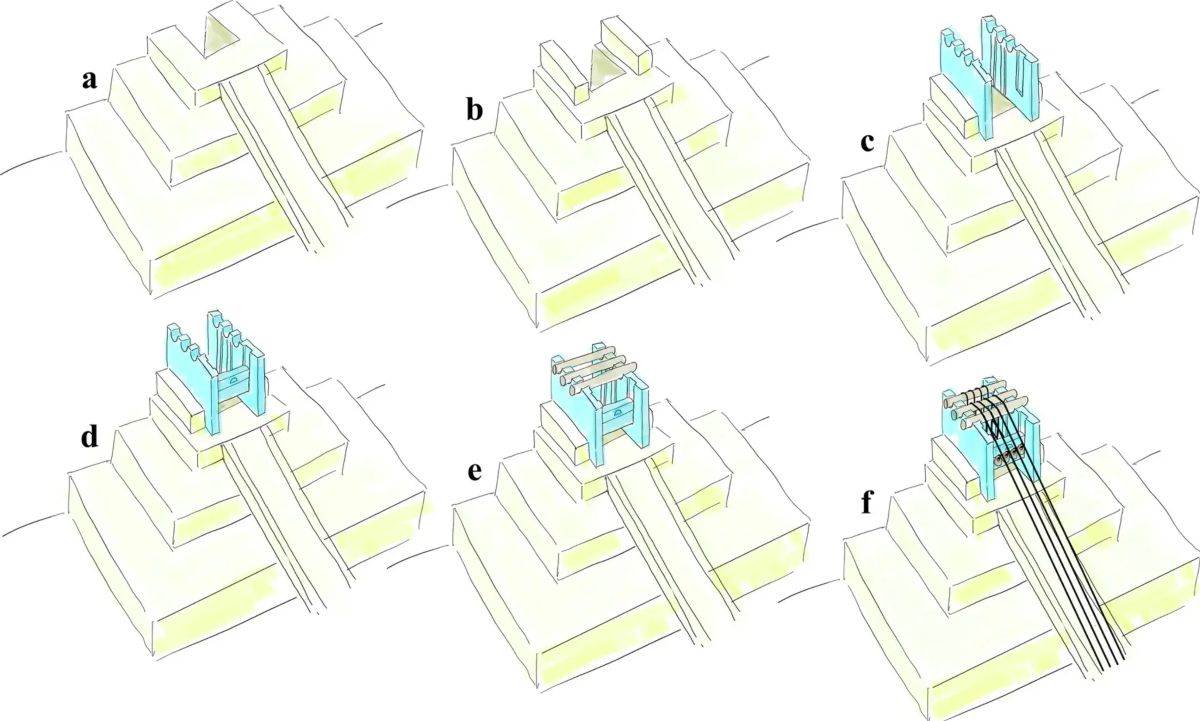
This mechanism provides both lift and the precision needed to bring massive rocks to the upper layers of the Great Pyramid.
If this hypothesis is correct, the Great Pyramid of Egypt may have been built in a "from inside to outside" direction. The structure starts from the central core, and as the pyramid rises, the inner pulley system is also expanded according to the construction progress.
The basis for this bold argument comes from reinterpreting a series of architectural features inside the pyramid.
The research team believes that the Grand Gallery and Ascending Passage are actually internal slopes, where counterweights slide down to power the lifting system.
The research team also offered a new perspective on the Attenché - a small granite room that is believed to be the place for placing mosque-proof nets.
Dr. Scheuring said that this hypothesis is "unconvincing" because that mechanism does not actually work effectively, it is unlikely that ancient Egyptians would have designed errors in a work so accurately.
According to research, the lobby may be the backbone in the pulley system, where the heaviest stone blocks are lifted up.


