
Domestic pepper prices
As of 11:30 am today (August 10), domestic pepper prices rebounded, listed at 137,400 VND/kg. Currently, key areas are trading in the range of 136,000 - 139,500 VND/kg.
Domestic pepper prices simultaneously increased by 500 VND/kg, except for Gia Lai province. Currently, provinces and cities list the domestic pepper prices as follows:
Dong Nai and Ho Chi Minh City simultaneously listed at 136. 500 VND/kg, an increase of 500 VND/kg.
Similarly, Dak Lak and Lam Dong respectively offered for sale at the highest purchase price in the whole region of 138,500 VND/kg and 139,500 VND/kg.
After 5 consecutive sideways sessions in the past week, domestic pepper prices have adjusted upwards, with the average price currently being about 2,300 VND/kg higher than this time in June.
World pepper price
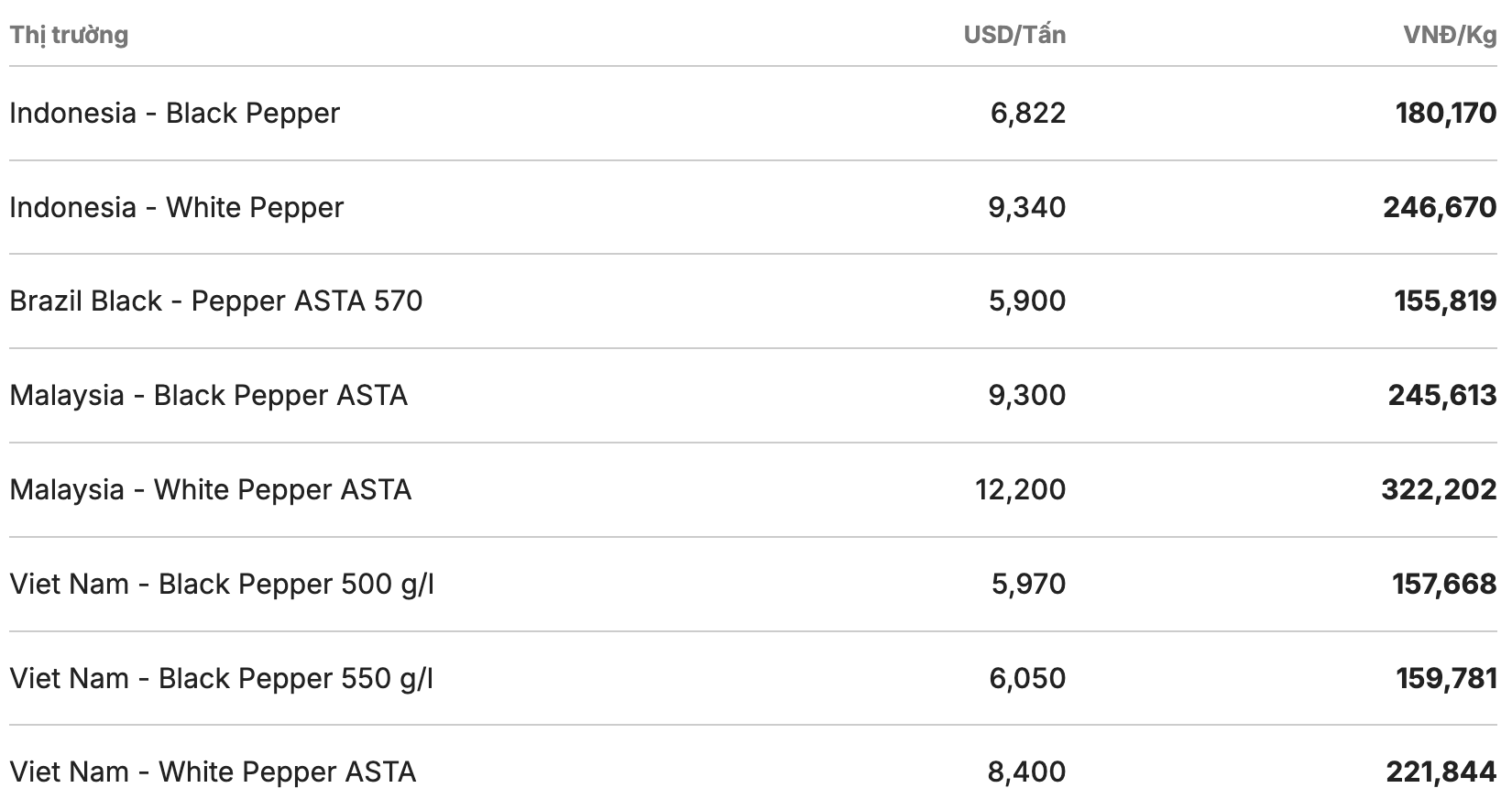
In the world market, pepper prices are maintained in high prices in most countries. Indonesia's black and white peppers are no exception, trading in the range of 6,822 - 9,340 USD/ton (equivalent to 180,170 VND/kg - 246,670 VND/kg).
Similarly, the price of Brazilian black pepper sold to the market is 5,900 USD/ton (about 155,819 VND/kg). However, black and white Malaysian pepper still maintain the same price range, trading at high prices, respectively 12,200 USD/ton and 9,300 USD/ton.
In Vietnam's pepper export market, the price of black pepper of 500 g/l and 550 g/l is maintained at 5,970 - 6,050 USD/ton. ASTA white pepper is offered for sale at 8,400 USD/ton (equivalent to 221,844 VND/kg).
Assessments and forecasts
Pepper prices after a sharp weekly decrease in the last days of the week have adjusted in the first trading session of the week.
Geopolitical instability in the Middle East has affected global trade activities in the second quarter, causing world pepper prices to fluctuate in opposite directions. Export black pepper prices from Vietnam and Brazil decreased by about 200 USD/ton compared to the previous quarter, while prices in Malaysia and Indonesia increased from 50 - 116 USD/ton.
In order to maintain a double-digit growth rate in 2026, according to the Vietnam Pepper and Spice Plant Association (VPSA), businesses need to invest more heavily in standard raw material areas, strengthen links with farmers, control pesticide residues, improve the traceability system and fully meet the technical standards of the import market.


