
Domestic pepper prices
As of 11:30 am today (August 12), domestic pepper prices temporarily stopped adjusting, listed at 137,000 VND/kg. Currently, key areas are trading in the range of 136,000 - 139,000 VND/kg.
Domestic pepper prices simultaneously stand still after two days of alternating increases and decreases. Currently, provinces and cities list the domestic pepper prices as follows:
Dong Nai and Ho Chi Minh City simultaneously listed at the mark of 136,000 VND/kg.
Similarly, Dak Lak and Lam Dong respectively offered for sale at the highest purchase price in the whole region of 138,000 VND/kg and 139,000 VND/kg.
World pepper price
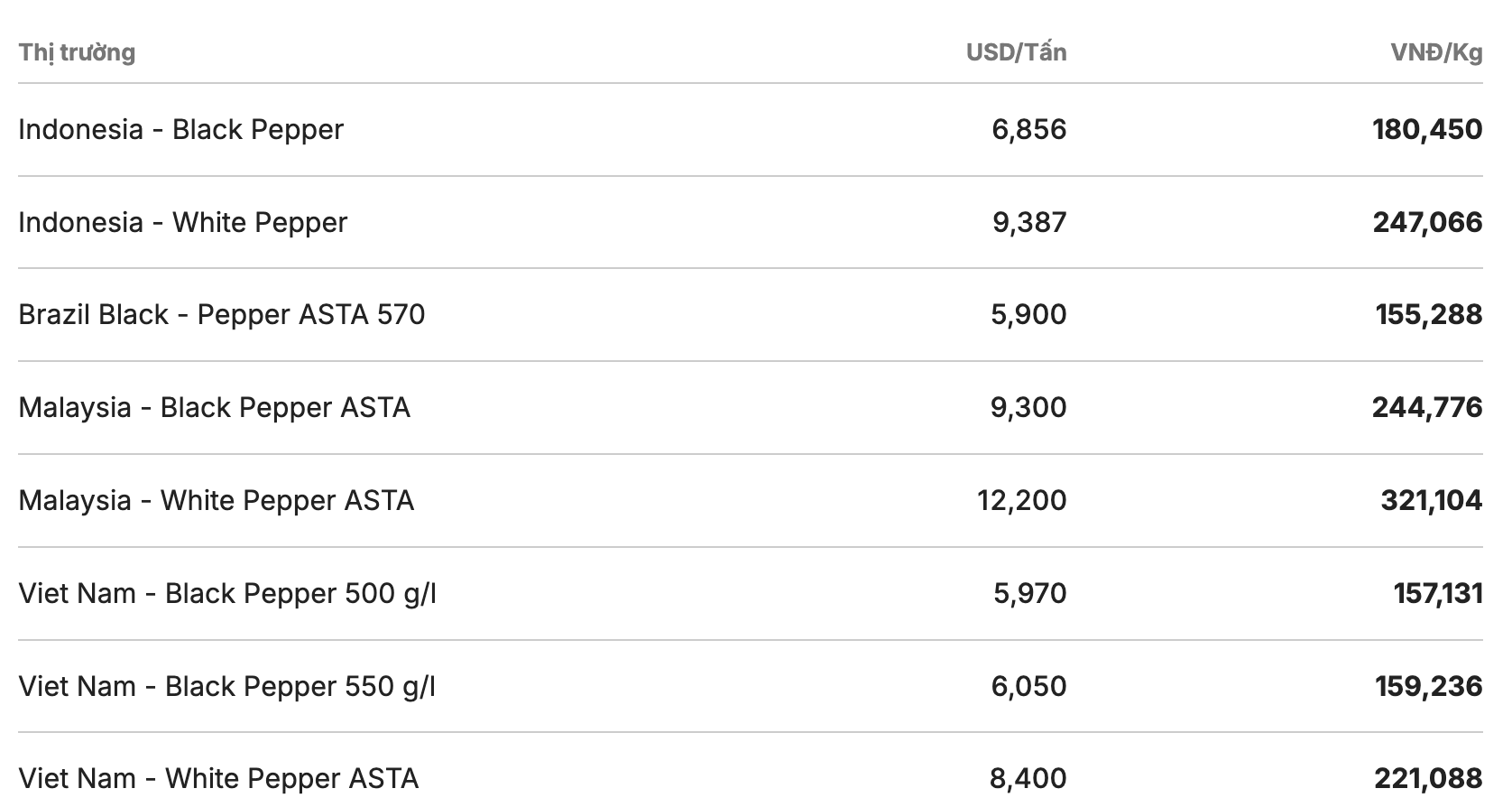
In the world market, pepper prices are maintained in high prices in most countries. Indonesia's black and white peppers adjusted up, trading in the range of 6,856 - 9,387 USD/ton (equivalent to 180,450 VND/kg - 247,606 VND/kg), increasing by 34 USD/ton and 47 USD/ton respectively.
Similarly, the price of Brazilian black pepper sold to the market is 5,900 USD/ton (about 155,288 VND/kg). However, black and white Malaysian pepper still maintain the same price range, trading at high prices, respectively 12,200 USD/ton and 9,300 USD/ton.
In Vietnam's pepper export market, the price of black pepper of 500 g/l and 550 g/l is maintained at 5,970 - 6,050 USD/ton. ASTA white pepper is offered for sale at 8,400 USD/ton (equivalent to 221,088 VND/kg).
Assessments and forecasts
Most areas in the country experienced heavy rain and strong winds in July. Rainfall in the southern region is forecast to decrease slightly in the first week of August.
However, according to the National Center for Hydro-Meteorological Forecasting, due to the impact of super typhoon Dolphin, most of the Central Highlands provinces are forecast to have scattered showers and thunderstorms next week. As pepper plants begin to enter the new flowering season, scattered rains in the Central and Southern regions are expected to create favorable conditions for the formation of pepper prices.
After the harvest ends, Vietnamese farmers will start to limit selling, expecting prices to increase higher at the end of the year. Meanwhile, harvesting activities in Indonesia and northern Brazil will partly contribute to balancing supply.


