
Domestic pepper prices: Stable
As of 11:30 am today (January 31), domestic pepper prices have returned to a stable state, averaging 150,400 VND/kg. Currently, key areas are trading in the range of 149,000 - 152,000 VND/kg.
After a day of alternating increases and decreases, the regions maintained their price levels. Currently, the pepper price list for specific regions is as follows:
Dong Nai is anchored at the threshold of 150,000 VND/kg.
Gia Lai and Lam Dong respectively put them on the market in the price range of 149,000-151,000 VND/kg. Among them, Gia Lai is the province with the lowest price.
Ho Chi Minh City and Dak Lak still maintain the price threshold of 150,000-152,000 VND/kg.
World pepper prices: Indonesia rotates directions
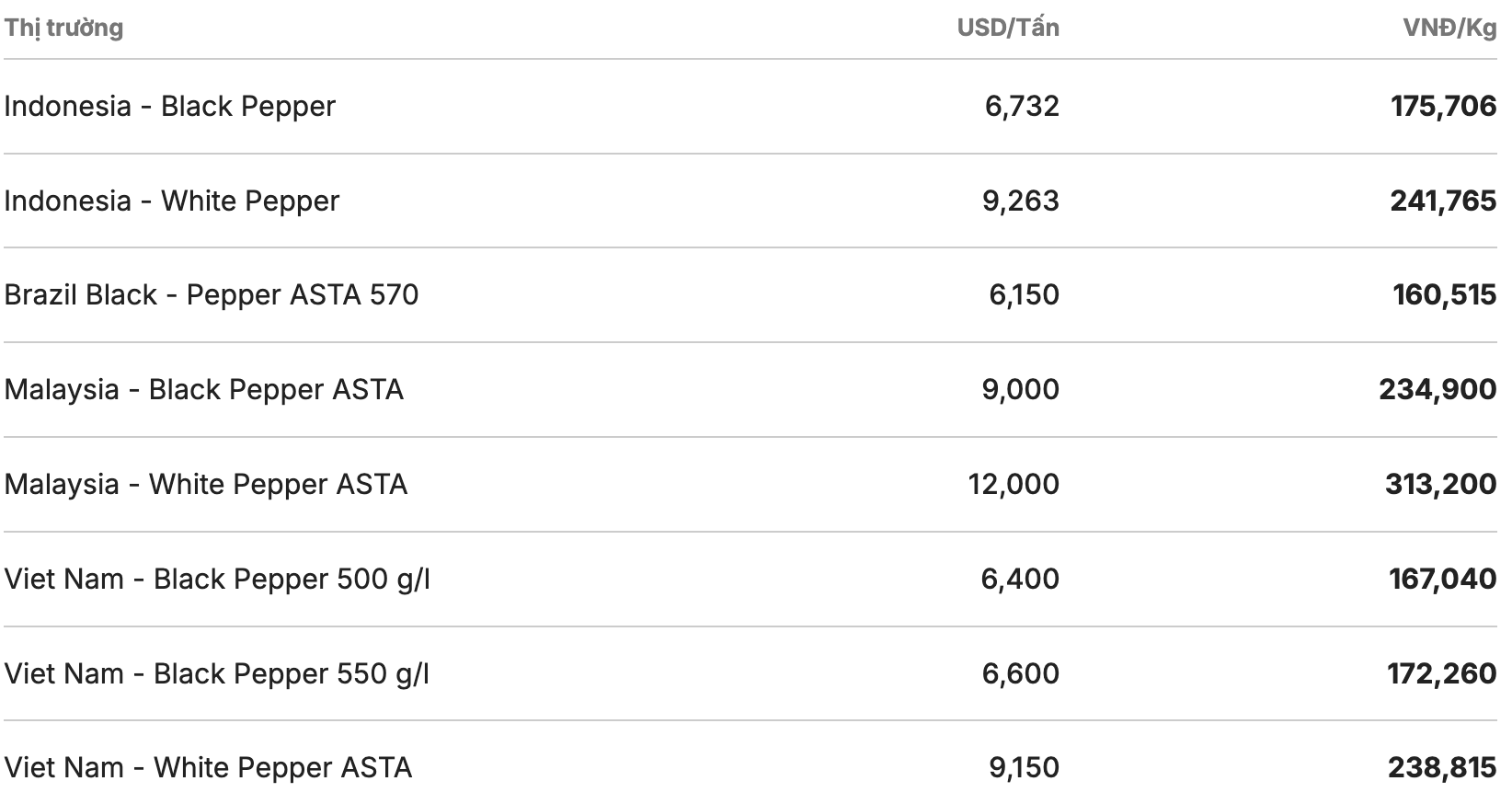
In the world market, pepper prices did not fluctuate much. The Indonesian exchange - one of the most active markets - continued to decline. These two items traded in the range of 6,732 - 9,263 USD/ton (equivalent to 175,706 VND/kg - 241,765 VND/kg), down 4 USD/ton and 6 USD/ton respectively.
Meanwhile, the Brazilian market maintained its upward momentum, trading at 6,150 USD/ton (about 160,515 VND/kg). Black and white pepper continued to remain unchanged, trading at 12,000 USD/ton and 9,000 USD/ton.
Notably, in Vietnam's pepper export market, the price of black pepper of 500 g/l and 550 g/l is maintained at the threshold of 6,400 - 6,600 USD/ton. ASTA white pepper price continues to be offered for sale at 9,150 USD/ton (equivalent to 238,815 VND/kg).
Assessments and forecasts
According to the Vietnam Pepper and Spice Plant Association (VPSA), Vietnam's harvest season is expected to start at the end of February 2026 and will last until the end of April. However, garden owners prioritize selling only a part instead of massively. A part of the people who have enough finances will keep pepper in storage, waiting for prices to increase.
The limited supply has raised concerns about a difficult export year for Vietnam's pepper industry. Meanwhile, experts predict that world pepper demand in 2026 will recover, especially in the US market, after tariffs on pepper are reduced to 0%, along with increased purchases from many countries.


