
Domestic pepper prices: Hold in high price range
As of 11:30 am today (January 28), domestic pepper prices have stabilized after a high increase, averaging 150,800 VND/kg. Currently, key areas are trading in the range of 149,000 - 152,000 VND/kg.
Areas maintaining the price zone after the day simultaneously increased from 500-3,000 VND/kg. Currently, the pepper price list of specific areas is as follows:
Dong Nai is the province with the lowest price at the threshold of 149,000 VND/kg.
Three provinces Ho Chi Minh City, Dak Lak and Gia Lai respectively put on the market in the region at a price of 150,000-152,000 VND/kg.
Lam Dong province maintains being the purchasing area with the highest price when anchored at the threshold of 152,000 VND/kg.
World pepper price: Sideways trend
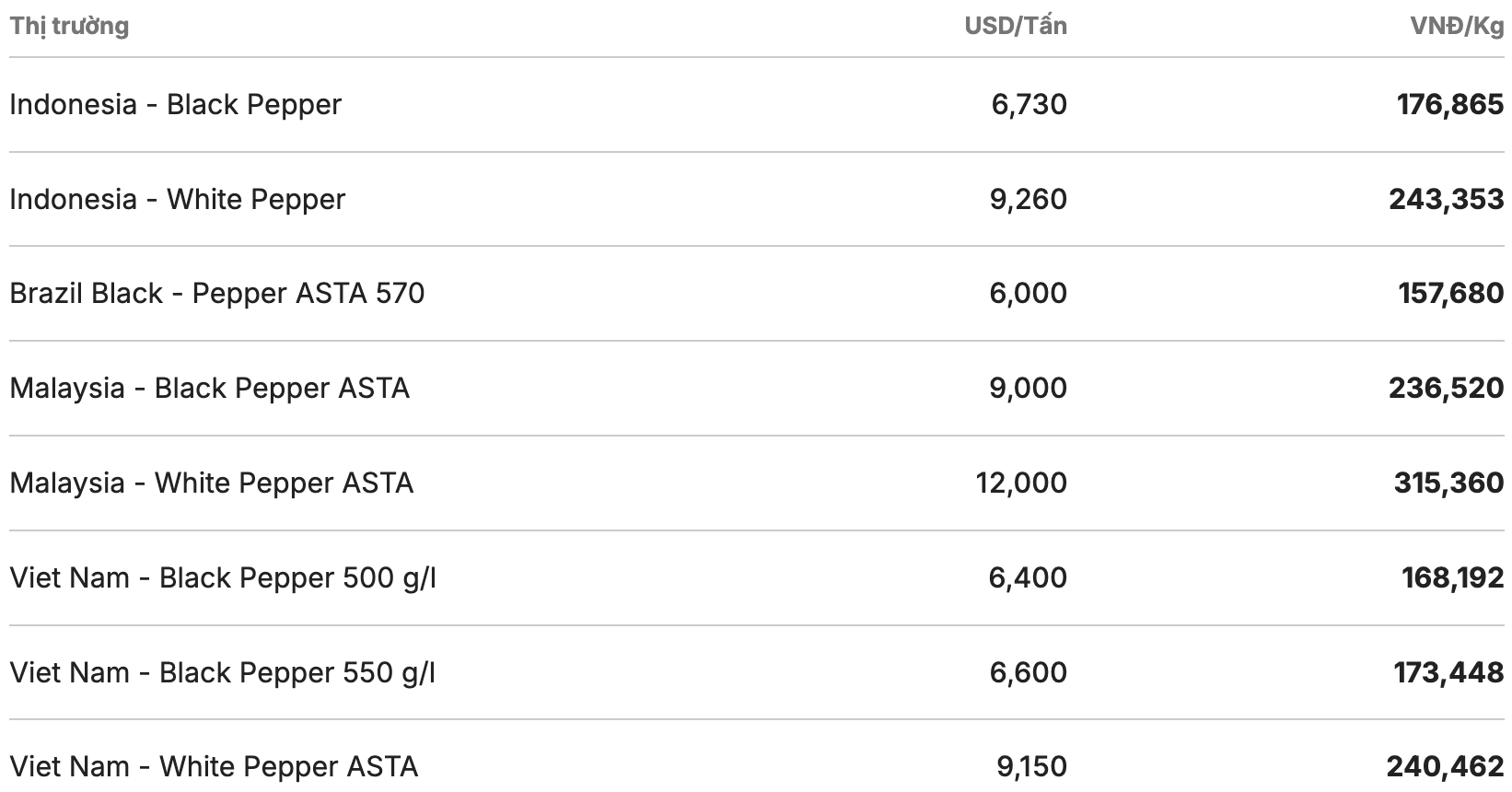
In the world market, pepper prices continue to remain flat in most countries. The Indonesian exchange - one of the most vibrant markets - reversed to slightly decrease. These two commodities traded in the range of 6,730 - 9,260 USD/ton (equivalent to 176,865 VND/kg - 243,353 VND/kg), down 9 USD/ton and 13 USD/ton respectively.
Meanwhile, the Brazilian market extended its unchanged days, trading at 6,000 USD/ton (about 157,680 VND/kg). In the same direction, black and white pepper continued to remain unchanged, trading at 12,000 USD/ton and 9,000 USD/ton.
Notably, in Vietnam's pepper export market, the price of black pepper of 500 g/l and 550 g/l is kept at the threshold of 6,400 - 6,600 USD/ton. ASTA white pepper continues to be offered for sale at a price of 9,150 USD/ton (equivalent to 240,462 VND/kg).
Perspectives and forecasts
The domestic pepper market witnessed a strong increase in the previous trading session. The acceleration was directly affected by the plunge of the greenback in the international financial market.
However, behind the impressive price growth is concern about the sustainability of supply. According to the Vietnam Association of Pepper and Spice Plants (VPSA), our country's leading export position is being affected by the rise from Brazil. While domestic production is forecast to decrease due to the impact of climate change and farmers' crop conversion psychology, competitors maintain stable farming areas with high output.


